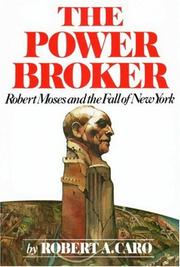
Start with The power broker: Robert Moses and the fall of New York. It is self-contained, it is the book that made Caro, and it is the clearest statement of the thesis everything else elaborates: that power reveals rather than corrupts, and that the way to understand a country is to understand one person who accumulated an enormous amount of it without ever being elected to anything.
The alternative is to begin with the Lyndon Johnson volumes, on the reasonable grounds that they are the life's work and the Moses book is a prologue. I would not. The power broker is 1,200 pages that end; the Johnson books are 3,500 pages that do not, because the fifth volume is unfinished. Starting with a book that concludes is worth something.
If 1,200 pages is genuinely the obstacle, start with Working instead. It is about 200 pages, it is a collection of pieces about how Caro reports and writes — the file cabinets, the years in the Hill Country, the interviews with people who had never been asked — and it will make you want to read the big books. It is the only Caro title that functions as a sampler.
The order
- The power broker: Robert Moses and the fall of New York (1974)
- The Path To Power (1982)
- Means of Ascent (1990)
- Master of the Senate (2002)
- The passage of power (2012)
Volume five, covering Vietnam and the end, has not been published. Read the four with that in mind: the sequence stops rather than ends.
Working can go anywhere. Some readers use it as an appetiser, others as a palate cleanser between volumes. Both work.
The contested volume
Means of Ascent is the one historians argue about, and the argument is real rather than academic sniping. The book is built around the stolen 1948 Senate primary, and it sets Johnson against Coke Stevenson, whom Caro portrays as an almost mythic figure of Texas integrity. Several historians have argued that this portrait flattens Stevenson's record considerably, and that the book's moral scheme is too clean. Caro has defended it. Readers should know the dispute exists and form their own view; it does not make the book skippable, but it does make it the volume to read most sceptically.
It is also the shortest and the narrowest — essentially one campaign at enormous length.
Honest warnings
Master of the Senate opens with roughly a hundred pages on the institutional history of the United States Senate before Johnson properly appears. A lot of readers stall there. It is also, for many, the best writing in the whole sequence, and the Senate material is what makes the civil rights chapters land. Push through it; do not skip it.
The books are repetitive across volumes by design. Caro reintroduces context, restates the thesis, and re-establishes characters, because each was written to be readable alone. Reading them back to back, you will notice.
And there is a length problem that is not really a problem: Caro does not summarise. If a Hill Country farm wife hauled water, you get the physics of hauling water. That is the method and it is why the books work.
Where to stop
After Master of the Senate you have the core argument complete — the accumulation, the misuse, and then the one moment where the power was turned to something worth doing. The passage of power, covering the vice-presidency and the assassination, is the most propulsive book of the four and takes about a week. Most readers who reach volume three finish.
The companion in our catalogue, The making of the President, 1960 by Theodore H. White, is not Caro's and is a very different kind of book — contemporary campaign reporting rather than retrospective biography. It pairs usefully with The passage of power. More ordered reading is here when you finish.
Follow the full ordered path here: Robert Caro Reading Order: Where to Start.