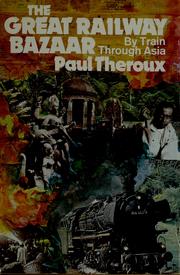
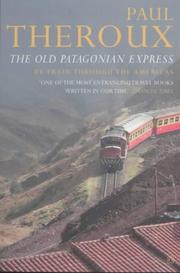
Start with The Great Railway Bazaar, then Old Patagonian Express, The — a catalogue inversion of The Old Patagonian Express, same book. The first is the one that invented the modern travel book: no research, no interviews arranged in advance, no destination worth arriving at, with the train carriage as the subject and the countries passing the window. The obvious alternative is Dark Star Safari, which is the strongest thing he wrote after the 1970s, but it is a return journey and it depends on knowing the traveller he had been.
Know what kind of writer this is before you commit a month to him. Theroux is unkind. He is contemptuous about fellow passengers, about hosts who feed him, about entire countries, and other travel writers and writers from the places he describes have criticised him for exactly that, at length. Some readers find the refusal to be charmed bracing after a lifetime of gushing travel writing; others find it insufferable and stop. Both reactions are common. The first stage exists partly so you can find out which one you are — if the answer is that you cannot stand him, stop there rather than at book six.
The 1973 route is also now unrepeatable: Iran under the Shah, Afghanistan before the Soviet invasion, Vietnam with the war still running. Much of the book's value is that nobody can take that journey again.
More journeys
The kingdom by the sea is the funniest and the nastiest — he had lived in Britain for over a decade when he walked its coast, so it is an insider pretending to be a foreigner. Riding the iron rooster is the most repetitive, because a year of Chinese trains in the mid-1980s produces a lot of similar days and he includes many of them; if you stall anywhere on this path it will be in the middle of it. Read it in short sittings with a map open, and accept that the sameness is partly what he is reporting. It is now an accidental archive of cities that have been demolished.
Read The happy isles of Oceania last of the three whatever order you buy them in. It is where the concealment breaks: his marriage had collapsed, he says so, and the misanthropy that looked like a pose in the earlier books suddenly has a visible cause. Mark the page where the divorce first appears, then reread the fifty pages before it.
Africa
Dark star safari and Last Train to Zona Verde are a pair and should be read in that order with no long gap — the second is explicitly the sequel and the refutation of the first. Theroux taught in Malawi in the 1960s, so this is a return rather than a visit, and the contempt is now aimed at institutions rather than at individuals on trains.
State the contested part plainly: Dark star safari contains a sustained, angry argument that the international aid apparatus has created dependency and insulated its foreign staff from the countries they work in, stated as polemic rather than as reporting, and many readers with direct experience of that work consider it unfair and factually selective. It is his most contested book and worth reading precisely because it is arguing. Read one substantial critique of the dependency argument alongside it. Last Train to Zona Verde is a book about quitting: he announces mid-journey that this is his last African trip, and the Angola chapters are the bleakest pages in his work.
The novels
A real change of gear — these are plotted and cannot be read in twenty-page commuting chunks. The Mosquito Coast first, in which Allie Fox is the travel persona taken to its endpoint, narrated by his son so that the reader sees a monster through eyes that love him. Our listing credits a translator alongside Theroux; the novel is his.
Then Saint Jack, written in 1973 before the travel career began, which shows the subject was always displacement rather than travel, and which contains his one genuinely decent protagonist. Put My secret history last, and that placement is the whole design: it is thinly disguised autobiography, and reading it after four travel books tells you how much of the travel persona was built rather than found.
Where to stop
Deep South is the end of the path and was chosen as an ending rather than as an afterthought. He drove the back roads of the American South four times across a year, returning to the same people each season, which is something he never does abroad — so his subjects get to change, for the first time. The contempt is largely absent. Some longtime readers call that maturity and others call it a loss of nerve; read it and decide.
Two obvious continuations are not in our catalogue and deserve naming: Ghost Train to the Eastern Star, in which he retraces the first book's route thirty-three years later and is honest about what it concealed, and Sir Vidia's Shadow, his account of a friendship's collapse. More routes on Discover.
Follow the full ordered path here: Paul Theroux Reading Order: Where to Start.