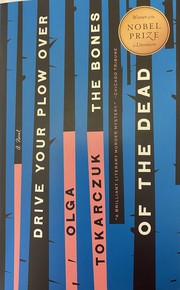
Start with Drive Your Plow Over The Bones Of The Dead. It is 274 pages, it moves like a crime novel, and most readers go faster than they meant to. The obvious alternative is Flights, which won the International Booker Prize and is the book she is best known for in English — and it is the wrong place to begin. Flights is over a hundred fragments with no plot, and readers who bounce off Tokarczuk almost always bounce off there, waiting for a narrative the book has no intention of supplying.
Drive Your Plow Over The Bones Of The Dead gives you her real subject inside a familiar shape. Janina Duszejko narrates, refuses to use people's given names — Oddball, Big Foot, Dizzy, Good News — capitalises common nouns, and casts astrological charts as an investigative method that the novel neither endorses nor mocks. You are made to like her voice for two hundred pages before you are given a reason to distrust it. Read the chapter epigraphs rather than skipping them: every one is from William Blake, the title is a line from the Proverbs of Hell, and Janina spends the book translating Blake with a former pupil.
Note the translator's name on the copyright page while you are there. This one is Antonia Lloyd-Jones — dry, clipped, plainer, closer to speech. Roughly half of Tokarczuk in English comes through Jennifer Croft instead, who runs longer, cooler and more essayistic. Registering that now prevents you concluding later in the sequence that Tokarczuk changed as a writer when in fact the translator changed.
The two that won the prizes
Now Flights, and read it in short doses — two or three fragments at a time, twenty minutes at most. Bingeing it is the commonest way to decide you dislike it. The travel fragments run against an anatomy strand of preserved bodies, plastination and a composer's heart carried across a border in a jar, and a handful of long stories behave like conventional fiction so that returning to one feels like coming home. Croft and Tokarczuk shared the International Booker for it in 2018; the Nobel Prize for Literature for 2018 followed, awarded in 2019.
Then Primeval and Other Times as the antidote — 287 pages of short titled sections, warmer, much easier, and best taken in two or three long sittings. A whole village told as parallel clocks, with sections of time handed out to people, to a place, to a mycelium and to God. It makes Flights retroactively legible. One buying warning: our listing for this one resolves to a foreign-language edition rather than the English, so check before ordering; the English translation you want is Lloyd-Jones's. Read the two back to back, because the point of the pairing is the contrast in temperature.
The earlier strange one
House of Day, House of Night is structurally the strangest thing she has written: dreams, local legends, biographies of the dead, a saint's life, an unfinished monastic manuscript and a run of mushroom recipes, interleaved with no signposting. It was written in the 1990s and reached English in 2002, long before Flights, which is the proof that the fragmentary method was not a late experiment. Our record is a recent reissue whose ISBN format sends the buy link to a search rather than a product page, so confirm you are getting the English text. Read the mushroom recipes. Everyone skips them; they are load-bearing.
The monument, and the cooling-off
The Books of Jacob is 992 pages in our listing and is paginated in reverse — the numbers count down, so the last page is page one, following the direction of a Hebrew book. In practice it is a useful progress bar. Plan a month at thirty pages a day, read the seven books as units and never stop mid-book, and write down six names before you start rather than trying to hold the whole cast. It follows the eighteenth-century Jewish heretic Jacob Frank, who declared himself messiah and led thousands through conversions across religions.
Two facts about its reception, stated and then left alone: after Polish publication Tokarczuk received threats and needed security for a period, and nationalist critics attacked the novel's account of Polish history and of Polish antisemitism. That is the reception, not the book.
Finish with The Empusium, around three hundred pages and a week at most — a men-only sanatorium in 1913, which is to say Thomas Mann's The Magic Mountain turned into a horror story. Read the author's closing note: the men's pronouncements about women are quoted from real male writers, and she lists her sources. Then reread one dinner-table scene knowing that.
Where to stop
This is effectively everything major available in English. Her short illustrated fable The Lost Soul is an hour's reading and is not in our catalogue. After that the honest next move is to follow the translators rather than the author — both have brought a shelf of Polish writing into English. Neighbouring routes are on Discover.
Follow the full ordered path here: Olga Tokarczuk Reading Order: Where to Start.