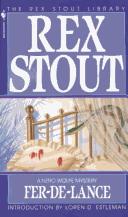
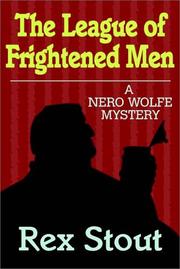
Start with Nero Wolfe:Fer De Lance, the 1934 first novel, and read The League of Frightened Men straight after it. Judge the series on the second one. Rex Stout was still finding the rhythm in the first book, and the voice arrives only in patches; by the second the double act has locked in. If you would rather sample before committing to two, take Some buried Caesar on its own instead — it is the book most fans name first and it works cold.
That flexibility is the honest answer to the reading-order question, and it is unusual enough to state up front. Stout wrote thirty-three novels and around forty novellas across forty-one years. The characters never age, never develop and carry nothing between cases. The brownstone resets every time. You can drop in almost anywhere, and most lifelong readers did. There is exactly one exception, and it is in the middle of this path.
Two catalogue notes before you buy. Our first record reads Nero Wolfe:Fer De Lance, which is just Fer-de-Lance with the hyphens lost. And both listings in the opening stage run near 300 pages because they are large-print or older editions — a standard Wolfe paperback is 180 to 220 pages and takes about two hours.
Know this going in: it is not fair-play detection
Archie Goodwin narrates, and Archie does not tell you what Wolfe sent Saul Panzer to do. Readers who come for a solvable puzzle are routinely disappointed, and no later book fixes it. Read for the company or do not read at all.
The 1930s peak
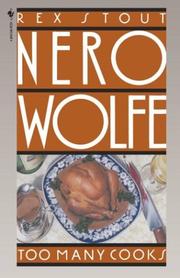
Too Many Cooks and Some buried Caesar both get Wolfe out of the brownstone, which Stout only does a handful of times in thirty-three novels, and the removal is itself the event. Some buried Caesar contains the bull-and-boulder sequence in its first thirty pages, the funniest thing Stout wrote, and introduces Lily Rowan, the one recurring character who touches Archie's private life.
One plain warning about Too Many Cooks. It is set at a West Virginia resort in 1938, part of its plot rests on the testimony of the Black kitchen staff, and it uses the racial language of its time on the page, repeatedly; it also contains a scene in which Wolfe addresses those men as equals in a way almost no 1938 popular novel does. Both things are true at once. Nothing later depends on it, so skip it if you would rather.
The Zeck trilogy — the one fixed sequence
And be a villain, then The second confession, then In the best families, in that order, with no other Wolfe in between. Arnold Zeck is the only continuing antagonist Stout ever wrote and these are the only three books that form an arc: a phone call, then violence aimed at Wolfe rather than at a client, then the demand that ends the arrangement.
Reading In the best families first does not merely spoil it, it removes the book. Its effect depends entirely on having watched Zeck warn Wolfe twice and on knowing, from eight or nine books of accumulated routine, exactly how immovable the man in the brownstone is. Avoid the back-cover copy on that one specifically; several editions give away the central move.
The famous later cases
Murder by the book is the best-constructed plot in the corpus — a manuscript nobody can produce, which kills everyone who reads it, and which never appears on the page. The Golden Spiders is one of the few cases Wolfe takes without a fee. Take The doorbell rang last of the three: its whole charge comes from knowing how rigid the routine is, and it is the book non-readers have heard of, so opening with it makes everything after feel like a footnote. It is the most famous Wolfe and not the best one; keep those two judgements separate.
Where to stop, and what must come last
Black Orchids is not a novel — it is a 1942 volume of two novellas, and our listing does not say so. Roughly a third of all Wolfe stories are novellas, published three to a volume, and the collections are interchangeable once you know the household. Our catalogue carries no others; buy Trouble in Triplicate or Curtains for Three elsewhere if the short form suits you.
A Family Affair (Mystery Masters) must come last. Published in 1975, weeks before Stout died at eighty-eight, it is the final Wolfe and it puts the murder inside the brownstone, breaking the no-consequences rule the other thirty-two run on. Whether he earned that in his last book is the only real critical argument the series has.
Say the quiet part plainly: this path is twelve books out of thirty-three novels. It is a route, not the corpus. After it, pick any of the remaining twenty-one at random — the only sequence that mattered is behind you. Robert Goldsborough's authorised continuations from 1986 onward are a separate decision. More series routes live on Discover.
Follow the full ordered path here: Nero Wolfe Reading Order: Where to Start.