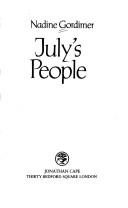
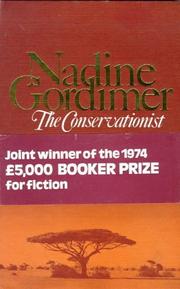
Start with July's people. It is 163 pages, it contains her whole method, and it is the only Gordimer that a reader can finish in two evenings and immediately understand what she was doing. The obvious alternatives are The Conservationist, which won the Booker Prize, and Burger's daughter, which is the novel most often named when the Nobel case is made — but both are hard, and both are much easier after the short books have taught you her sentence.
That sentence is the whole difficulty. Gordimer writes long, clause-heavy periods with the pronouns deliberately ambiguous, and in the major novels the point of view slides between third person, free indirect narration and interior monologue with no signal at all. Twenty pages a sitting is a sensible ceiling. Readers who bounce off her almost always bounced off The Conservationist at speed, which is a book that punishes skimming and rewards nothing else.
Follow July's people with The Late Bourgeois World, only 96 pages and compressed even harder: a woman is told her ex-husband has killed himself, and by evening is asked to launder money for the underground. It ends before she decides. Both novels put a political situation entirely inside one household and keep the public events offstage, which is the design of everything that follows.
The two major novels
Read The Conservationist before Burger's daughter, even though the second is the better book. The reason is difficulty rather than chronology: The Conservationist is elliptical and will wear you down if you meet it tired, and it is worth taking while you are fresh. A rich white industrialist owns a farm as a weekend possession; an unidentified black body surfaces on his land, is buried carelessly, and comes up again. Zulu praise-song passages run under the novel as a second text, and they are a claim on the land older than his title deed.
Burger's daughter is 361 pages, easier to follow and much heavier. Rosa Burger, daughter of a dead Afrikaner communist hero, is trying to work out whether she is allowed a private life or whether her inheritance has already spent it. Large sections address her dead father in the second person. It was banned in South Africa on publication; Gordimer later published the censors' report alongside her own reply, which is worth reading as a record of precisely what the state objected to. If you read one Gordimer novel, read this one.
The long apartheid years
Most reading orders stop here, and that is a mistake. A Guest of Honour is 523 pages and the only novel in which she looks properly beyond South Africa's borders: a former colonial administrator is invited back into a newly independent African state, and the government that invited him splits in two. It is her most conventionally plotted big novel, so it moves more easily than its length suggests.
A sport of nature is picaresque and divides readers — Hillela drifts through the liberation movement by way of the men in it, and the book ends at the inauguration of a free South Africa that had not yet happened when it was published. Some readers find it her most hopeful novel and others find it unserious; both readings hold up. My son's story, narrated by the son of a coloured schoolteacher turned activist, is the last of the apartheid novels and the most intimate.
After 1994, and the stories
Read None to accompany me straight after My son's story with no gap — together they are the country changing. Then The house gun, in which a liberal white couple must hire a black advocate to defend their son on a murder charge, and The pickup, whose second half, set in her husband's village, is the best writing of her late career.
Finish with Jump and Other Stories, one or two an evening rather than in a run. Many readers rate her short fiction above the novels, and after nine of them every compression here opens back onto a book you have already read.
One live critical argument, stated rather than settled: these novels put white South Africans at the centre while the political stakes belong mostly to black South Africans, who are often kept at the edge of the narration. Whether that is a limitation of the books or their actual subject is a question readers still divide on, and Gordimer — who lived in South Africa all her life, was banned there, and joined the African National Congress while it was illegal — was demonstrably aware of it. Readers who want the other great white South African novelist of the period should go on to J. M. Coetzee.
Follow the full ordered path here: Nadine Gordimer Reading Order: Where to Start.