Moral psychology asks where moral judgments actually come from, which is not moral philosophy's question of whether they are correct. It is an empirical field and an unsettled one, so the reading order below deliberately puts rivals next to each other rather than presenting a single account. Start with The Righteous Mind by Jonathan Haidt, the most influential popular book in the field, for the social-intuitionist argument that judgment comes first and reasoning follows. Read the moral-foundations taxonomy as a proposal rather than a finding: its factor structure and its cross-cultural generality are contested within psychology. One practical note on this record — its ISBN belongs to a Colombian imprint, so check the listing if you want the English original.
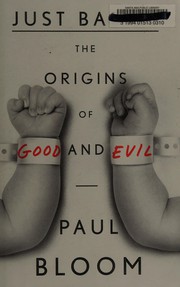
Read Moral tribes by Joshua Greene second, because it is the rival account. Greene builds on the same intuition-versus-reasoning split and reaches a utilitarian conclusion Haidt rejects, and his dual-process model rests heavily on the trolley-problem imaging work that a later stage gives you grounds to question. Then Just babies by Paul Bloom supplies the developmental evidence — what infants appear to prefer before they can be taught anything — which matters because both Haidt and Greene need some claim about what is innate.
You do not need a psychology degree for the first two stages. From the third stage on, some literacy in research methods helps a great deal: several of the field's famous results are argued over on methodological grounds, and the books that do this well assume you can hold a claim and its evidential basis apart.
The evolutionary case
Good Natured by Frans de Waal is the foundational primatology — reconciliation, consolation and fairness responses in chimpanzees and capuchins. Read it before the theoretical books so the observations are in mind rather than the interpretations. Primates and Philosophers prints de Waal's argument alongside replies from philosophers who disagree with him, which is unusually honest packaging and the clearest short statement of what is at stake in claiming continuity between primate and human morality.
Moral origins by Christopher Boehm is the anthropological version, arguing that hunter-gatherer bands suppressed dominant individuals and that this selection pressure shaped conscience. It proposes a different mechanism from de Waal's, which is why it belongs after him. A natural history of human morality by Michael Tomasello is the most careful of the evolutionary accounts, built on comparative experiments with children and apes rather than field observation, and it explicitly positions itself against the simpler continuity story. Read it last in this stage.
Where the field argues with itself
Against empathy is Bloom again, and it is placed here rather than first for a reason: it is a deliberate contrarian move by an author you have already read sympathetically. His claim that empathy is a poor guide to moral decisions is a direct challenge to the sentimentalist reading of Haidt.
Would You Kill the Fat Man? by David Edmonds is a history of the trolley problem that takes seriously the objection that responses to bizarre hypotheticals may not predict anything about real moral behaviour. It is the check on Greene, whose model is built almost entirely on that paradigm. Experiments in Ethics by Kwame Anthony Appiah is a philosopher asking what empirical results actually license, and it is the most useful corrective on the path: it neither dismisses the science nor concedes that findings about how we judge settle how we should.
Into the academic literature
Moral Psychology by Valerie Tiberius is the textbook and the right bridge out of popular science, mapping the field's positions against each other and supplying the vocabulary the monographs assume. It is catalogued under the bare title, so buy by author; it belongs to a series of contemporary philosophy introductions and reads like one.
Moral Minds by Marc Hauser is the strongest statement of the linguistic analogy, that we have a moral faculty structured like Chomskyan grammar. Read it as an important and heavily criticised position rather than a settled result. Readers should also know that Hauser left Harvard following a research-misconduct finding concerning work on primate cognition, separate from the arguments in this book; the argument stands or falls on the wider literature, not on his authority. The Emotional Construction of Morals by Jesse Prinz is the relativist counterweight, arguing that moral concepts are emotion-laden and culturally constructed rather than innately structured, and reading the two consecutively is the fastest way to see what is genuinely in dispute.
End with Elements of Moral Cognition by John Mikhail, the most technical book here, which works the Rawlsian linguistic analogy out formally. It demands everything the earlier stages supply, and it is catalogued under a shortened form of its published title. If the developmental evidence is what interests you most, the developmental psychology hub is the neighbouring subject.
Follow the full ordered path here: Where Moral Judgments Come From: Moral Psychology Books in Order.
Ready to learn something deeply?
Build a reading path — free