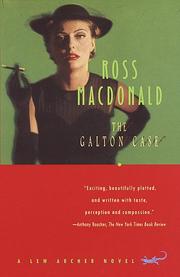
Start with The Galton case, published in 1959. It is the eighth Lew Archer novel, not the first, and starting there is a deliberate recommendation rather than an accident of what was in stock.
The competing option is the obvious one: begin at The moving target in 1949 and read forward. There is a real case for it. Those early books are lean, fast and funny, and you watch a writer improving in public. But Ross Macdonald — the pen name Kenneth Millar wrote these under — spent nearly a decade producing capable Chandler imitations before he found his own subject, and The Galton case is where he found it: a missing-persons case that turns out to be about a buried family crime, told with a detective who is less a tough guy than a listener. Read forward from 1949 and you spend seven books waiting for the series to become itself. Start at The Galton case and you are inside the real thing from page one, with the apprentice work available afterwards as a bonus.
Start here: where the series turns great
The Galton case, The chill and The far side of the dollar, in that order and close together, because the pattern is the point and it is easiest to see across three consecutive books. They are short by modern standards, 200 to 275 pages, and go down in three or four evenings. Give The chill an uninterrupted final session: its last twenty pages reorganise everything before them, and losing momentum there costs you the effect entirely.
The late peak
Black money, The goodbye look and The underground man. The reading gets slightly harder even though the books do not get longer — the prose thins, the wisecracks nearly disappear, and more of the plot arrives in dialogue. Black money is the most conventional and the quickest. The goodbye look has the most intricate plotting of the three. Save time for The underground man, where a wildfire burns in real time underneath the investigation; long sittings are how you feel that.
Back to the beginning
Now go back and read The moving target, The Drowning Pool and The way some people die as a block. These are the lean, hard, fast ones with a joke every other page, and any of them goes down in two evenings. A reader who does not care about literary archaeology can skip this stage entirely and lose nothing — none of the three is required for any other book on the path.
The bridge books and the end
The doomsters is the book immediately before the breakthrough, and its interest is in watching Macdonald almost get there; read it first here and read it slowly. The zebra-striped hearse is the most straightforwardly enjoyable book in this stage. The Blue Hammer is the last Archer novel, and it is the slowest and the weakest — a tired book by his own standards. Knowing that going in is better than deciding the series collapsed.
Where this path stops
Eighteen Lew Archer novels exist. This path takes twelve, so the series continues past what is listed here: The Ivory Grin, Find a Victim, The Barbarous Coast, The Wycherly Woman, The Instant Enemy and The Sleeping Beauty are all absent, and none of them is a bad book. They are simply not the twelve that make the case. If the shape of this appeals, the other detective reading paths are built the same way.
Follow the full ordered path here: Lew Archer Reading Order: Where to Start.
Ready to learn something deeply?
Build a reading path — free