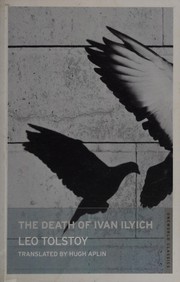
Start with The death of Ivan Ilyich. Sixty pages, written in 1886: a competent, unremarkable judge falls ill, the illness will not go away, and everyone around him — his wife, his colleagues, his doctors — participates in a polite fiction that he is getting better. It is the most efficient demonstration of what Tolstoy can do, which is to describe an interior state so precisely that you recognise it before you have finished the sentence. If it grips you, the long novels will grip you. If it does not, you have lost an evening rather than a season.
Then, when you go to the novels, read Anna Karenina before War and Peace. This is the reverse of what the reputation suggests, and it is the right way round. Anna Karenina is a domestic novel about two marriages and one affair, with a single continuous plot and no historiography in it. War and Peace is a national epic with five hundred characters, four families, several battles and a philosophy of history bolted on. The first teaches you to read Tolstoy; the second asks you to already be able to.
The short fiction first
The death of Ivan Ilyich, which is paired in this edition with The Devil. Then The Kreutzer sonata variations, Michael Katz's edition of the notorious 1889 novella about a man who murders his wife, presented alongside contemporary responses including one from Tolstoy's own wife and son. Reading the responses with the text is the only sane way to take the novella, whose sexual politics are extreme even by the standards of its author's late period.
Then Hadji Murat, the very last thing he wrote and, according to a good number of readers including Harold Bloom, the best short novel in Russian. A Chechen commander defects to the Russians during the Caucasian war and is destroyed by both sides. It is a hundred and fifty pages, entirely free of sermonising, and it is the single most underread Tolstoy.
The two novels
Anna Karenina, then War and Peace.
An honest warning about War and Peace. Roughly a fifth of it is not novel. Tolstoy periodically stops the story to argue at length that history is not made by great men, that Napoleon was a figurehead swept along by forces he did not control, and that historians have systematically misunderstood causation. The second epilogue is thirty pages of pure philosophy with no characters in it at all.
Do not let anyone tell you this material is skippable and do not let anyone shame you for skimming it. Both positions are defensible and readers have taken both since 1869. The practical advice: read the war-and-history chapters properly on a first pass through the main body, and skim the second epilogue if you are flagging. It is genuinely the driest thing in the book and nothing in the story depends on it.
The translation question
This is the real controversy with Tolstoy, and it is unsettled. The Maude translations were made with Tolstoy's own approval and read as smooth Edwardian English. The Pevear and Volokhonsky versions are the modern default, and aim at reproducing the awkwardness and repetition of the Russian; they are praised for fidelity and criticised, sometimes fiercely, for stiffness. Anthony Briggs and Rosamund Bartlett have their own advocates. There is no consensus. Read the first two pages of two editions in a shop and pick the one whose rhythm you can live with for a thousand pages.
The late religious books
After 1880 Tolstoy renounced most of his own fiction and wrote as a Christian anarchist and pacifist. A confession and What I believe pairs the account of his spiritual crisis — genuinely gripping, the best entry to the late work — with the doctrinal statement. What I Believe is that statement on its own. The Kingdom of God Is Within You is the fullest version: nonresistance to evil, rejection of the state and of church authority, and the book that Gandhi credited as decisive for him.
Be clear about what these are. They are polemics by a man who had come to regard Anna Karenina as a wasted effort, and their moral absolutism is contested — admired as radical integrity by some readers, criticised as tyrannical by others, including within his own household. Read A confession first and continue only if the argument holds you. More literary reading orders sit on Discover.
Follow the full ordered path here: Leo Tolstoy Reading Order: Where to Start.