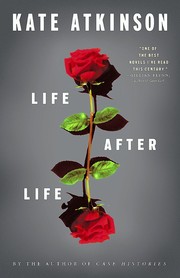
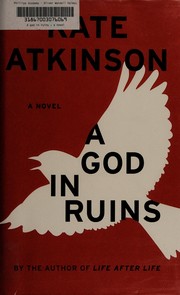
Start with Life After Life, then A god in ruins. They are a linked pair sharing one family, they must be read in that order, and the last pages of the second reframe everything before them in a way that depends entirely on having read the first. Avoid reviews, jacket copy and any discussion of that ending — this is the one place in Atkinson where a spoiler genuinely destroys a book.
Get the shape of her bibliography straight before you buy anything, because readers confuse the groups constantly. The linked pair above is one thing. The Jackson Brodie novels are an entirely separate detective series in a different register, read in publication order, and nothing in the pair connects to them in any way. Everything else is a standalone.
Life After Life gives Ursula Todd a life that restarts every time it ends: born in a snowstorm in 1910, dead, born again, each version diverging from a small changed detail. The premise explains itself within ten pages and requires no patience. Read it in long sittings — the repetitions build a rhythm that short bursts destroy — and leave a few days before A god in ruins, which follows Ursula's brother Teddy, a Halifax bomber pilot, and then the long unremarkable English life afterwards. It is explicitly a companion rather than a sequel: no restarting device, and a structure that moves freely across seventy years instead.
The Jackson Brodie novels, in publication order
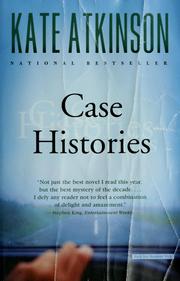
Case Histories, One Good Turn, When Will There Be Good News?, Started Early, Took My Dog, Big Sky. The order matters, but not for the usual reason — each case is self-contained and what carries across is Brodie's personal life: his money, his marriages, his daughter, his sister's murder. Atkinson never recaps, so the books simply assume you know where he stands.
All five have the same structure: three or four apparently unrelated storylines, each with its own cast, developed at length before they collide. That is why the first hundred pages of each always feel scattered, and why you should not batch them — starting one while another is fresh causes real confusion. When Will There Be Good News? is the one that reliably makes readers finish the set, largely because of Reggie Chase. Big Sky is the revival, published nine years after the quartet, and it leans on accumulated affection for Brodie, so it works poorly as an entry point.
The early standalones
Behind the scenes at the museum was the debut and won the Whitbread Book of the Year over established competition. It is narrated by Ruby Lennox from the moment of her conception above a pet shop in York, alternating her life with chapters going back through four generations of the women in her family, and everything Life After Life does at length is here in miniature. Human croquet is the strangest thing she has written, with time that will not stay put. Emotionally Weird is the most formally playful and the least representative — several other novels nested inside it, printed in different typefaces — and it is the book of hers most readers rate lowest; read here it is an enjoyable experiment, read first it would put anyone off.
The completist tail
Transcription follows a young woman recruited in 1940 to transcribe the recorded meetings of British fascist sympathisers run by MI5, drawing on a genuine wartime operation, and it shares its war with A god in ruins from an entirely different angle — the office, the boredom, the compromise. It has a late turn that readers argue about. Shrines of Gaiety is 1920s Soho, loose and crowded, with more plot strands than it resolves; give it three weeks and keep a list of the Coker children.
Where to stop
After the linked pair, if you only want her best work — it is complete in itself. If you want the other Atkinson, the Brodie quartet through Started Early, Took My Dog is the natural unit, with Big Sky optional. Discover has more ordered routes.
Follow the full ordered path here: Kate Atkinson Reading Order: Where to Start.
Ready to learn something deeply?
Build a reading path — free