Start with Blindness. The obstacle in Saramago is not difficulty of thought, it is punctuation: paragraphs that run for a page or more, no quotation marks, no dashes, no line breaks for speech, with dialogue embedded in the prose and a new speaker signalled only by a capital letter in the middle of a sentence. Blindness is first because its premise — an epidemic of white blindness, a quarantine in a disused asylum, a society reorganising within days around whoever controls the food — is urgent enough to pull you through that.
How to actually read it: treat each capital letter after a comma as a change of speaker. Almost every exchange has only two people in it, so they alternate. Read aloud or subvocalise for the first fifty pages, because the punctuation is modelled on speech and the ear parses it far faster than the eye. Almost every reader who gave up did so silently. This is the author's style rather than a translation artefact, and it is the same in every book here, so there is no easier edition to go and find.
Two warnings. Read the first thirty pages in one uninterrupted sitting even if it is hard going; the style only resolves at length. And the middle section of Blindness, inside the asylum, contains sustained violence including organised sexual violence used as a means of control — not gratuitous, but unsparing, and the part people remember.
The core: the historical fabulations
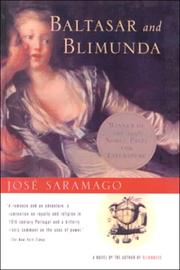
Baltasar and Blimunda, The year of the death of Ricardo Reis, the Gospel novel, The Stone Raft. Ten or eleven weeks. Baltasar and Blimunda is the warmest book he wrote: eighteenth-century Lisbon, a priest building a flying machine, and the enormous convent at Mafra going up on conscripted labour — a novel about what a society chooses to spend people on. The year of the death of Ricardo Reis takes one of Fernando Pessoa's heteronyms and brings him home to Lisbon in 1936; nothing happens, deliberately, and the not-happening is the indictment, so give it three weeks and do not fight its pace.
A buying warning on the third: our catalogue's record, Evangelio Según Jesucristo / the Gospel According to Jesus Christ, is a dual-language Spanish and English edition, so make sure the copy you order carries the English text. The novel itself is his most confrontational — a human Jesus with a human family, and a God who negotiates the crucifixion as a business proposition — and it caused a genuine political crisis: the Portuguese government blocked its nomination for a European literary prize on religious grounds, and Saramago left Portugal for the Canary Islands, where he lived for the rest of his life.
The parables of the administered life
All the Names, The History of the Siege of Lisbon, The Double, Seeing. These all work the same way: an absurd premise stated flatly in the opening pages and then obeyed with complete logical rigour, no further magic permitted. All the Names is the purest — a clerk in a Central Registry of births, marriages and deaths becomes obsessed with the card of a woman he has never met — and it is the natural companion to Blindness, one book about a society collapsing and one about a society that functions perfectly and is just as frightening. The History of the Siege of Lisbon is the funniest thing he wrote: a proofreader inserts the word not into a history of the 1147 siege and is then required to write the alternative history he has created. The Double is the coldest book here. Seeing is the direct sequel to Blindness, set in the same city four years on, so reread the last five pages of the first before you start it.
The completist tail
Death with interruptions, The Elephant's Journey, Cain. The late voice is genial and interrupts constantly, closer to an old man talking than to a novel being constructed. Death with interruptions is the best of them — people simply stop dying in one small country — and its second half changes register entirely when death herself becomes a character with a bureaucratic problem. Cain was his last novel and finishes the quarrel with God he began in the Gospel book, working through the Old Testament in sequence and prosecuting the case as it goes. An eighty-six-year-old writing his most combative book is worth noticing.
Where to stop
After Blindness and All the Names you have both halves of him — collapse and procedure — and that is a legitimate stop. If you want the Nobel case rather than the famous novel, it rests on the historical fabulations. Browse Discover for more routes.
Follow the full ordered path here: Jose Saramago Reading Order: Where to Start.
Ready to learn something deeply?
Build a reading path — free