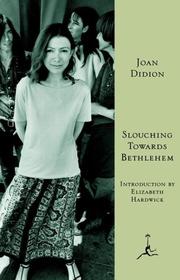
Start with Slouching Towards Bethlehem. It collects the magazine pieces she wrote through the 1960s, including the title essay on Haight-Ashbury and "On Keeping a Notebook" and "On Self-Respect", and it is the book where the famous voice arrives complete — the cold eye, the short declarative, the detail that is left to do the arguing. Read it before anything else and you will understand what everyone else is imitating.
Do not start with the novels, and do not start with the grief books. The grief books in particular are the most-recommended Didion of the last twenty years and they are the worst possible introduction, because their power depends entirely on knowing the writer whose control they document breaking down.
The essays
Slouching Towards Bethlehem, then The White Album, which covers the late 1960s and early 1970s and opens with the sentence about telling ourselves stories in order to live — a line so quoted that people forget the essay it belongs to is about her own psychiatric evaluation. The White Album is more fragmented than the debut and slightly less consistent, and its best pieces are her best pieces.
Read these two carefully and slowly. They are the foundation.
The reporting
Then the political and foreign work, where Didion is doing something harder and gets less credit for it. Salvador is a short, frightening account of a 1982 visit to El Salvador during the civil war, built around the gap between official language and the bodies at the airport. After Henry collects longer pieces from the late 1980s, including the essay on the Central Park jogger case that dismantles how a city narrates a crime. Political fictions gathers her work on American electoral politics through the 1990s and is the most sustained argument she ever made — that the political process had become a closed professional performance with the electorate as audience.
Political fictions is the book of hers that has aged best. It is also drier than the personal essays, which is why it comes third rather than first.
The novels, and an honest assessment
Didion published five novels and the general critical verdict — not universal, but common — is that she is a major essayist and a minor novelist. Start with Play It as It Lays, which is the best of them: eighty-four very short chapters, an actress driving Los Angeles freeways, and prose stripped to almost nothing. It works.
A book of common prayer is the ambitious one, set in an invented Central American republic, and it is where the Conrad influence shows most. Democracy is the most difficult — deliberately fractured, with Didion inserting herself as narrator, and readers who admire it and readers who find it mannered are both easy to find. If you are testing whether you like her fiction at all, one novel is enough to decide.
The grief books
Year of Magical Thinking, The, in the catalogue's listing, is the 2005 account of the year following her husband's sudden death while their daughter lay in intensive care. It won the National Book Award and it is a genuinely extraordinary piece of writing about how the mind negotiates with a fact it cannot accept.
Blue nights followed in 2011, after her daughter's death. It is thinner, more circling, more openly frightened about ageing and about her own competence as a mother, and it does not have the structural control of its predecessor. Read it as a coda.
Both books work far better once you have read the essays, because what you are watching is a writer whose entire method was self-possession describing the loss of it.
Where to stop
Two essay collections, one novel, and Year of Magical Thinking, The gives you the whole writer. Everything else is depth rather than breadth. Browse further author paths on Discover.
Follow the full ordered path here: Joan Didion Reading Order: Where to Start.