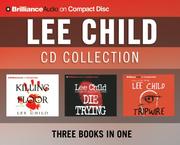
Start with Killing Floor, the 1997 debut — in this catalogue it appears inside an omnibus alongside the next two books, which is actually the cheapest way in. Reacher gets off a bus in small-town Georgia, is arrested for a murder he did not commit, and the whole formula arrives fully formed: the drifter with no luggage, the counted paces, the arithmetic of violence. It is also one of the best books in the series, which is unusual for a debut.
Read the series in publication order. This gets argued about constantly and it should not be, because of one fact: Reacher does not develop. He has no arc, no ageing to speak of, no relationships that persist between books. What does change is Lee Child's writing, which gets tighter through the first dozen books and then loosens again. Publication order tracks the author's development, which is the only development on offer.
The core run
Killing Floor, Die Trying, Tripwire, then Running Blind and Echo Burning — both collected in an omnibus in this catalogue alongside Without Fail, which is book six and the one where Child starts writing about power rather than just fists.
Then Persuader, The Enemy, One Shot, The Hard Way, Bad Luck and Trouble, Nothing to Lose. Of those, One Shot is the standout — a sniper case built as an actual mystery rather than a chase, and the book the first Reacher film was adapted from. Bad Luck and Trouble is the other peak: it reassembles Reacher's old army unit, which is the closest the series comes to giving him people.
Later: Gone Tomorrow, 61 hours, Worth Dying For, The Affair, A Wanted Man, Never Go Back, Personal, Make Me, Night school. 61 hours is the best of the late solo run, a siege novel set in a South Dakota winter with real dread in it.
The chronological trap
The chronological order exists because two books are prequels to the whole series. The enemy is set in 1990 with Reacher still a serving military policeman, and Night school is set in 1996. A chronological reading starts with those, then the short-story material, then Killing Floor.
Do not do this. The prequels work as prequels — they are interesting precisely because you already know the man Reacher becomes, and the military hierarchy he chafes against only means something once you have watched him live without any hierarchy at all. Read chronologically and The enemy becomes a competent army procedural about a stranger. Publication order also protects a late reveal in Never Go Back that chronological order damages.
There is one legitimate exception: if you specifically want military mysteries rather than drifter thrillers, read The enemy and Night school back to back after book ten. That is a genre preference, not a reading order.
Honest warnings
The formula is the point, and by book fifteen you will be able to predict the beats — the wrong-place arrival, the local corruption, the escalation, the last-act violence delivered in short sentences. Some readers find that comforting and read one a year forever. Others hit the wall around book twelve. Both are reasonable responses.
The bigger break is the co-authored era. From The Sentinel onwards the books are written with Andrew Child, credited on the cover, and Better Off Dead is the second of them. The change is noticeable in the sentence rhythm and in Reacher's interior voice, and the reception among long-time readers has been mixed. This is a stated fact about the books rather than a slight on either writer, but you should know it before you buy.
Where to stop
There is no ending to be denied. Stop whenever the formula stops paying. If you want a natural line, Night school closes the solo Lee Child run before the handover begins. Other series orders are laid out on Discover.
Follow the full ordered path here: Jack Reacher Reading Order: Publication or Chronological?.