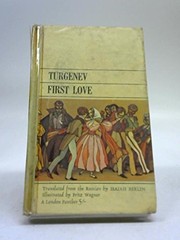
Start with First Love. It is about a hundred pages, it reads in one sitting though it is better in two, and it is the fastest possible demonstration of what Turgenev does: a middle-aged man tells friends after dinner about a humiliation from decades earlier that he has still not resolved, and the reader works out what is happening well before the sixteen-year-old he used to be does.
Then Fathers and Sons, which is the famous one and the usual recommended starting point. It is a better second book than first. It gave Russian the word nihilist in its modern sense and gave critics Bazarov to argue about for a century, and it is written by a man who could see both generations clearly and refused to award the argument to either — radicals thought Bazarov a slander and conservatives thought him a glorification, and that symmetrical hostility contributed to Turgenev's long expatriation. Meeting First Love first teaches you to read for the hesitation rather than the event, which is the skill Fathers and Sons requires.
Be unintimidated about the scale. Turgenev is the shortest and most immediately readable of the great Russians, and this entire path is roughly two thousand pages — less than one novel by Tolstoy. His plots turn on things not done: a declaration not made, a departure taken a day too early, a man who talks himself out of the moment.
The sketches and the first novels
A Sportsman's Sketches, Rudin, On the Eve. The sketches are the fieldwork behind every novel here — a landowner walks the Oryol countryside with a gun and a dog, and the serfs he meets are individuals rather than a class. Turgenev never argues against serfdom in these pages; he simply declines to write serfs as a category. One buying warning: this book appears in English under several titles involving sketches, notes and a hunter's album, and the selections differ substantially between editions, so check the contents page before you commit — the one to make sure yours includes is Bezhin Meadow. Rudin is the first novel and the origin of the superfluous man: a brilliant talker who can move a room and cannot act. On the Eve states his recurring claim most directly — the women have the will and the men have the theories.
The mature novels
Home of the Gentry was the novel Russians of his own day loved best, and its subject is renunciation, which Turgenev refuses to make noble. It appears in English under at least three titles involving nests, gentlefolk and gentry; they are the same book. Smoke is the outlier — Russian exiles at a German spa town, contemptuous of Slavophiles and Westernisers alike — and it offended almost everybody in Russia, which is why it is placed after you know the camps. Virgin Soil is the last and longest, about young populists going to the people, written from abroad, and the least controlled thing he wrote; expect stretches that sag.
The completist tail
Torrents of Spring is First Love written by an old man: the same frame, the same trap, and a far harsher verdict on himself. Do not confuse it with Hemingway's novel of the same title, which is a parody of a different writer entirely, and note that editions also print it as Spring Torrents. Then finish with A Month in the Country, the missing link between Turgenev and Chekhov — an estate, a bored intelligent woman, a young tutor, and almost nothing happening at enormous emotional cost. Everything Chekhov is credited with inventing for the stage is already here, decades early.
Where to stop
First Love and Fathers and Sons are a complete introduction and plenty of readers never go further. If you want one more, make it Home of the Gentry. If you want the argument the whole career is making, you need Rudin and A Month in the Country, because the ineffectual man is the single situation Turgenev kept rewriting. More single-author routes are on Discover.
Follow the full ordered path here: Ivan Turgenev Reading Order: Where to Start.
Ready to learn something deeply?
Build a reading path — free