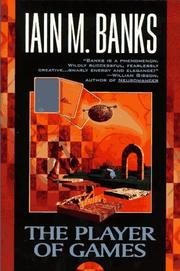
Start with The player of games. It is the cleanest possible introduction to the Culture: a bored master gamer from a post-scarcity utopia is sent to a brutal empire whose entire political structure is decided by a single game. The premise gives you the Culture from outside and inside at once, the plot is a straight line, and it is around three hundred pages.
Do not start with Consider Phlebas just because it was published first. It is a picaresque told from the point of view of someone fighting against the Culture, it is structurally baggy — a sequence of only loosely connected set pieces — and its most notorious chapter involves a cannibal cult and has nothing to do with the plot. It is a good book once you care about this universe. It is a bad advertisement for it.
One catalogue note: these are shelved here under Iain Banks. He published science fiction as Iain M. Banks and literary fiction as Iain Banks, and the middle initial is the only reliable way to tell which shelf a title belongs on.
The Culture, in reading order
The player of games, then Use of Weapons, then Consider Phlebas, then The State of the Art.
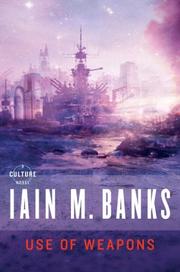
Use of Weapons is the best of them and the most demanding. It runs two interleaved narratives — one moving forward, one moving backward through the protagonist's past — and the reveal at the end recontextualises everything. Pay attention to the chapter numbering, take the structure seriously, and be prepared to sit quietly for a while after the last page.
Consider Phlebas now makes sense: read after two Culture novels, its outsider hostility becomes an argument rather than a confusion. The State of the Art is a novella and stories, including the one where a Culture ship quietly evaluates Earth and decides what to do about us.
The later Culture novels
Excession, Look to windward, Surface Detail.
Excession is the one about the Minds — the Culture's hyper-intelligent AI ships — talking to each other in encrypted correspondence about an artefact from outside the universe. It is the most alien of the novels and the least interested in human characters, which makes it either the best or the most frustrating depending on what you came for.
Look to windward is the most elegiac and the most humane, and it works as a direct thematic answer to Consider Phlebas. Surface Detail is about virtual hells run by civilisations that believe in punishment after death, and the chapters set inside those hells are genuinely nasty. It is signposted, but be warned.
This path is not the complete Culture sequence — Inversions, Matter and the final novel are not on it. Nothing here depends on them, but the list is a strong selection rather than the full set.
The books without the M
The Wasp Factory was his debut and remains notorious: a short, controlled, extremely dark novel about an adolescent on a Scottish island, with a great deal of cruelty to animals and a reveal that split reviewers violently on publication. Some critics called it repulsive; others called it the best first novel in years. Both reviews are defensible.
The Crow Road is the better entry to his non-science-fiction, and one of the best Scottish novels of its era: a family mystery, a very funny first line, and a genuinely warm book. Start there if the Culture is not your thing. Complicity is a violent thriller with a strong political argument and it is not for everyone.
Where to stop
The player of games and Use of Weapons will tell you everything. If you love them, the entire Culture sequence is waiting and you will not need persuading. If they leave you cold, the later novels will not change your mind — but The Crow Road might still be worth your evening.
More science fiction sequences are on Discover.
Follow the full ordered path here: Iain M. Banks Reading Order: Where to Start.