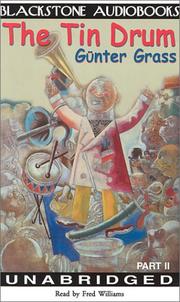
Start with The Tin Drum. It is the hard one and it is still the right one: Oskar Matzerath decides at three to stop growing, narrates from a mental institution, and takes you through the Nazi years by way of drumming, eels and a horse's head. The grotesque is doing the work solemnity would fail at, and no summary prepares you for it.
The tempting alternative is Cat and Mouse, which is 180 pages, brutal and the most immediately readable thing Grass wrote. It is a legitimate test of whether the trilogy is for you and it costs a weekend. But it is the middle book of three and it assumes the Danzig geography the first one teaches, so use it as a sample rather than a starting point. If you read it and want more, go back to The Tin Drum and start properly.
A buying warning before anything else: our catalogue's record for The Tin Drum comes from a split-volume edition. Check that the copy you order is the complete novel and not one half of it. There are also two English translations — the 1961 original and a retranslation issued for the novel's fiftieth anniversary in 2009 — and which one you have changes the book more than most readers expect.
Start here: the Danzig Trilogy
The Tin Drum, Cat and Mouse, Dog Years. Ten to twelve weeks. Budget six of them for The Tin Drum at around 570 pages, read in daily sittings rather than long bursts, because Oskar's voice is exhausting in quantity. Dog Years is back up to 550 pages and goes faster, because you now know the map. Find one of prewar Danzig before you start; the trilogy assumes districts, suburbs and the Baltic coast throughout. The three books are linked by place and period rather than plot, and the project is refusal — Grass will not let postwar Germany treat the Nazi years as an aberration performed by other people.
The core: arguing with the Federal Republic
Local Anaesthetic, From the Diary of a Snail, The Flounder. The target shifts from open atrocity to comfortable forgetting. Local Anaesthetic is narrated from a dentist's chair, with the dentistry as the metaphor: pain managed rather than cured. From the Diary of a Snail braids Grass's campaigning for Willy Brandt with a letter to his children and the story of a Jewish teacher hidden in a cellar; the snail is his image for political progress, offered against the revolutionary impatience of the 1968 left. The Flounder is the wall of this stage — over 500 pages running a fairy tale across the entire history of human nutrition, and its treatment of its female characters has been argued about since 1977. Read it in fixed daily stints; it punishes marathon attempts.
Late fiction and the century in view
Call of the Toad is a compact satire in which a German widower and a Polish widow start a business reburying the dead in their birthplaces. Too Far Afield is the wall of the whole path — over 650 pages of hostile reunification novel, dense with allusion to the nineteenth-century novelist Theodor Fontane, savaged in the German press on publication, and the book most English-language readers abandon. Read a one-page account of Fontane first; that single step is the difference between a difficult book and an impossible one. My Century gives a short piece to each year from 1900 to 1999, in a hundred different voices, and reads well in fragments; note that our record for it is a dual-language edition listing the German title alongside the English, so make sure you have an English translation in hand. Crabwalk is the best of the late novels: the 1945 sinking of the Wilhelm Gustloff, and three generations arguing about it.
If you are short of time
Call of the Toad and Crabwalk are the essential pair in that stage. Too Far Afield is for readers who want the complete argument.
The memoir goes last
Peeling the Onion, published in 2006, is where Grass disclosed that he had served in the Waffen-SS as a seventeen-year-old conscript in the final months of the war, having described his service for sixty years only as a Flakhelfer and a soldier. He had spent his career as the loudest voice telling Germany to confront its past honestly. Some, including Lech Walesa, initially called for him to give up his honorary Gdansk citizenship; others argued that a seventeen-year-old drafted in late 1944 had no meaningful choice and that the late confession was the point of the book. Both responses are on the record. Read it last: read it first and everything before it arrives pre-judged. More single-author routes are on Discover.
Follow the full ordered path here: Gunter Grass Reading Order: Where to Start.
Ready to learn something deeply?
Build a reading path — free