Start with Chronicle of a Death Foretold. It is about a hundred and twenty pages, it announces its own murder in the first sentence, and it then reconstructs the morning from a dozen contradictory memories to work out how an entire town could know a killing was coming and let it happen anyway. It is the most perfectly engineered thing he wrote, and it introduces the manner — flat, factual reportage of extraordinary events — without any of the demands the big novel makes.
One Hundred Years of Solitude is the reason he has a Nobel Prize and it is the harder read, for one specific and practical reason: it covers seven generations of the Buendía family across a hundred years, and the family reuses roughly four given names. Aureliano and José Arcadio recur constantly. Readers who start here often stall around the third generation, not through difficulty of language but through simple bookkeeping. Read it second, and use the family tree printed in most editions without embarrassment.
A cataloguing note worth flagging: the record on this path for One Hundred Years of Solitude credits Gregory Rabassa, who was the translator rather than the author. It is a data quirk, though a fitting one — García Márquez reportedly considered Rabassa's English version better than his own Spanish, and the translation is genuinely famous in its own right.
The three major novels
Chronicle of a Death Foretold, then One Hundred Years of Solitude, then Love in the Time of Cholera. The last is the one to read when you want to test whether the magical elements were the point; it is a straight, patient, sometimes uncomfortable novel about a man who waits fifty-one years for a woman, with almost nothing supernatural in it. Many readers end up preferring it. It is also the book that most divides opinion on the treatment of its central romance, which the novel presents without commentary and readers assess very differently.
The difficult one
The Autumn of the Patriarch is where to be honest with you. It is his most ambitious book and his hardest: a portrait of an ageing Caribbean dictator in sentences that run for pages, shifting narrator mid-clause, with paragraph breaks so rare that some chapters have none at all. There is no plot to hold onto. Read it fourth or fifth, once the voice is familiar, and read it in long sittings rather than fifteen-minute ones — it works far better with momentum. Some readers consider it his masterpiece. Many put it down.
Of Love and Other Demons is much easier and comes from late in the career: a short novel about a girl bitten by a dog and confined for exorcism, and it is one of the most underread things he wrote.
The stories
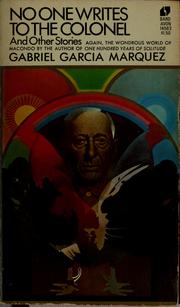
Leaf Storm and Other Stories, No One Writes to the Colonel and Other Short Stories and Collected Stories overlap in contents, so pick according to how much you want. Leaf Storm is his first published fiction and the first appearance of Macondo, so it is interesting mainly as an origin. No One Writes to the Colonel is the standout — a retired officer waiting weekly for a pension letter that never arrives, written in a spare, Hemingway-influenced style entirely unlike the later work. Collected Stories is the one to own if you only buy one.
The memoir
Living To Tell The Tale covers his childhood and early journalism and is the first volume of an autobiography he did not complete. It is the best supplement to the fiction because it shows how literally he meant the claim that he was simply writing down the way his grandmother told stories.
Where to stop
After the three major novels you have read the essential work. Add Collected Stories if you liked the compression of Chronicle of a Death Foretold, and add The Autumn of the Patriarch only if you want to be tested. There is no weak late period to avoid here, only a difficult middle one. If the Latin American tradition interests you further, Discover has more ordered lists.
Follow the full ordered path here: Gabriel Garcia Marquez Reading Order: Where to Start.
Ready to learn something deeply?
Build a reading path — free