Fusion has been twenty years away for seventy years, and the literature carries the scars. Several of the popular books are advocacy, one is a sustained attack on the field's credibility, and the technical shelf jumps without warning from readable survey to graduate plasma theory. Read them in the wrong order and you end up either a believer or a cynic, without the physics to judge either.
A useful sequence separates three questions: what fusion is, what the machines actually do, and why it has been so hard. Take them in that order and the disagreements start to look like engineering rather than personality.
Two short introductions
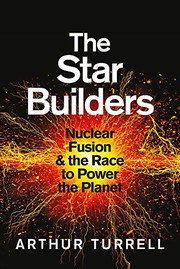
Start with The Star Builders. Arthur Turrell is a plasma physicist, and the book covers both routes to fusion, magnetic confinement in tokamaks and inertial confinement by laser, plus the wave of privately funded companies that older books predate. It beats the obvious alternative, the narrative histories, because it explains the machines before telling you their story.
If you want something shorter still, Nuclear Fusion by Sharon Ann Holgate is a brief, sober introduction with no equations. One honest caveat about the whole popular shelf: every book here was written before the December 2022 ignition result at the National Ignition Facility, so none of them describes the current state of inertial fusion.
The history, and the sceptic
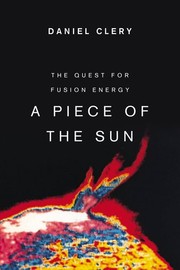
A Piece of the Sun by Daniel Clery is the strongest narrative history, covering Cold War secrecy, the Soviet tokamak and the long grind toward ITER. Fusion by G. M. McCracken sits between history and textbook, explaining confinement physics at a level a determined general reader can follow.
Then read Sun in a Bottle. Charles Seife is unsympathetic and deliberately so: cold fusion, bubble fusion and a pattern of overpromising form the spine of the book. It is a corrective rather than a survey, and it lands better after Clery than before. An Indispensable Truth by Francis Chen argues the opposite case from a plasma physicist who wants fusion built; it is harder than it looks and shades into a textbook in places.
For the archive-minded, Project Sherwood is a 1958 account of the declassified American programme and is a primary source rather than a modern history, while Fusion by Joan Lisa Bromberg is the scholarly institutional history of that same programme.
Learning the plasma physics
There is no route around plasma physics, and the entry point is Introduction to plasma physics and controlled fusion by Francis Chen. It assumes electromagnetism, vector calculus and differential equations, and it is unusually kind for a textbook at that level. Plasma Physics by Richard Fitzpatrick grew out of graduate lecture notes and makes a good second pass over the same material, more formal and more compact. The physics of fluids and plasmas by Arnab Rai Choudhuri covers the theory with an astrophysical slant, which helps if stars interest you as much as reactors do.
The reactor books
Plasma Physics and Fusion Energy by Jeffrey Freidberg is the graduate text that connects plasma theory to reactor design, and it is where confinement time, beta limits and tritium breeding stop being slogans. Tokamaks by John Wesson is the professional reference on the dominant machine, used as a handbook rather than read cover to cover. The physics of inertial fusion by Stefano Atzeni is the laser-driven counterpart and the hardest book on this list: implosion hydrodynamics, radiation transport and instability analysis, written for researchers.
Work through the path in order and you finish able to read a fusion announcement and say precisely which number is missing.
Follow the full ordered path here: How to Learn Fusion Energy from Books, in Order.