Roughly ninety-five per cent of the universe is unaccounted for by anything we have ever detected in a laboratory, and it turns out to be two separate problems rather than one. Dark matter is extra gravitating mass, inferred from galaxy rotation, cluster dynamics and lensing since the 1930s. Dark energy is whatever is accelerating the expansion, discovered in 1998 from distant supernovae. They are often bundled and they have almost nothing in common except that we cannot see either.
The reading problem is twofold. First, the popular books date fast — the field has had real experimental results and real null results since 2010, so a 2004 book is a period piece. Second, several authors are advocates for a position, which is entirely legitimate and worth knowing before you read them as neutral surveys.
The narrative entry point
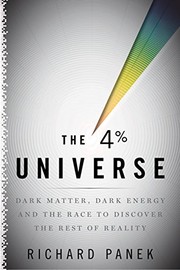
Start with The 4-Percent Universe by Richard Panek. It tells both discoveries as one story of competing teams, which is the fastest way to understand why anyone believes in either thing — the evidence arrives attached to the people who fought over it. The obvious alternative, Dark Matter and Dark Energy by Brian Clegg, is a shorter and more expository primer; take it if you want the concepts stripped of narrative, but it will leave you with less feel for how contested the field was.
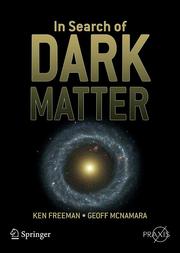
Then two books by people who do the work. The Cosmic Cocktail Three Parts Dark Matter by Katherine Freese is a theorist's account of the candidate particles and the detection experiments, with a first-person view of how the searches are run. In search of Dark Matter by Ken Freeman and Geoff McNamara comes from the observational side, and is strong on the galaxy dynamics that made the problem visible in the first place. Dark Cosmos by Dan Hooper approaches it from particle physics — what a dark matter particle would have to be, and how a collider or an underground detector might find it.
The specialists and the participants
Einstein's telescope by Evalyn Gates is about gravitational lensing specifically, which is now the most direct mapping tool we have for invisible mass. The Extravagant Universe by Robert P. Kirshner is the insider account of the supernova cosmology work from within one of the two competing teams, and it is a primary source about a discovery rather than a survey of it — expect a point of view. Elephant in the Universe by Govert Schilling is the most recent reporting here and the best single update on where the searches stand, including the long run of null results.
Quintessence by Lawrence Maxwell Krauss is an earlier account, written close to the moment dark energy appeared; read it as a snapshot of what people thought then rather than as current.
Two books need labels. Dark matter and the dinosaurs by Lisa Randall proposes a specific speculative hypothesis — a dark disc periodically disturbing comets — and Randall is clear that it is speculation, but it is not the mainstream picture and should not be a first book. The dark matter problem by Robert H. Sanders is a genuinely useful history of how the problem developed, written by a scientist sympathetic to modified gravity rather than to particle dark matter. That disagreement is real and unresolved: most cosmologists hold that modified gravity struggles with cluster collisions and the cosmic microwave background, while its defenders point to how well it predicts galaxy rotation. Sanders is the honest way to hear that case; just know whose case it is.
The textbooks, and what they require
This is where the level changes sharply. Introduction to Cosmology by Barbara Ryden is the standard undergraduate text and the right first real one: it assumes calculus and introductory physics, uses general relativity conceptually rather than computationally, and is unusually clear. Most physics undergraduates could work through it.
Modern cosmology by Scott Dodelson is graduate level and a different order of demand — Boltzmann equations, perturbation theory, and general relativity as a working tool rather than a picture. Particle Dark Matter, edited by Gianfranco Bertone, is not a textbook at all but a collection of review chapters by researchers, useful once you can read the literature and largely impenetrable before.
The full path keeps that ladder intact, so the mathematics arrives only when the physics is already familiar.
Follow the full ordered path here: How to Learn Dark Matter and Dark Energy from Books, in Order.