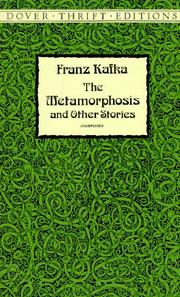
Start with The Metamorphosis and Other Stories. The title novella is the one complete, polished, indisputably finished major work Kafka published in his lifetime, it runs about sixty pages, and a man waking up as an insect turns out to be a domestic story about a family's dwindling patience with an inconvenient relative. Everything people mean by the word Kafkaesque is present, in a form that ends.
Do not start with The Trial, even though it is the famous one. All three of Kafka's novels are unfinished, none was published in his lifetime, and all three exist because his friend Max Brod ignored a written instruction to burn them. That is not trivia — it directly shapes the reading experience. Chapters are in a reconstructed order, some break off mid-scene, and the fragments were arranged by an editor rather than an author.
The short fiction first
The Metamorphosis and Other Stories, then In the Penal Colony, which is a short, exact and genuinely horrifying account of an execution machine explained lovingly by its operator. It is the most controlled thing he wrote and the least ambiguous.
The Penguin complete short stories of Franz Kafka is where to go if the first two work on you. It holds the parables and the miniatures — A Hunger Artist, Before the Law, In the Village — that are, for many readers, the real Kafka. Several are two pages long and none is wasted. This is the single best-value book on the list.
Then the novels
Read The Trial first among the novels. Josef K. is arrested one morning without being told the charge and spends a year failing to find out. It is the most complete of the three, its final chapter exists and is devastating, and the famous parable Before the Law sits at its centre.
Then The Castle. A land surveyor arrives at a village and cannot obtain confirmation from the castle authorities that he was hired. It is longer, slower and better than The Trial on most rereadings, and it stops mid-sentence — Kafka died before finishing it. Know that before page one and it is fine; discover it at the end and it is maddening.
Amerika is the lightest, the least characteristic and the most straightforwardly comic, following a boy exiled to a New York that Kafka never visited. It is the least essential of the three and a pleasant surprise for readers who assume he is uniformly grim. Published in German as Der Verschollene, it appears under several English titles.
The diaries and letters
The Diaries of Franz Kafka and Letter to his father. Brief an den Vater are the biographical core. The letter runs about fifty pages, was never delivered, and is the document to read if you want to know where the fiction's authority figures come from — though treating it as a straightforward key to the work is a mistake, and Kafka was constructing an argument in it, not filing a report.
Biography and criticism
Kafka by Klaus Wagenbach is the short, well-regarded life; Wagenbach was one of the first serious researchers into the Prague context and the book is a good deal more concrete than the mythologising that surrounds the subject. kafka's other trial, Elias Canetti's essay, reads the letters to Felice Bauer and is a strange, brilliant, arguable piece of criticism by a novelist rather than an academic.
The translation question
This is a genuine controversy worth knowing about. The Muir translations from the 1930s shaped the English-language Kafka for fifty years and are more fluent, more religious in tone and more atmospheric than the German. The later translations, particularly Mark Harman's and Breon Mitchell's, work from the restored critical editions and are flatter, more bureaucratic and closer to Kafka's actual sentences, which are plainer than his reputation suggests. Most current scholars prefer the newer versions; some readers still love the Muirs. Check whose translation you are buying — it matters more here than with almost any other author.
Where to stop
The stories plus The Trial is a complete reading of Kafka for most purposes. Add The Castle if the first novel worked. Amerika, the diaries and the criticism are for readers who have decided this is theirs.
Follow the full ordered path here: Franz Kafka Reading Order: Where to Start.