Start with A good man is hard to find. It is her first story collection, catalogued here under that lowercase form and published as A Good Man Is Hard to Find and Other Stories, and its title story is the most complete thing she wrote: a family road trip in Georgia that ends in a roadside encounter with an escaped convict, and a final exchange that has been argued over for seventy years. Ten stories, none longer than thirty pages, and every characteristic O'Connor move is in there.
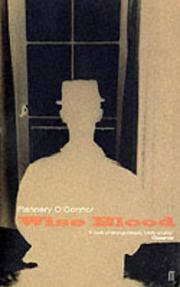
Do not start with the novels. Wise blood is a strange, jagged, brilliant book, and it was assembled partly from previously published stories, which shows. Her method — a comic set-up that swerves into violence at the last possible moment — works better at twenty pages than at two hundred, and readers who meet her first through the novels often find her merely bleak rather than what she actually is, which is savagely funny and theologically deadly serious at once.
The stories, both collections
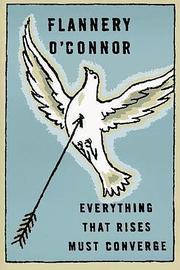
A good man is hard to find, then Everything That Rises Must Converge. The second collection was published after her death in 1964 and contains the more controlled work — the title story, Revelation, Parker's Back — written when she knew she was dying of lupus. Between them these two books hold almost everything she wrote in the form, and they are about four hundred pages combined.
An honest warning about the content: the stories turn on violence and they use the racial language of the mid-century rural South directly and constantly. That is not incidental. Which brings us to the reassessment.
The dispute, stated plainly
O'Connor's private letters and journals, including material published in recent years, contain expressions of racist attitudes that are considerably harder to read as satire than the fiction is. This prompted a genuine reappraisal — some scholars and writers argue the work is compromised by it, others argue that the fiction is precisely an indictment of the world those attitudes belong to, and the disagreement is live and unresolved. This article does not adjudicate it. It is raised because readers routinely encounter the argument alongside her name and it is better to meet it knowingly.
The novels
Wise blood comes third. Hazel Motes returns from the war and founds the Church Without Christ, and the novel is a comedy about a man who cannot escape the belief he is trying to destroy. It is her funniest sustained work and her most grotesque.
The violent bear it away is the harder of the two and the better constructed: a boy raised by a backwoods prophet against the rationalism of a schoolteacher uncle, with the argument between them driving the whole book. It is short, it is relentless, and it is the closest she came to putting her theology on the page without disguise.
The essays and the letters
Mystery and manners collects her occasional prose on writing and on being a Catholic novelist in the Protestant South, and it is one of the best books about fiction by a practising novelist. The essay on the grotesque in Southern writing explains her own method better than any critic has.
The habit of being - Letters of Flannery O'Connor is the correspondence, and it is where most readers discover that she was extremely funny in person — the letters are gossipy, sharp and startlingly unsentimental about her own illness. Read it last, when the fiction has made you curious about the woman who produced it.
Where to stop
The two story collections are the essential O'Connor, and stopping there is entirely defensible. The novels are for readers who want the full argument, and Mystery and manners is for anyone who writes. Her whole output fits in about a thousand pages, which is what happens when a writer dies at thirty-nine. Readers who come to her through the Southern setting usually go to William Faulkner next, though she is a very different kind of writer — compressed where he is expansive.
Follow the full ordered path here: Flannery O'Connor Reading Order: Where to Start.