Finite element analysis is unusual among engineering subjects in that the software will happily give you a wrong answer that looks completely convincing. Stress contours render just as smoothly on a model with the wrong boundary conditions, a badly distorted mesh or an element type that cannot represent bending. This is why the reading order matters more here than in most technical subjects: the people who get into trouble are the ones who learned the interface before they learned what the interface is approximating.
The path below therefore alternates deliberately between practice and theory. It starts with a book about judgement, then goes to the mathematics of the method, then back out to application and finally to the two hard specialisms — nonlinear analysis and writing the code yourself.
Judgement before theory
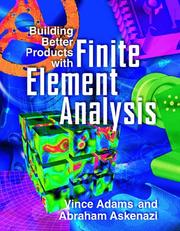
Building better products with finite element analysis is the right first book for almost anyone who already has access to a solver. Vince Adams writes about modelling decisions rather than derivations: what to simplify, where results are trustworthy, how to sanity-check an answer, and what a mesh convergence study is actually telling you. It will not teach you the method, and that is fine at this stage.
A first proper course
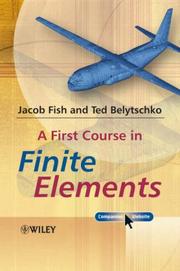
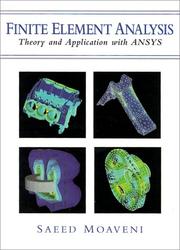
A first course in finite elements is the cleanest introduction to the theory, working from weak forms and shape functions upward with the mathematics kept at an undergraduate level. Finite Element Analysis by Saeed Moaveni covers similar ground while teaching the workflow in commercial software alongside it. These two overlap substantially and one is enough at this stage — take Fish if you want the method, Moaveni if you want the method and the software together, and be aware that any software-specific book dates quickly as versions change.
The standard texts
Concepts and applications of finite element analysis is the classic engineering course text and the most balanced book on the path, strong on element formulation, modelling errors and the things that go wrong. An Introduction to the Finite Element Method is J. N. Reddy's more mathematical treatment, and it is the one to read if you want the variational foundations rather than the recipes.
The finite element method is Zienkiewicz, the reference the field grew up around. It exists as a multi-volume set covering basics, solid mechanics and fluid dynamics, and our catalogue records it as a single title, so check which volume you are buying. Nobody reads it front to back; it is where you go when you need the authoritative treatment of something specific. Finite element procedures in engineering analysis is Bathe, later editions of which are published simply as Finite Element Procedures, and it is the strongest book on the computational side — solution algorithms, time integration, the numerical behaviour that determines whether a large model converges at all.
Mathematics, nonlinearity and code
An analysis of the finite element method is the mathematician's account, and it is where the method stops being a set of engineering procedures and becomes approximation theory with error estimates. It is short, it is demanding, and it explains why the method works.
Nonlinear finite elements for continua and structures is the graduate text for large deformation, contact, plasticity and explicit dynamics — in other words, for crash, forming and impact work, where linear intuition stops applying. Programming the finite element method closes the path by having you build solvers rather than use them, which is still the fastest way to stop treating the software as a black box.
One thing to say plainly. Analysis that anything structural depends on is regulated professional work in most jurisdictions, and books support that competence rather than confer it. Verification and validation against physical test data is not an optional extra. The automotive engineering hub covers one of the fields where this matters most.
Follow the full path in order and you will end up able to tell a converged result from a colourful one.
Follow the full ordered path here: Best Books to Learn Finite Element Analysis, in Order.