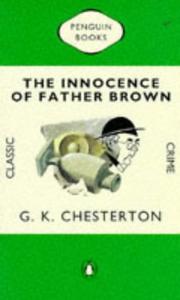
Start with The Innocence of Father Brown (Father Brown Mystery) — the parenthetical is our catalogue's series tag, not part of the title. It is the 1911 collection, it contains The Blue Cross, The Queer Feet, The Invisible Man and The Sign of the Broken Sword, and it is the only correct place to begin.
The second thing to know is that there are no Father Brown novels. G. K. Chesterton wrote fifty-three short stories, published across five collections between 1911 and 1935, and everything else on the shelf is a reprint, a themed selection or a television tie-in that scrambles the sequence and hides which book a story came from. That matters more here than it would for most detective series, because the five collections are not interchangeable.
The five collections, in order
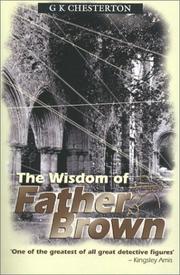
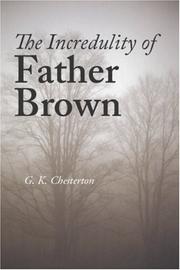
The Innocence of Father Brown (Father Brown Mystery) (1911), The Wisdom of Father Brown (1914), The incredulity of Father Brown (1926), The secret of Father Brown (1927) and The scandal of Father Brown (1935). Read the first two together: Flambeau, the thief introduced in The Blue Cross, is in a materially different situation by the second book, and the change only makes sense in sequence.
Why the order matters more than usual
Chesterton was received into the Catholic Church in 1922, and the gap of twelve years between the second collection and the third is visible on the page. The early stories are dazzling and not very serious: a marvel turns out to be an ordinary thing seen wrongly, and the solution is usually a matter of noticing what everyone has looked at. The later ones are a convert working out a theory of sin. The incredulity of Father Brown is openly about false miracles and credulous rationalists, and it is darker and slower than what came before.
The secret of Father Brown is the structurally important one. It is framed by the priest explaining his method — that he solves murders by imagining himself committing them until he can feel how it was done. That frame is a retrospective account of everything you have already read, which is exactly why it should come fourth rather than first.
Five books or one
The Penguin Complete Father Brown (Father Brown Mystery) holds all five collections in publication order plus the late uncollected stories that no individual collection contains, and reading it front to back reproduces the order above exactly. For most readers this is the practical answer: buy it instead of the five, not as well.
Be careful of the other omnibus. The Father Brown stories is the earlier collected edition, from 1931, so it necessarily stops before The scandal of Father Brown. It is common secondhand and easily mistaken for a complete edition.
Chesterton's other fiction
The Man Who Was Thursday is his best novel and the obvious next read: an undercover detective infiltrates an anarchist council whose members are named after days of the week, and the situation reverses repeatedly. It is subtitled A Nightmare, which licenses the ending. The Club of Queer Trades is an earlier story cycle about men who invented their own professions, and is the direct precursor to Father Brown — the same shape of a sinister mystery resolving into something absurd and innocent, without the right detective yet. The Napoleon of Notting Hill, his first novel, has no detective at all and is the clearest statement of the politics underneath the fiction.
The ideas, and a life
Orthodoxy is the one piece of his non-fiction to read if you read only one: it contains, in argument form, the view of human nature that lets Father Brown assume every criminal's motive is available to him. Heretics is the earlier companion, attacking the leading thinkers of his day. The Everlasting Man is the longest and hardest, a history of humanity and of Christ written against H. G. Wells; C. S. Lewis credited it with his own conversion. All three are Catholic apologetics and are advocacy rather than neutral survey. Ian Ker's G. K. Chesterton, published as G. K. Chesterton: A Biography, is the standard modern life and treats him as a thinker rather than a producer of paradoxes.
One honest note about the stories themselves: Chesterton's Edwardian prose carries the racial and antisemitic caricature ordinary in popular fiction of the period, most visibly in The God of the Gongs and The Sins of Prince Saradine. More is on the Father Brown hub.
Follow the full ordered path here: Father Brown Reading Order: Where to Start with G.K. Chesterton.