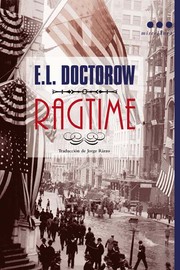
Start with Ragtime. It is short, it is the book that made him, and it is the clearest demonstration of the method everything else varies: American history written as fiction, with real people put into invented lives and no marking of which is which. Houdini, Emma Goldman, J.P. Morgan and Henry Ford do and say things they did not do or say, delivered in exactly the same voice as the fictional family.
Know one thing before page one. Ragtime has almost no quotation marks. Dialogue sits unmarked inside the narration and the sentences are short, flat and declarative, which looks like a mistake for about ten pages and then becomes the point — the prose is built to move like a piano roll, mechanical and syncopated. Read the first three pages, stop, and read them again before going on; two passes usually clear the barrier. If it still defeats you, start with Billy Bathgate instead: first person, a boy apprenticed to Dutch Schultz's gang in 1935, a narrator who actually talks to you, and the same method inside an ordinary coming-of-age shape. Our catalogue files it under a film tie-in title; the novel is simply Billy Bathgate.
Notice in Ragtime that the central family have no names — Father, Mother, Mother's Younger Brother, the Little Boy — while the historical figures keep theirs in full. That inversion decides where your sympathy is allowed to settle. Notice too the paragraph where the tone stops being playful and Coalhouse Walker's story takes over; readers agree on that pivot more than you would expect.
The serious ones
The book of Daniel, then The March. The first is the hardest book here. It reimagines the Rosenberg case — Julius and Ethel Rosenberg were executed in 1953 after a conviction for conspiracy to commit espionage, and the case is still argued about — through the invented grown son of an invented couple, changing the names and declining to settle the guilt question. It is narrated in a broken first person that switches between I and he mid-paragraph, jumps decades without warning and breaks into outright essay, with nothing signalling any of it. Keep a timeline. Daniel is also not a sympathetic narrator, and his cruelty to his wife is on the page, undefended.
The March removes the single viewpoint entirely: Sherman's army moves through Georgia and the Carolinas while the narration hands off between soldiers, freed people, surgeons and Sherman himself, sometimes inside a page. The structure is the argument — the army is the protagonist and individuals are picked up and dropped, which is what a marching army does to the people in its path.
Both books put you inside events people still argue about and refuse to tell you what to conclude. That is a position rather than an evasion, but if you want a verdict on the Rosenbergs or on Sherman, neither novel supplies one.
America, era by era
Welcome to Hard Times, World's fair, Homer and Langley — the three shortest novels here and the easiest stretch of the path. Frontier, then a Depression childhood, then a whole century seen from inside one house.
Welcome to Hard Times is a first novel and an anti-Western, written while he was reading Western screenplays for a living and reading as a direct rebuttal of them. World's fair is the outlier in the whole body of work: a Bronx childhood close enough to his own to function as memoir with the names changed, and the one book where the method relaxes. Homer and Langley takes the Collyer brothers, two genuine New York hoarders, and extends their lives by decades through a twentieth century that did not happen in that order — his most open falsification, flagged nowhere. Narrating through the blind brother means the house is described by touch and sound, so the book is claustrophobic rather than grotesque.
The late experiments
Loon Lake, The Waterworks, City of God, Andrew's brain, in that order, which alternates difficult and easy on purpose. Loon Lake gives you no reliable narrator at all, shifting person mid-sentence and dropping into verse. The Waterworks is the deliberate relief and the most conventionally satisfying novel on this path — a tightly plotted gothic mystery in 1871 New York written in convincing nineteenth-century newspaper prose. City of God is barely a novel, and some readers give up on it, which is a defensible thing to do; if it stalls, read only the notebook sections straight through and then go back. Andrew's brain is a single voice talking to an unnamed listener while lying, or misremembering, or medicated.
The pattern is worth naming: as the history thins out, the unreliability thickens. This is his least-loved work and the reviews said so at the time, which is exactly why it belongs last.
Where to stop
Ragtime, Billy Bathgate and The book of Daniel are the writer. More literary reading orders are on Discover.
Follow the full ordered path here: E.L. Doctorow Reading Order: Where to Start.