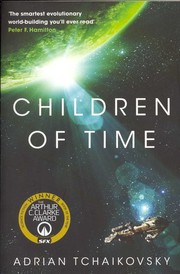
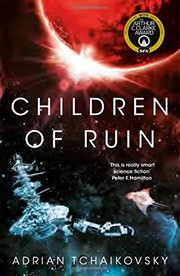
Start with Children of Time and read the trilogy in publication order: Children of Time, then Children of Ruin, then Children of Memory. There is no chronological alternative to argue about — the books run forward in time as they were published, and each one assumes the last.
The more useful thing to say is that Children of Time is a complete novel with a real ending, and stopping there is a perfectly good outcome. It won the Arthur C. Clarke Award in 2016 and it is the book that made Tchaikovsky's reputation outside fantasy readers. The sequels extend the idea rather than complete it.
The trilogy
Children of Time runs two timelines against each other. A terraforming project is meant to seed a planet with uplifted monkeys and a nanovirus to accelerate them; the monkeys die and the virus finds spiders instead. On the planet, thousands of years of arachnid civilisation unfold in generational jumps. In orbit and in cold sleep, the last remnant of humanity arrives to claim a world that is already occupied. Most readers find the spider chapters far more interesting than the human ones, and that imbalance is deliberate — the ark-ship sections exist to give the alien timeline something to collide with.
Children of Ruin repeats the structure with octopuses, who turn out to be much harder to write a civilisation for than spiders, and introduces a third intelligence that is the most genuinely unsettling thing in the trilogy. It is closer to horror than the first book.
Children of Memory is the divisive one. It is a puzzle-box built around a failing colony and a narrative that keeps restarting, and what it is doing does not become clear until quite late. Readers who go in expecting the third act of a space opera often find it slow and evasive; readers who take it as a novel about what a mind is tend to rate it highest of the three. Both reactions are common and both are reasonable.
What to read next, and in what order
Tchaikovsky writes several unrelated sequences, so "what comes after" is a question about which direction you want.
For more of the non-human-mind material: Dogs of War is narrated in part by Rex, a bioengineered war dog who wants very badly to be a good dog, and it uses that voice to ask what legal personhood is for. Bear Head follows it much later in a colonised Mars setting and is the more conventional book of the two. Read Dogs of War first; it stands alone.
For space opera with more plot and less deep time: Shards of Earth, Eyes of the Void and Lords of Uncreation are the Final Architecture trilogy, one continuous story about a crew of misfits and entities that unmake planets. Faster, lighter, and best read straight through.
For standalones: Alien Clay is a prison-planet novel with a hard political edge, and Service Model is a comic novel about a valet robot in a collapsed civilisation, much lighter than anything else here.
The books that shaped it
The path closes with three novels that make the trilogy's ambitions legible. David Brin's Startide Rising is the earlier canonical treatment of uplift — humans raising other species to intelligence and inheriting the politics of it. Vernor Vinge's A Fire upon the Deep is the reference point for alien minds built on an unfamiliar architecture, in its case a pack intelligence. Peter Watts's Blindsight is the hard case against the whole project: a first-contact novel arguing that consciousness may be a liability rather than an achievement. It is the most difficult book on the list and the one that argues most directly with Tchaikovsky.
Honest warnings
Children of Ruin contains sustained body-horror content involving parasitism. And the generational structure of Children of Time means characters you have followed for two hundred pages die of old age between chapters — the book is about the species, not the individual, and readers who bond to a viewpoint character find the first third frustrating before that clicks. More science fiction reading orders are on Discover.
Follow the full ordered path here: Children of Time Reading Order: Where to Start with Adrian Tchaikovsky.