The fastest way to get this subject wrong is to start with the headline findings. Behavioral genetics is defined by what it can measure — twin designs, adoption designs, and more recently genome-wide association studies and polygenic scores — and each of those methods answers a narrower question than the summary of it suggests. Learn the instruments first and the field's claims become things you can evaluate.
The pivotal concept is heritability, and it is routinely misread. A heritability estimate is a statement about how much of the variation in a trait, within one population under one set of environmental conditions, tracks genetic variation. It is not a statement about an individual, not a measure of how fixed a trait is, and it can change when the environment changes. Nearly every dispute in this field is downstream of that distinction. This subject also has a documented history of political misuse, and several books on the path address that directly.
Start with the methods
Robert Plomin's Blueprint is the accessible statement of the strong hereditarian position from the field's most prominent researcher, and it is a good place to begin precisely because it is unhedged: you can see clearly what is being claimed. Matt Ridley's Genome is a chromosome-by-chromosome tour of human genetics and supplies the molecular background a reader without a biology course will need.
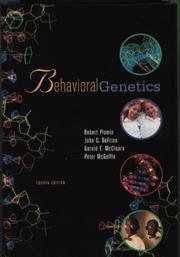
For the actual apparatus, Plomin and colleagues' textbook Behavioral genetics is the standard course text and the only book here that will teach you how a twin study is designed, what an ACE model decomposes, and where the assumptions sit. Nancy Segal's Born together--reared apart is the history of the Minnesota Study of Twins Reared Apart, the single most cited body of evidence in the field, told by a researcher who worked on it.
Learn what the estimates cannot tell you
This is the stage that separates a reader who can use the field from one who quotes it. Kostas Kampourakis's Making Sense of Genes is a philosopher-of-biology's account of what a gene is and what causal language about genes can legitimately support. David Moore's The Dependent Gene argues from developmental systems theory that the nature-nurture partition is itself the wrong frame, and that traits emerge from interaction that heritability statistics cannot decompose.
Kevin Mitchell's Innate introduces a third source of variation that neither camp emphasises: developmental noise, the stochastic variation in how a brain wires itself, which is neither inherited nor environmental. Judith Rich Harris's The nurture assumption comes at the environmental side and argues that the shared family environment explains far less of adult personality than parents assume, with peer groups doing more of the work.
Robert Sapolsky's Behave is the long integrative treatment — a neurobiologist walking a behaviour backwards from seconds to evolutionary time — and is the best single antidote to single-cause explanation, genetic or otherwise. Carl Zimmer's She Has Her Mother’s Laugh is a science journalist's history of heredity itself, and it covers the eugenics era at length rather than in a footnote.
The current frontier, and its critics
Genome-wide association studies changed what the field can do, and Kathryn Paige Harden's The Genetic Lottery is the most discussed recent book on what follows: she argues that polygenic scores are real and should be taken seriously, and that the egalitarian response is to use them rather than to deny them. The book has been contested from several directions, including on the interpretation of within-family effects and on the policy inferences.
For the long-standing critical tradition, Richard Lewontin, Steven Rose and Leon Kamin's Not in our genes attacks the entire programme as biological determinism serving political ends; it is polemical, written in 1984, and it is the position much of the field's later methodological care was developed in response to. Mitchell's Free Agents closes the path on a different question, arguing from neuroscience that agency is compatible with a physically caused brain.
Read the methods, then the limits, then the frontier. For the argument itself — who holds which position and why — the companion path on the nature-nurture debate covers that ground instead.
Follow the full ordered path here: Behavioral Genetics: The Best Books on Heritability, in Order.