Atmospheric chemistry has an unusually steep internal gradient. The trade books about air pollution are genuinely readable journalism; the standard textbooks are graduate-level physical chemistry with fluid dynamics attached. There is no gentle ramp between them, so the useful thing an ordered path can do here is tell you exactly where the step is and what each book expects you to already know.
The other reason order matters is that the field's two great success stories — the ozone layer and urban smog — are also its best teaching examples. Reading the popular accounts of those episodes first gives you the chemistry's stakes and vocabulary before any equations arrive.
Popular accounts: the problem and the politics
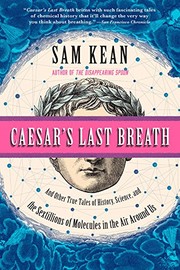
Beth Gardiner's Choked and Tim Smedley's Clearing the Air are both reported books on outdoor air pollution, its health burden and the policy fights around it; they overlap substantially, so read whichever you find first rather than both. Sam Kean's Caesar's Last Breath is a popular history of the atmosphere gas by gas — not an air-quality book, but the most enjoyable way to acquire the cast of molecules.
The ozone story gets two books from opposite angles. Sharon Roan's Ozone crisis is the journalistic account of the science and the alarm; Richard Benedick's Ozone diplomacy is a negotiator's memoir of the Montreal Protocol, and remains one of the better books on how scientific evidence becomes a treaty. No mathematics in any of these.
The undergraduate step
Daniel Jacob's Introduction to atmospheric chemistry is the natural bridge and the best-loved short textbook in the field: about 250 pages, built around problems, and assuming first-year calculus plus basic physical chemistry. If you can follow a rate law and an exponential decay, you can read it.
Thad Godish's Air Quality is a survey of pollutants, sources, health effects, monitoring and regulation with very little mathematics — closer to an environmental-science course than a chemistry one, and useful if your interest is applied. Mark Jacobson's Air pollution and global warming connects local air quality to climate forcing at upper-undergraduate level; expect calculus and some numerical thinking.
Richard Wayne wrote two books covering much the same ground at a higher level. Chemistry of atmospheres is the long-standing one, strong on photochemistry, spectroscopy and the chemistry of other planets' atmospheres; Atmospheric Chemistry is the shorter treatment. One of the two is enough, and both assume a chemistry degree in progress.
The graduate references
Atmospheric chemistry and physics by John Seinfeld and Spyros Pandis is the field's standard graduate text and the book most working researchers own. It is comprehensive and unforgiving: chemical thermodynamics, kinetics, transport and fluid dynamics, and differential equations used throughout. Barbara Finlayson-Pitts and James Pitts wrote Chemistry of the upper and lower atmosphere, which is less a course than a research reference, exceptionally strong on laboratory kinetics and mechanisms.
Two applied volumes finish the path. William Hinds's Aerosol technology is the standard text on particle behaviour — deposition, sizing, filtration — and is the book to read if particulate matter is your interest; it is quantitative but self-contained. Noel de Nevers's Air pollution control engineering is a chemical engineering text on the devices and mass balances that actually remove pollutants from a stack, and assumes engineering fundamentals rather than atmospheric chemistry.
Work up the path in order and the jump from journalism to Seinfeld and Pandis stops being a cliff. If the health and policy side is what draws you, the reading on air pollution and clean air is the better branch.
Follow the full ordered path here: Atmospheric Chemistry and Air Pollution: What to Read, in Order.