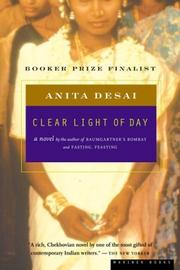
Start with Clear Light of Day. Desai's novels are standalone, so nothing forces publication order on you — and publication order is the wrong choice here. Her first novels are the most claustrophobic things she wrote, long stretches inside one distressed consciousness with no comedy and no relief, and readers who begin at the beginning routinely give up on her altogether.
Clear Light of Day is the disciplined version of the same attention. An adult sister returns to the family house in Old Delhi; the novel moves backwards through its sections into the summer of Partition and then forward again, and the events are shifts in what one family member is finally willing to say to another. It is 183 pages and it does not read fast. Twenty pages a sitting is about right, because Desai buries the plot inside descriptions of heat, dust and furniture, so skimming loses the story rather than saving time.
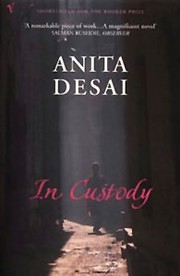
If you want something more plotted, start instead with In Custody, the outlier: funnier, driven by one man rather than a household, and about the decline of Urdu in independent India. A schoolteacher worships a great poet, finally gets access to him, and discovers a shambling and expensive old man. Three of Desai's novels were shortlisted for the Booker and none won; the shortlistings are a reliable map of her strongest work, and two of the three are in this pair.
Then: the books that leave India
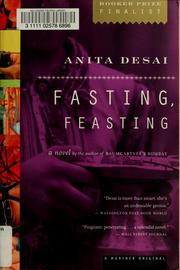
Fasting, feasting is a diptych — a long first half about an unmarried daughter kept at home in a north Indian town, then a shorter second half about her brother eating badly and alone in suburban Massachusetts, with the two halves never explicitly compared. Read the last page of the first half and the first page of the second back to back. The cut between them is the argument.
Baumgartner's Bombay is the outsider novel of her career: a German Jewish man escapes the Nazis, is interned by the British in India as an enemy alien, and lives out his life in Bombay feeding stray cats. That internment is a real historical fact and it catches many readers off guard. Desai's own mother was German, and the novel prints Baumgartner's German untranslated, so his mind runs partly in a language nobody around him can read. Read together, these two show that her subject was never simply the Indian family: it is people who cannot leave, set beside people who cannot arrive.
The early novels, read as origin
Cry, the peacock, Voices in the city, Fire on the mountain. Come to these knowing what they are. Cry, the peacock appeared in 1963, written in her twenties, and is an image-saturated study of a young wife's disintegration — read it in sittings of no more than forty pages, because it is written to feel airless and in long stretches it stops registering at all.
Voices in the city is where a city first acts on the characters, and the Calcutta writing is the strongest thing in the early work. Fire on the mountain is the hinge: 145 pages, an old woman in a Himalayan hill station who wants only to be left alone, and an ending most readers do not see coming. Across the three you can watch the style tighten. If you only ever read four Desai novels, none of them is in this stage.
The later and shorter work
Games at Twilight is her first story collection; the title story, about a boy who hides so well that the others forget him, is the most anthologised thing she wrote and holds the whole career in a few thousand words. Journey to Ithaca follows a European couple who come to India after a guru and then turns back into the history of the woman who arrived decades before them, neither mocking the seekers nor endorsing them. The artist of disappearance is three late novellas about withdrawal, written when she was around seventy.
Where to stop
Four books — Clear Light of Day, In Custody, Fasting, feasting, Baumgartner's Bombay — are the writer. Everything else is for readers who want the range. This path holds ten titles; she published more, including children's fiction, so treat it as the spine rather than the complete works. More literary reading orders are on Discover.
Follow the full ordered path here: Anita Desai Reading Order: Where to Start.