Start with Brave New World. Sometimes the famous book is the famous book for good reasons: it is short, it is his most controlled piece of construction, and its central argument — that a society can be governed by pleasure rather than pain — has aged far better than most of the dystopian shelf. If you buy the combined edition Brave New World and Brave New World Revisited, you also get the 1958 essays in which Huxley reassesses his own prophecy, which is the single best companion to the novel.
The interesting decision comes next, because Huxley was effectively three writers. There is the 1920s social satirist, the 1930s novelist of ideas, and the post-1945 mystic and psychedelic essayist. They read nothing alike, and the reason people bounce off him after Brave New World is that they pick the wrong one second.
If you liked the satire: the early comedies
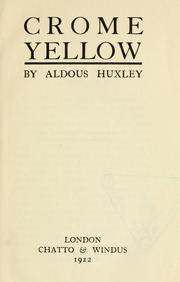
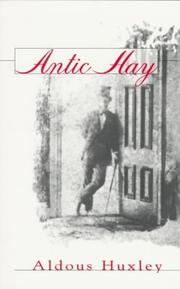
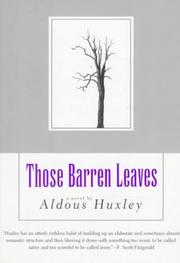
Crome yellow (1921) is the debut and the lightest thing he wrote — a country-house comedy in the tradition of Thomas Love Peacock, in which nothing happens and everyone talks brilliantly. Antic Hay follows with post-war London bohemians, and Those barren leaves, a novel moves the same formula to Italy. These are funny, cold and structurally slight. Read one, not all three; they use the same machinery, and by the third the pattern is obvious.
If you liked the ideas: the major novel
Point Counter Point (1928) is his most ambitious fiction and the book his admirers defend hardest. It sets a dozen characters against each other as embodied arguments, and it contains a musical structure Huxley pinched from Gide. It is also long, cerebral and short on warmth. If Brave New World interested you as a novel of ideas rather than as a story, this is your next book. If you found it dry, skip it and go straight to the essays.
The late Huxley: mysticism and mescaline
This is where readers divide, genuinely and permanently. The perennial philosophy (1945) is an anthology of mystical writing from every tradition with Huxley's commentary — the founding text of a whole strand of twentieth-century spiritual writing, and to sceptical readers a book that flattens the differences between religions into a single thesis. The doors of perception (1954), his account of a mescaline experiment, is ninety pages long and the most influential thing he ever wrote after Brave New World.
Island (1962) is his last novel and the deliberate mirror image of Brave New World: a utopia rather than a dystopia, on an island rather than in a world state. Be warned — most readers find it fails as fiction. The characters exist to be lectured at, and long stretches are essentially a manifesto with dialogue tags. Read it if you want to know what Huxley actually believed by the end. Do not read it expecting the novelist who wrote Point Counter Point.
Where to stop
A completely respectable Huxley reading consists of exactly two books: Brave New World and The doors of perception. Between them you get the satirist and the mystic, roughly four hundred pages, and the two arguments he is remembered for. Whether the late turn represents a deepening or a decline is a real disagreement among his readers rather than a settled matter — his defenders point to the coherence of the whole arc, his critics to the loss of the comic edge that made the early books alive.
Browse more author reading orders on Discover.
Follow the full ordered path here: Aldous Huxley Reading Order: Where to Start.
Ready to learn something deeply?
Build a reading path — free