Viktor Frankl: The Best Books to Read, in Order
Almost everyone who has read Frankl has read one book, and that book does two different things at once: the first half is Holocaust testimony and the second half sets out logotherapy, a school of psychotherapy. Testimony and clinical claim are not the same kind of statement, and this path keeps them apart throughout — the memoir is a survivor's account and carries the authority of witness, while logotherapy is a therapeutic method whose evidence base is thin by modern standards and which never became a mainstream clinical psychology. The path reads the famous book properly, then the therapy on its own terms, then the later restatements, and finishes with the life and the historical scholarship that has complicated it.
The book everyone has read, read properly
BeginnerSeparate the two halves of the famous book and keep them separate for the rest of the path. Part one is testimony from Auschwitz, Kaufering and Türkheim; part two is a compressed statement of a therapy. You should finish able to say which claims in it are witnessed and which are theoretical propositions that would need clinical evidence.
▸ Study plan for this stage
Pace: Two to three weeks, and the reading has to be split the way the book is. The 1946 volume runs 242 pages in this edition — the one whose longer title states plainly that its second half is an introduction to logotherapy; ask for it under that longer form, because the bare title resolves in our catalo
- Testimony and clinical claim as two different kinds of statement, carrying different kinds of authority
- What a survivor's account establishes: what happened, what was witnessed, what it was like
- What it cannot establish on its own: that a psychological mechanism operates generally
- The claim that meaning can be found in unavoidable suffering, stated in the memoir and argued in the therapy
- The existential vacuum in its first, least elaborated form
- Selection effects in survivor testimony, which Frankl himself acknowledges
- Which claims in part one are things Frankl witnessed, and which are generalisations he draws from them?
- Where does part two make a proposition that could in principle be tested clinically? List three.
- What does Frankl himself say about who survived and why, and how does he qualify it?
- How do the 1946 lectures differ from the memoir's second half — in content, or only in polish?
- If part two were published on its own, what would you want to see before accepting it?
- Make two columns for the whole book — witnessed, and asserted — and place every substantive claim in one of them. Keep this document for the rest of the path.
- Take one passage where Frankl moves from an incident he saw to a general psychological claim, and mark the exact sentence where the move happens.
- Set the three lectures beside part two and list what appears in both, what appears only in the lectures, and what only in the book.
- Write 300 words stating what the memoir establishes, using only the witnessed column.
Next up: With the two halves separated, the therapeutic half can be read where it was actually worked out — in the clinical books written for other clinicians.
The 1946 book in the edition whose title states plainly what the second half is doing. Ask for it under this longer form: the bare title resolves in the catalogue to a young-adult adaptation, which is a different, abridged book. The record's display title is set in lower case, but this is the standard Washington Square Press edition of the work.

Three lectures given in Vienna in 1946, eleven months after his liberation, rediscovered and published in English in 2020 — the earliest and least polished statement of the same ideas. Reading it second shows how quickly the memoir's conclusions were being turned into a general position.
The therapy on its own terms
BeginnerRead logotherapy as a clinical proposal rather than as an inspirational message: the will to meaning against Freud's will to pleasure and Adler's will to power, the noogenic neurosis, paradoxical intention and dereflection as actual techniques. Judge it as therapy — noting that its case material is Frankl's own clinical reporting and that controlled outcome research on the method is sparse.
▸ Study plan for this stage
Pace: Five to six weeks, and here logotherapy is being assessed as a clinical proposal rather than received as a message. The Doctor and the Soul comes first — the systematic book Frankl wrote before the memoir and considered his real professional work — and our catalogue records no page count for it, so
- The will to meaning as a claim about motivation, set against Freud's will to pleasure and Adler's will to power
- Noogenic neurosis: a disorder attributed to a conflict of values rather than to drives
- Paradoxical intention as a specific technique, and its resemblance to later behavioural methods
- Dereflection, and the conditions under which Frankl says it applies
- Existential analysis as the diagnostic side of the same system
- Uncontrolled case reporting as an evidence base, and what it can and cannot support
- What would count as evidence that logotherapy works: outcome measures, controls, comparison therapies
- State the will to meaning as a testable proposition. What observation would count against it?
- How does Frankl distinguish a noogenic neurosis from other neuroses in practice, and is the distinction operational?
- Describe paradoxical intention with one of his cases, and say what mechanism he proposes for it.
- What evidence does Frankl offer for the method's effectiveness, and what form does it take?
- In Psychotherapy and Existentialism, which criticism does he answer best and which does he sidestep?
- How would you design a trial of logotherapy against an existing therapy? What would be hardest?
- Take five of Frankl's clinical cases and record for each: presenting problem, technique used, outcome reported, and how the outcome was assessed.
- Write the paradoxical-intention technique as a protocol another clinician could follow, then note every point where the text leaves a judgement to the therapist.
- List the criticisms Frankl answers in Psychotherapy and Existentialism and write, for each, whether the reply is evidential or conceptual.
- Return to your two-column document from stage one and add a third column: propositions this stage has now given clinical content to.
Next up: Having seen logotherapy stated for clinicians, you can watch what happened to it across the following four decades as it was extended well beyond the clinic.
The systematic book he wrote first and considered his real professional work, setting out logotherapy and existential analysis in full. The right second stop for anyone who wants the method rather than the message, and much less quoted than the memoir precisely because it is a clinical text.

Lectures delivered to American psychiatrists and the clearest exposition of the foundations and applications of logotherapy as a school. Addressed to clinicians, so it states its claims in a form you can actually test against other therapies. The catalogue record carries a French translator in the author field.
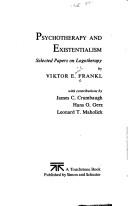
Selected papers positioning logotherapy within the existential and humanistic psychotherapy of its time, including his responses to critics. The most academic book of the three and the place where the theory is defended rather than asserted.
The later restatements
IntermediateFollow what Frankl did with the ideas over the following four decades, including the turn toward religion, and notice where the argument becomes less falsifiable as it broadens. This stage also covers logotherapy in applied use, which is where most contemporary interest in Frankl actually lives.
▸ Study plan for this stage
Pace: Five to six weeks. Three lengths are recorded here — Man's Search for Ultimate Meaning at 192pp, The unheard cry for meaning at 207pp and Pattakos's Prisoners of Our Thoughts at 208pp, which is 607 pages between them — while The feeling of meaninglessness carries no page count in our catalogue; allo
- The existential vacuum as it broadens from a clinical presentation to a cultural diagnosis
- Unconscious religiousness, and what kind of claim it is
- Falsifiability: how a proposition loses testable content as its scope widens
- Frankl's argument with the humanistic psychology dominant in America at the time
- The move from treating patients to diagnosing a society, and what evidence that move would require
- The popular afterlife: logotherapy as workplace and personal-development advice, and what is dropped in translation
- What is unconscious religiousness, and by what evidence does Frankl claim to have found it?
- Where exactly does the theological commitment enter, and could the clinical theory stand without it?
- How does the existential vacuum change between the clinical books and the cultural essays?
- What is Frankl's objection to humanistic psychology, and does he engage its evidence or its outlook?
- What does Pattakos keep from logotherapy and what does he drop? Name three of each.
- Take one late claim and say what would falsify it. If nothing would, say so plainly.
- Trace the existential vacuum through every book you have read so far and record how its definition changes at each appearance.
- For three claims in Man's Search for Ultimate Meaning, write what evidence Frankl gives and what evidence the claim would actually require.
- Take a chapter of Pattakos and identify the clinical proposition underneath each piece of advice. Note where there is none.
- Add a fourth column to your running document: claims that have become unfalsifiable as stated.
Next up: The ideas are now traced from testimony to therapy to cultural diagnosis, which leaves the man himself and the account he gave of his own life.
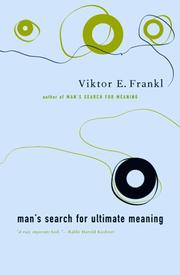
The expanded version of his 1948 The Unconscious God, on the unconscious religiousness he claimed to find in patients. The most explicitly theological book in the corpus and the one where the boundary between clinical claim and metaphysical commitment is thinnest — worth reading for exactly that reason.

Essays applying logotherapy to the mass meaninglessness he saw in affluent post-war societies, and his answer to the humanistic psychology then dominant in America. A good gauge of how far he extended a clinical theory into a diagnosis of a whole culture.

A late collection assembling his writing on the existential vacuum, edited and published in English in 2010. Useful as a compendium of the mature position, though it repeats material from the earlier books and is best read after them.
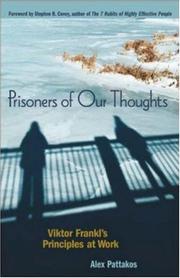
Logotherapy translated into workplace and personal-development advice, and a fair representative of how Frankl is mostly used today. Secondary and firmly in the self-help register — included so you can see the gap between the clinical proposal and its popular afterlife, not as evidence for either.
The life, and what the historians found
IntermediateClose with biography and with the scholarship that has questioned parts of Frankl's own account — the timeline of when he was deported, how long he spent in which camps, his professional conduct in Vienna before deportation, and how the memoir's composition history was described. Hold two things at once: he was a survivor whose testimony stands, and some of the story around the book has been shown to be less straightforward than the standard telling.
▸ Study plan for this stage
Pace: Five weeks for 736 pages, read in a deliberate order: his own account first, then the sympathetic biography, then the critical one. Recollections (144pp) is his late autobiography and takes under a week — read it before anything that tests it, so that you meet the account he gave in his own voice. K
- The difference between disputing a survivor's testimony and disputing the biography built around it
- Authorised access as both a source of unique material and a constraint on what gets asked
- Archival reconstruction as a method, and what it can establish that memoir cannot
- Disagreement on fact versus disagreement on interpretation, and why the distinction has to be made case by case
- Composition history: when a book was written, and why that matters to how it is read
- Reading a contested biography without adjudicating a dispute you are not equipped to settle
- What account does Frankl give of the composition of the 1946 book, and what do his biographers say?
- On which specific points do Klingberg and Pytell disagree about fact?
- Where do they agree on the facts and differ only on what those facts mean?
- What does Pytell's archival material add that neither the memoir nor the authorised biography contains?
- Does anything in this stage bear on whether logotherapy works? Say why or why not.
- State, in three sentences, what you now hold to be established, what is contested, and what you cannot judge.
- Build a single timeline of Frankl's life from Recollections, then annotate every entry that Klingberg or Pytell dates differently, citing each.
- For each contested point, write two columns — what both biographers accept, and what only one asserts — and leave the second column unresolved.
- Return to the witnessed column of your stage-one document and check whether anything in this stage touches it. Record the answer either way.
- Write 800 words on how to cite Frankl responsibly: what the testimony supports, what the therapy has behind it, and what belongs in a clause rather than a claim.
Next up: You can now use Frankl precisely — as a witness where he witnessed, as a clinician whose method has a thin evidence base, and as a figure whose biography is still argued over.

His own late autobiography, covering the Vienna years, the camps and the decades of lecturing afterwards. Read it first in this stage so you know the account he gave before you read anyone testing it.

The authorised biography of Viktor and Elly Frankl, written with their cooperation and full of material available nowhere else. Sympathetic by construction — its access is exactly what makes it both valuable and partial. Secondary.

The critical scholarly biography, working from archives to reconstruct Frankl's career under the Nazi regime and to question elements of the received story. Contested by Frankl's supporters and the necessary counterweight to Klingberg — read the two together and note where they actually disagree on fact rather than on interpretation. Secondary.
Discussion
Keep reading
Paths that share books, cover the same subject, or open a related topic.