Understanding Pierre Bourdieu: books to read, in order
Bourdieu built a single conceptual machine — habitus, field, capital — and then ran it over education, taste, art, academia, language, photography, housing and television. The difficulty is that the machine is explained least clearly in the books where it is first assembled, and most clearly in the books where it is being used. So this path starts with two secondary guides, meets the theory in the two Algeria-derived books that generated it, and only then goes to Distinction and the studies of particular fields. All the primary texts are translated from French, and one of them is catalogued here under its French title; the notes say which.
Two ways in
BeginnerGet habitus, field, cultural capital and symbolic violence defined plainly, and understand the ambition — to dissolve the opposition between structure and agency rather than pick a side — before reading Bourdieu's own famously difficult prose. Both books here are secondary literature.
▸ Study plan for this stage
Pace: Three weeks for 551 pages, and the only stage where you can read at a normal pace. Jen Webb's Understanding Bourdieu is 209 pages, written for readers coming from cultural and media studies, and full of concrete examples — a week, and the right book if you have never read social theory. David Swartz
- Habitus: durable dispositions produced by conditions of existence and generating practice without conscious rule-following
- Field: a structured space of positions with its own stakes, entry conditions and internal logic
- The forms of capital — economic, cultural, social, symbolic — and their convertibility
- Symbolic violence: domination that is misrecognised as legitimate by those it operates on
- Doxa and the naturalised, unquestioned order of a field
- The ambition to dissolve the structure-agency opposition rather than choose a side
- Reflexivity: the researcher's own position as data rather than as a vantage point
- Define habitus without using the words structure or agency. What work is the concept doing?
- How does cultural capital differ from taste, and what makes it capital rather than preference?
- What distinguishes symbolic violence from ideology in the classical Marxist sense?
- What is the standard objection that Bourdieu's system is deterministic, and how does Swartz say he answers it?
- Why is a field not the same as an institution or a market? Give a case where the distinction matters.
- Write your own definition of each of the seven terms above from Webb, then rewrite each from Swartz. Where the two differ, note it — those differences are where the concept is genuinely unsettled.
- Take a setting you know well — a workplace, a scene, a school — and describe it as a field: what the stakes are, what counts as capital there, who is dominant and by what.
- Swartz devotes attention to how the concepts developed over time. Sketch that development as a timeline and mark which books on this path belong at each point.
- Write down the strongest objection to Bourdieu you can find in Swartz, in one sentence. Keep it and test it against every primary text from here on.
Next up: With the machinery named and defined, the next stage takes you to where it was built — and to the hardest prose on the path.

The most approachable short introduction, written for readers coming from cultural and media studies, and unusually good at giving concrete examples of each concept. Start here if you have never read any social theory.

The best single scholarly account of the whole sociology, tracing how the concepts developed and taking the standard criticisms seriously. Read second; it is the book to return to whenever a primary text stops making sense. Catalogued with an ampersand as Culture & Power.
The theory of practice
BeginnerMeet the theory where it was made — in the confrontation between Bourdieu's Algerian ethnography and the structuralism he was trained in — and understand habitus as the answer to why people reproduce structures they never chose and mostly cannot articulate. This is the hardest primary reading on the path.
▸ Study plan for this stage
Pace: Eight weeks for 913 pages, and the page count badly understates it. Outline of a theory of practice is 248 pages and is the book on this path readers abandon: the sentences are long, heavily qualified, translated from a French already written against the grain, and the argument is conducted simultan
- The critique of structuralism: the model of practice is not the practice, and Levi-Strauss mistook one for the other
- The three modes of theoretical knowledge — phenomenological, objectivist, praxeological — and why Bourdieu wants the third
- Habitus as the answer to why people reproduce structures they never chose and cannot articulate
- The Kabyle house and the analysis of inverted homologies, the set-piece of The Logic of Practice
- Practical sense (le sens pratique) and the feel for the game, as against rule-following
- Time and strategy in gift exchange: the interval between gift and counter-gift is what makes it not an exchange
- Participant objectivation and the reflexive turn as Bourdieu states it to Wacquant
- What exactly is Bourdieu's objection to Levi-Strauss, and does it apply to all structuralism or only to a version of it?
- Why does the timing of a counter-gift matter so much, and what does the example establish about the limits of rule-based explanation?
- How can habitus be both structured and structuring without the account being circular?
- What does the Kabyle house analysis demonstrate that a verbal statement of the theory does not?
- In the Invitation, which of his own concepts does Bourdieu concede are most often misunderstood, and what does he say the misunderstanding is?
- Return to the objection you recorded in stage one. Does the primary text answer it?
- Read the Outline's preface and first chapter, then read Swartz on the same material, then return to the primary text. Track how much more you get on the second pass; this is the technique for the rest of the stage.
- Diagram the Kabyle house from The Logic of Practice yourself, with the oppositions marked, then write what the diagram cannot show — which is precisely Bourdieu's argument against diagrams.
- Take the gift-exchange analysis and apply it to a reciprocal practice in your own life. Time the intervals. Note what would be violated by making the exchange explicit.
- In the Invitation, find the passages where Wacquant presses Bourdieu on determinism and write out whether the answer satisfies you.
- Write one page of your own prose explaining habitus to a stranger. If you cannot do it without quoting, go back to the Invitation.
Next up: The machine is now assembled; the next stage is where it gets run over the questions that made Bourdieu famous.

The founding statement, built on Kabyle fieldwork and aimed squarely at Levi-Strauss: structuralism describes the model of practice, not practice itself. Difficult prose and worth pushing through, because every later book assumes it.

The rewritten and considerably clearer version of the same argument, with the crucial essay on the Kabyle house and a fuller account of habitus. Read it directly after the Outline, as the second pass Bourdieu himself thought was needed.
Bourdieu with Loic Wacquant, explaining his own concepts in dialogue and in plain answers to direct questions — including the reflexive turn, that the sociologist's position in the academic field is itself data. The clearest exposition of the system in Bourdieu's own voice; read it last in this stage as consolidation.
Taste, schooling and social reproduction
BeginnerSee the machine applied to the questions Bourdieu is famous for: how aesthetic judgement encodes class position, how schools convert inherited cultural capital into apparently earned merit, and how language itself distributes authority.
▸ Study plan for this stage
Pace: Eight weeks for 1,196 pages. Distinction A Social Critique Of The Judgement Of Taste is 640 of them and it is the longest book on the path: survey tables, correspondence-analysis diagrams and a running commentary on 1960s French consumption. It is not conceptually as hard as the Outline, but it is e
- Taste as a marker and a weapon of class position rather than an individual property
- The claim that disinterested aesthetic pleasure is itself a class position, and the reading of Kant's aesthetics it depends on
- Cultural capital in its embodied, objectified and institutionalised states
- The school as a converter: inherited cultural advantage transformed into apparently earned academic merit
- Pedagogic action as symbolic violence, in Bourdieu and Passeron's formal statement
- The linguistic market: an utterance's force derives from the speaker's authority and the setting, not from the sentence
- The social space and the space of lifestyles as two maps of the same structure
- Why the 1960s French data limits the findings but not necessarily the argument
- State Bourdieu's claim about the Kantian aesthetic. What would it take to refute it?
- How does the school convert inheritance into merit, step by step, in Reproduction's account?
- What is the difference between saying taste correlates with class and saying taste is a class practice?
- Language and symbolic power says a sentence's force is not in the sentence. What linguistic theories does that reject, and what does it require instead?
- How much of Distinction's argument depends on the specific French data, and how would you test it elsewhere?
- Is symbolic violence compatible with the dominated having accurate knowledge of their own position?
- Take one of Distinction's correspondence diagrams and translate it into a paragraph of plain prose. Then translate a paragraph of Bourdieu's prose into a diagram. The two directions are not equally easy, and the asymmetry is informative.
- Design the survey you would run to test Distinction's central claim in your own country today, and note which questions would no longer work.
- Read one numbered proposition from Reproduction and expand it into an ordinary paragraph. Do this three times, then decide what the austere form was for.
- From Language and symbolic power, analyse one real speech situation — a courtroom, a classroom, a job interview — for where authority is coming from.
- Trace cultural capital across all three books and write down each new specification it acquires.
Next up: Taste and schooling were applications; the next stage takes up the concept that has proved most portable of all, and turns it on Bourdieu's own profession.
The central work: a survey-based demonstration that taste in food, music, furniture and film maps onto class fraction, and that claiming disinterested aesthetic pleasure is itself a class position. Long, statistical, and rooted in 1960s France, so read the argument rather than the data; the catalogue also holds it under the French title La distinction.

With Jean-Claude Passeron, the argument that the school's real function is to convert social inheritance into academic merit while appearing neutral, and that this is symbolic violence. Written in a deliberately austere theorem-and-proof style; the catalogue record displays under the bare title Reproduction.
On the linguistic market: an utterance's force comes from the speaker's authority and the setting, not from the sentence. Placed here because it extends the reproduction argument from schooling into every act of speech, and it includes John Thompson's excellent editorial introduction.
Fields: art, literature and the academy
BeginnerUnderstand the field concept properly — a structured space of positions with its own stakes and its own inverted economy where disinterestedness pays — through the three fields Bourdieu analysed at book length, including the one he was himself in.
▸ Study plan for this stage
Pace: Six weeks. The field of cultural production is 323 pages of collected essays and is the right entry to this stage precisely because it is essays rather than a treatise — two weeks, and read the essay on the inverted economy of the avant-garde first. Our record for The Rules of Art carries no page co
- A field as a structured space of positions, with position-takings that only make sense relationally
- Autonomy and heteronomy: the degree to which a field imposes its own criteria against external ones
- The inverted economy of the restricted field, where commercial failure converts into symbolic profit
- Consecration and the agents who perform it — critics, prizes, academies, publishers
- Flaubert and the invention of the autonomous literary position, as The Rules of Art reconstructs it
- Homology between the field of production and the field of consumption, which links this stage back to Distinction
- Participant objectivation carried out on one's own field, which is what Homo academicus actually is
- What makes a field autonomous, and how would you measure the degree of autonomy of a field you know?
- Explain the inverted economy without using the word paradox. What is the mechanism?
- How does Bourdieu use Flaubert — as evidence, as illustration, or as a case that constitutes the argument?
- In Homo academicus, what does turning the method on his own institution cost Bourdieu analytically, and what does it gain?
- Does the field concept require conscious strategy on the part of agents? Point to where Bourdieu says so.
- Where does the field concept overlap with what economists mean by a market, and where does it definitively part company?
- Map a contemporary cultural field — literary fiction, a music scene, academic philosophy — with poles of autonomy and heteronomy, and place actual actors on it.
- Read the avant-garde essay in The field of cultural production and then find a present-day case where commercial failure has produced symbolic profit. Write the mechanism out.
- Apply Homo academicus to an institution you belong to, including your own position in it. Then write what you were tempted to leave out — that reluctance is the reflexive problem in action.
- Set the account of the literary field in The Rules of Art beside the account of taste in Distinction and write how the homology between production and consumption is supposed to work.
Next up: The final stage is what happens when a sociologist of this kind turns to public argument and to people who are not artists or academics.

The collected essays that set out the field concept most usably, including the inverted economics of the avant-garde where commercial failure is symbolic profit. The best entry to this stage because it is essays rather than a treatise.

The full-length study of how the French literary field became autonomous in the nineteenth century, worked out through Flaubert's Sentimental Education. Read after the essays; it is the sustained demonstration of what they sketch.

Bourdieu turning the apparatus on the French university system and on his own colleagues, published in the aftermath of 1968. The reflexive move from stage two made concrete, and the most uncomfortable book he wrote.
The late, public Bourdieu
IntermediateFollow the shift in the 1990s from academic sociology to public intervention against neoliberalism, and see the method used to give an account of ordinary suffering rather than of elites.
▸ Study plan for this stage
Pace: Three weeks for 760 pages, and the most humane reading on the path. The Weight of the World is 656 pages, a large collective volume of interviews with teachers, police officers, immigrants, factory workers and unemployed people, each framed by a short sociological commentary. It is designed to be di
- The suffering of position (la misere de position) as distinct from material deprivation
- The interview as a sociological method with its own violence, which Bourdieu discusses explicitly in the methodological appendix
- Neoliberalism as a political project analysed with the same apparatus used for taste and schooling
- The journalistic field: how competition for audience produces conformity while every participant feels free
- Structural constraint and the way it is experienced as personal failure by those subject to it
- The transition from academic authority to public intervention, and the criticisms it drew from both directions
- What is positional suffering, and why does Bourdieu think it needs a name of its own?
- In the methodological appendix to The Weight of the World, what does he say the interview does to the person interviewed?
- How does the journalistic field produce homogeneity through competition rather than despite it?
- Is the late public Bourdieu consistent with the reflexive sociologist of stage two, or is there a genuine change of position?
- Which of the interviews most resists the commentary attached to it, and what does that tell you about the method?
- Read three interviews in The Weight of the World with their commentaries covered, write your own analysis, then read Bourdieu's. Compare.
- Apply the argument of On television to a current media environment he did not live to see, and decide which parts of the analysis transfer and which were specific to broadcast.
- Write a 600-word answer to the question the path opened with: what does the machine of habitus, field and capital explain that its rivals do not, and where does it overreach? Cite at least one book from each stage.
- Return to your stage-one definitions of the seven terms and rewrite them all from memory. The gap between those two documents is the measure of the path.
Next up: This is the end of the path: the concepts are now yours to use, and the last thing Bourdieu would want is for you to use them on everyone except yourself.
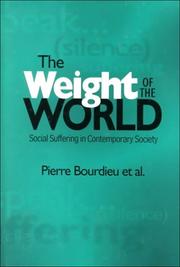
A large collective book of interviews with people at the sharp end of French social change — teachers, police, immigrants, the unemployed — each framed by a short sociological commentary. The most humane thing in the corpus and the most readable; dip rather than read cover to cover.

Two short lectures, delivered on television, on how the journalistic field's structure produces conformity while everyone in it feels free. A brisk final book that shows the field concept doing polemical work in public.
Discussion
Keep reading
Paths that share books, cover the same subject, or open a related topic.