Understanding Isaiah Berlin: books to read, in order
Isaiah Berlin wrote almost no books. He wrote essays, lectures and letters, and the shape of his thought has to be assembled from them — which is why a reading order matters more here than for a philosopher who published treatises. This path starts with the two or three essays everyone reads, then works through the argument about liberty, then the Counter-Enlightenment thinkers Berlin spent his career recovering, and finally the Russian writers and the man himself. Primary texts dominate; two secondary books are included and labelled, because Berlin's essays are seductive enough to read without noticing what is being claimed.
The essays everyone starts with
BeginnerMeet Berlin's voice and his central preoccupation — that human ends are many, and some of them are genuinely incompatible — through the short pieces that made his reputation, and get a scholarly account of what the position actually commits him to.
▸ Study plan for this stage
Pace: Four weeks, 1,019 pages, but the difficulty here is the opposite of the usual one. Berlin's prose is fluent and generous and you can read 60 pages an evening without effort — which is precisely the problem, because the arguments slide past. The hedgehog and the fox is 96 pages and can be read in a s
- Value pluralism: that genuine human goods are many and some are incompatible, so not all can be realised together
- The distinction between pluralism and relativism, which Berlin insisted on and which Crowder tests
- The hedgehog and the fox as a claim about intellectual temperament and about Tolstoy's own divided mind
- Berlin's suspicion of any single unifying system as the common root of the whole corpus
- Monism as the shared assumption Berlin traces from Plato through the Enlightenment
- Crowder's central objection: that pluralism does not obviously entail liberalism rather than some other politics
- What is Berlin actually arguing about Tolstoy, as distinct from the epigram everyone quotes?
- Give two goods you take to be genuinely incompatible. Does that make you a pluralist in Berlin's sense, and what more would you need to believe?
- How does Berlin distinguish pluralism from relativism, and does Crowder think the distinction holds?
- Why would a monist think value conflicts are failures of understanding rather than features of the world?
- If pluralism is true, what argument gets you from there to liberal institutions? State Crowder's version of the gap.
- Check the table of contents of The proper study of mankind against the rest of this path and mark which pieces you will already own separately. Decide now which route you are taking, because the overlap is substantial.
- Read The Hedgehog and the Fox, then write the counter-case: what would someone say who thinks Tolstoy's philosophy of history is right rather than a hedgehog's mistake?
- Take Crowder's statement of the pluralism-to-liberalism gap and try to close it yourself in one page before reading his assessment of the existing attempts.
- Pick one essay in the anthology you find persuasive and underline every sentence that is doing rhetorical rather than argumentative work. This habit is the point of putting Crowder first.
Next up: Pluralism is the premise; the next stage is the political argument Berlin built on it and spent the rest of his life defending against critics.
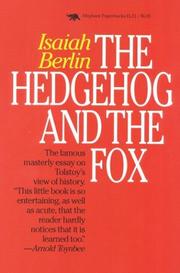
The famous essay on Tolstoy, built on the line about the fox knowing many things and the hedgehog one big thing. Short, brilliant, and the cleanest introduction to Berlin's suspicion of single unifying systems; note the catalogue record carries a nonsense publication year, which is metadata noise rather than a different book.
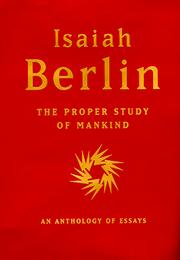
The one-volume anthology of the best essays, and the most efficient way to read a lot of Berlin quickly. Be aware that it reprints both The Hedgehog and the Fox and Two Concepts of Liberty, so it overlaps with the book above and the next stage — many readers use this volume instead of buying those separately.
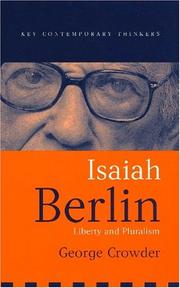
Secondary literature, and the best short scholarly guide: Crowder sets out value pluralism carefully and presses the hardest objection, that pluralism does not obviously support liberalism rather than something else. Read it now so the primary essays are read critically rather than admiringly. Catalogued under the bare title Isaiah Berlin.
Two concepts of liberty
IntermediateWork through Berlin's most consequential argument: the distinction between negative liberty (freedom from interference) and positive liberty (self-mastery), and his claim that the positive concept has historically been turned into a justification for coercing people toward their 'real' selves.
▸ Study plan for this stage
Pace: Four to five weeks for 807 pages. Four Essays on Liberty is 263 pages and the central primary text of the path; the essay itself is a single sitting, but the long introduction Berlin wrote to answer his critics is where he concedes and refines, it is routinely skipped, and it is worth as much time a
- Negative liberty as the absence of interference by others, and the specific way Berlin defines the area rather than the agent
- Positive liberty as self-mastery, and the historical transformation by which the true self becomes something a state can know better than you do
- Berlin's claim that the danger is not in the positive concept itself but in a particular chain of moves from it
- The concessions in the introduction to Four Essays, particularly on whether liberty and the conditions for exercising it can be separated
- The six enemies of freedom in Freedom and Its Betrayal — Helvetius, Rousseau, Fichte, Hegel, Saint-Simon, de Maistre — as case studies rather than abuse
- The pursuit of the ideal as the essay in which pluralism and the liberty argument are finally joined
- De Maistre as Berlin's most disturbing subject: read as a precursor of fascism rather than as a reactionary curiosity
- State the two concepts precisely. What does Berlin say is the question each answers?
- What is the strongest objection to Berlin's account of positive liberty, and where in the introduction does he answer it?
- Is poverty an obstacle to negative liberty on Berlin's definition? Trace exactly how he handles the case.
- Which of the six figures in Freedom and Its Betrayal is treated least fairly, and what would a defender say?
- How does The Crooked Timber of Humanity move beyond the liberty essay rather than restating it?
- Berlin says pluralism supports negative liberty. Reconstruct the argument and then apply Crowder's objection from the last stage.
- Read the introduction to Four Essays on Liberty first, before the essay it introduces, and list every concession you find. Then read the essay and see how many of the concessions were needed.
- Take one of Berlin's lectures in Freedom and Its Betrayal and go back to the original thinker's own statement of the position. Judge whether the lecture is a portrait or a caricature.
- Write out the chain of moves by which self-mastery becomes coercion, step by step, and mark which step you consider avoidable.
- Apply the negative-positive distinction to a real policy dispute and see whether it clarifies anything. Where the distinction fails to help, ask whether that is Berlin's problem or the case's.
Next up: Berlin's case against the positive concept rests on a history of ideas, and the next stage is where he spent thirty years assembling it.
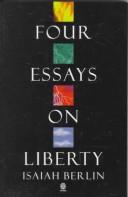
The volume containing Two Concepts of Liberty, along with Historical Inevitability and the long introduction Berlin wrote to answer his critics. The central primary text of the path; the introduction is where he concedes and refines, and is routinely skipped.
Six BBC lectures on Helvetius, Rousseau, Fichte, Hegel, Saint-Simon and de Maistre as enemies of freedom — spoken prose, transcribed, and far easier than the essays. It supplies the historical case studies behind the positive-liberty warning.
The mature statement of pluralism, including The Pursuit of the Ideal and the essay on de Maistre and fascism, organised around Kant's line that nothing straight was ever made from the crooked timber of humanity. Read after Four Essays: it assumes the liberty distinction and pushes past it.
The Counter-Enlightenment
IntermediateFollow Berlin's lifelong project of recovering the Enlightenment's opponents — Vico, Herder, Hamann, de Maistre — not to endorse them but to show that the idea of a single rational answer to how to live was contested from the start. This stage is the scholarly core and the least read part of the corpus.
▸ Study plan for this stage
Pace: Six weeks for 1,009 pages, and the least-read part of the corpus for a reason: these essays are about eighteenth-century figures most readers have not met, so you are learning Vico, Herder, Hamann and de Maistre and Berlin's reading of them simultaneously. Vico and Herder is 228 pages and the hardes
- The Counter-Enlightenment as Berlin constructed it — a category he did much to invent, which is itself a matter of scholarly dispute
- Vico's verum factum: we can know history in a way we cannot know nature, because we made it
- Herder on expressionism, populism and the incommensurability of cultures — the source of Berlin's own pluralism
- Hamann's total revolt against systematic reason, and the point at which Berlin's sympathy visibly strains
- The Machiavelli essay's thesis: the scandal is not immorality but the discovery that Christian and pagan virtue cannot both be had
- Romanticism as the moment the West stopped believing moral questions have discoverable right answers
- The distinction between recovering a thinker and endorsing them, which this stage is a sustained exercise in
- What does Vico mean by claiming we can know only what we have made, and what does Berlin take from it?
- How does Herder's cultural pluralism differ from relativism, and is Berlin's answer here the same as the one he gives in his own voice?
- Why is the Machiavelli essay the one Berlin himself thought most important, and what does it establish that the others do not?
- Berlin has been criticised for inventing the Counter-Enlightenment as a unified movement. What is the strongest form of that criticism?
- The roots of romanticism ends somewhere quite dark. What is the connection Berlin draws between romanticism and twentieth-century politics, and how careful is he about it?
- Read the Machiavelli essay and then write, in one page, the case that Berlin has extracted a pluralism from Machiavelli that Machiavelli did not hold.
- For Vico, Herder and Hamann, write a single sentence each stating what Berlin thinks they got right and one stating what he thinks they got wrong. The second sentence is harder and is the point of the exercise.
- Track the word 'incommensurable' across Vico and Herder, Against the Current and The Crooked Timber of Humanity from the previous stage. Berlin does not always use it identically.
- Listen for the shift in register in The roots of romanticism — these were spoken. Mark three places where the lecture form lets an argument through that would not survive being written down.
Next up: The Counter-Enlightenment gave Berlin his philosophy; the Russian intellectuals of the next stage gave it its politics and its emotional weight.

The two studies that ground everything else here: Vico on the historicity of human self-understanding, Herder on cultural pluralism and the incommensurability of ways of life. Read first in this stage, because the later essays assume both.
Berlin on J. G. Hamann, the most extreme irrationalist of the eighteenth century, and the book where his sympathy for the Counter-Enlightenment is most visibly strained. Note that Vico and Herder and this volume were later reissued together as Three Critics of the Enlightenment, which is the same material in one book.
Essays on Machiavelli, Montesquieu, Sorel, Marx and others swimming against their intellectual moment. The Machiavelli essay is the one that matters most: Berlin argues Machiavelli's real scandal was discovering that Christian and pagan virtue cannot both be had.
The Mellon Lectures, on Romanticism as the moment the West stopped believing that moral questions have discoverable right answers. Delivered without notes and the most exhilarating thing Berlin produced; the right place to end this stage because it draws the whole Counter-Enlightenment thread together.
Russia, portraits, and the life
IntermediateRead the other half of Berlin — the essays on Russian intellectuals that are the closest he came to a sustained book, the short portraits of people he knew, and a biography that connects the Riga-born emigre to the pluralist philosopher without collapsing one into the other.
▸ Study plan for this stage
Pace: Four weeks, 951 pages, and the most enjoyable stage on the path. Russian Thinkers is 312 pages and the closest Berlin came to writing a sustained book — read it first and take a fortnight, because the essays on Herzen and on the Russian intelligentsia's predicament carry the whole argument of the pa
- The Russian intelligentsia as a type: a class defined by ideas and by its distance from both state and people
- Herzen as Berlin's hero, and why a thinker who refused to sacrifice the present generation to the future is the emotional centre of the corpus
- Belinsky, Bakunin and Turgenev as three answers to the same predicament, and Berlin's clear preferences among them
- The 1945 Leningrad meeting with Akhmatova, and what it cost her
- The relation between the emigre and the philosopher — Ignatieff's central question, and the temptation to collapse one into the other
- Berlin's own political positions, including on Zionism, as the biography rather than the essays record them
- What is Herzen's objection to sacrificing the living for a future good, and how does it connect to the pluralism of stage one?
- Why does Berlin treat Turgenev's hesitation as a virtue rather than a failure of nerve?
- Personal impressions is affectionate about nearly everyone in it. Where does the affection cost the portrait something?
- Does Ignatieff succeed in connecting the life to the thought without reducing either to the other? Point to a specific chapter.
- Having read the whole path, what would you say Berlin's central claim is — and which single essay would you hand someone as the best case for it?
- Read the Herzen essays in Russian Thinkers alongside The pursuit of the ideal from The Crooked Timber of Humanity, and write what each supplies that the other lacks.
- Take the Akhmatova chapter in Personal impressions and Ignatieff's account of the same meeting, and note every difference in what is included.
- Using Ignatieff, list three occasions where Berlin declined to press an argument he believed in. Then decide whether that is pluralism in practice or evasion.
- Write your own answer to Crowder's objection from stage one, using material drawn from all four stages. This is the exam the path has been setting.
- Assemble a five-piece Berlin reader for someone with a month to spare, and justify each choice in a sentence.
Next up: This is the last stage: with the life, the Russians and the Counter-Enlightenment behind you, the essays you started with read as parts of one argument rather than as brilliant occasional pieces.
Herzen, Belinsky, Turgenev, Bakunin and Tolstoy, written by someone who read them in Russian and understood the political stakes from the inside. This is where Berlin's liberalism gets its emotional weight, and Herzen is plainly his hero.
Portraits of Akhmatova, Pasternak, Churchill, Roosevelt, Weizmann and others he met. The 1945 Leningrad meeting with Akhmatova is a piece of twentieth-century history in its own right and reads as Berlin's most personal writing.
Secondary, and the authorised biography — published as Isaiah Berlin: A Life — drawn from ten years of taped conversations. Read last: it is best as a rereading of a body of work you already know, and it is candid about the accusation that Berlin's charm did some of his arguing for him.