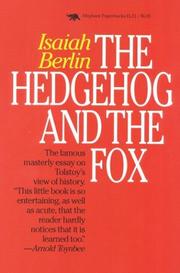
Start with The hedgehog and the fox, 96 pages on Tolstoy built around the line about the fox who knows many things and the hedgehog who knows one big thing. It is the cleanest introduction to Berlin's lifelong suspicion of single unifying systems. Our record for it carries a nonsense publication year of 1901, which is metadata noise rather than a different book.
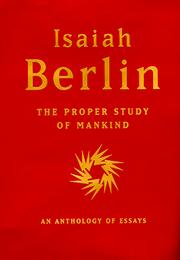
Then decide about the anthology. The proper study of mankind collects the best essays in 667 pages and is the most efficient way to read a lot of Berlin quickly — but it reprints both the Tolstoy essay and Two Concepts of Liberty, so it overlaps the book above and the next stage. Many readers buy this volume instead of the separate ones. Take one route or the other rather than both.
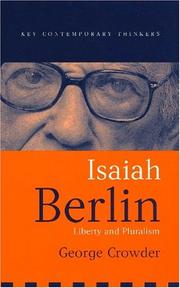
The argument itself is value pluralism: human ends are many, some of them are genuinely incompatible, and that is a permanent feature of moral life rather than a problem awaiting a solution. Read George Crowder's Isaiah Berlin, 256 pages, early — it is secondary literature, it sets out pluralism carefully, and it presses the hardest objection, which is that pluralism does not obviously support liberalism rather than something else. Berlin's prose is seductive enough that reading him without it is reading him admiringly.
Liberty
Four Essays on Liberty, 263 pages, is the central primary text: it holds Two Concepts of Liberty and Historical Inevitability, plus the long introduction Berlin wrote to answer his critics, which is where he concedes and refines and which almost everyone skips. Negative liberty is freedom from interference; positive liberty is self-mastery, and his claim is that the second has historically been turned into a licence to coerce people toward their real selves.
Freedom and Its Betrayal, 256 pages, gives the historical cases — six BBC lectures on Helvetius, Rousseau, Fichte, Hegel, Saint-Simon and de Maistre. It is spoken prose, transcribed, and far easier than the essays. The Crooked Timber of Humanity, 288 pages, is the mature statement of pluralism and assumes the liberty distinction, so read it after.
Where readers stall, and it is not the long book
The Counter-Enlightenment stage is the scholarly core and the least read part of the corpus. Vico and Herder is 228 pages and it is harder going than the anthology nearly three times its length — Vico on the historicity of human self-understanding and Herder on the incommensurability of ways of life are the foundations everything else rests on, and they are not entertaining. The magus of the north, 144 pages on the irrationalist J. G. Hamann, is where Berlin's sympathy for these thinkers is most visibly strained. Those two were later reissued together as Three Critics of the Enlightenment, which is the same material in one volume.
Against the Current, 407 pages, is easier again: essays on Machiavelli, Montesquieu, Sorel and Marx, of which the Machiavelli piece matters most, since Berlin argues the real scandal was discovering that Christian and pagan virtue cannot both be had. The roots of romanticism, 230 pages, was delivered without notes as the Mellon Lectures and is the most exhilarating thing he produced.
Russia, portraits and the life
Russian Thinkers, 312 pages on Herzen, Belinsky, Turgenev, Bakunin and Tolstoy, is where his liberalism gets its emotional weight. Check the language before you order: the ISBN on our record belongs to a French publisher, so the edition it points at may be the French translation rather than the English. Personal impressions, 277 pages, collects portraits of Akhmatova, Pasternak, Churchill and Weizmann, and the 1945 Leningrad meeting with Akhmatova is a piece of twentieth-century history in itself.
Close with Michael Ignatieff's Isaiah Berlin, the authorised 362-page biography drawn from ten years of taped conversations, candid about the accusation that Berlin's charm did some of his arguing for him. Its record credits Ignatieff three times over and adds several translators, which is a cataloguing artefact.
The ordered Isaiah Berlin path lays the same sequence out in stages, with a study plan for each.