Understanding Jurgen Habermas: books to read, in order
Jurgen Habermas is the last of the Frankfurt School's system-builders, and the reason he is hard to read is that the system arrived in instalments over fifty years: a theory of knowledge, then a theory of communication, then a theory of law and democracy, each rewriting the last. This path alternates deliberately between commentary and primary text — a path made only of Habermas is unreadable, and one made only of introductions leaves you with a summary of an argument you have never met. Each stage names which kind of book it is asking you to read and what it assumes. Note one gap stated up front: the book most people come for, The Structural Transformation of the Public Sphere, has no clean catalogue record here, so the public sphere is approached through Calhoun's scholarly collection instead.
Getting oriented before opening Habermas himself
BeginnerAcquire the map — communicative rationality, the public sphere, discourse ethics, deliberative democracy — and understand how the phases of the work relate, before reading a page of the primary texts. All three books in this stage are commentary; nothing here is Habermas's own voice.
▸ Study plan for this stage
Pace: Three to four weeks for 740 pages, and this is the only stage on the path where page count and effort are roughly proportional. Finlayson's Habermas is 178 pages written for readers with no philosophy background — two or three evenings. Outhwaite's Habermas is 208 pages and slower, because it assume
- Communicative rationality: reason as a property of speech oriented to mutual understanding rather than of a solitary consciousness
- The public sphere as a historically produced space of reasoned argument, and the thesis about its rise and decline
- Discourse ethics and the universalisation principle — a norm is valid if all affected could accept it in unconstrained discussion
- System and lifeworld, and what the colonisation thesis actually asserts
- Deliberative democracy as a standard rather than a description of any existing polity
- Why the project arrived in phases and why each phase rewrites rather than defends the last — Finlayson is unusually good on this
- The Frankfurt School inheritance and what Habermas rejected in Adorno and Horkheimer, which Outhwaite supplies
- What is Habermas's objection to Adorno and Horkheimer's account of instrumental reason, and why does it require a new theory rather than a correction?
- State the universalisation principle in your own words. What does it demand that a Kantian categorical imperative does not?
- What does 'colonisation of the lifeworld' name, and what would count as an instance of it?
- Why does Finlayson present the rebuilding of the system as a strength rather than instability?
- Which of the Cambridge Companion's contributors think the communicative turn fails, and on what grounds?
- Write a one-page glossary — communicative action, strategic action, lifeworld, system, discourse, validity claim, ideal speech situation — using Finlayson's definitions. Every later stage assumes all seven and defines none of them.
- Draw the phases as a timeline from Outhwaite: early critical theory, the linguistic turn, the legal-political work. Mark on it which books on this path belong where.
- Pick the Cambridge Companion chapter on discourse ethics and list the objections it raises before you have read any Habermas on the subject. Return to that list after stage three.
- Finlayson and Outhwaite disagree about how much continuity there is across the career. Find the passages where each states their position and decide, provisionally, which you find more plausible.
Next up: You have the map; the next stage is where you first meet the terrain, in Habermas's own prose and at its most approachable.

The most economical route into the whole project, and unusually good at explaining why Habermas keeps rebuilding rather than defending his earlier positions. Assumes no philosophy background; the Open Library record displays it under the bare title Habermas.

A longer and more sociological introduction, stronger than Finlayson on the Frankfurt School inheritance and the German intellectual context. Read second, once the shape of the argument is familiar; it is also catalogued under the bare title Habermas.

Commentary of a harder kind: specialist essays on each part of the system, including the critics. Read the chapter on whatever you are about to tackle rather than the volume straight through, and keep it beside you for the rest of the path.
The early work: knowledge, crisis and the public
IntermediateMeet Habermas's own prose in its earliest and most accessible form, and understand the pre-linguistic-turn project — the critique of positivism, the interest-laden character of knowledge, and the legitimation problems of late capitalism. These are primary texts and they assume familiarity with Marx, Weber and Adorno; the commentary from stage one is what carries you over that.
▸ Study plan for this stage
Pace: Seven to eight weeks for 1,196 pages, and this is where reading speed stops tracking page count. Toward a rational society is 132 pages of essays and the easiest primary Habermas there is — a week. Knowledge and Human Interests is 400 pages and it is the first book on this path people abandon: it ar
- The three knowledge-constitutive interests — technical, practical, emancipatory — and the sciences each grounds
- The critique of positivism as itself an ideological position, not a neutral method
- Psychoanalysis as Habermas's model of an emancipatory science, and why that model later embarrassed him
- Legitimation crisis: economic contradictions displaced into the political and cultural spheres, where they become crises of belief
- The bourgeois public sphere as Habermas historicised it, and Fraser's counter-publics objection
- Why Knowledge and Human Interests is the position the communicative turn is an escape from, not a foundation for it
- The relationship between motivation crisis and the exhaustion of inherited cultural resources
- What are the three interests, and why does Habermas think a science cannot be interest-free?
- Why did he later abandon the framework of Knowledge and Human Interests in this form, and what specifically was the problem?
- State the legitimation crisis argument as a causal chain. Where in that chain is it most vulnerable?
- What is Fraser's objection to the public sphere thesis, and how does Habermas's reply in Calhoun concede and resist it?
- Technology and Science as Ideology is the most cited essay in Toward a rational society. What is its claim, and how does it prefigure the system-lifeworld distinction?
- Read the Fraser essay in Calhoun and Habermas's reply back to back, then write the two-sentence version of each position that its opponent would accept as fair.
- Take Legitimation Crisis's schema of crisis tendencies and test it against one actual event you know well. Where does it fit and where does it strain?
- In Knowledge and Human Interests, track the argument through just the Freud chapters and write what work psychoanalysis is being asked to do. This is the load-bearing move of the book.
- The path is missing The Structural Transformation of the Public Sphere. Using Calhoun's contributors, reconstruct the original argument in one page and note explicitly which claims you are taking on their authority.
Next up: Legitimation Crisis poses the problem — a society whose norms can no longer be taken for granted — and the next stage is the two-volume answer Habermas spent the following decade building.

Short essays from the late 1960s including the classic Technology and Science as Ideology, and the most approachable entry point to the primary work. Start here rather than with a treatise.

The major early book: knowledge is always tied to human interests, and positivism's claim to be interest-free is itself ideological. Difficult, and the argument he later abandoned in this exact form — read it as the position the communicative turn was a way out of.
The 1973 argument that advanced capitalism displaces its economic crises into the political and cultural spheres, where they become crises of legitimacy. The pivot book: the problem it poses is what the theory of communicative action is built to solve.

The standard scholarly collection on the public sphere thesis, including Nancy Fraser's much-cited feminist critique and Habermas's own reply. This stands in for The Structural Transformation of the Public Sphere, whose catalogue record here resolves to a different 2023 book; Calhoun's contributors summarise the original argument thoroughly before attacking it.
The communicative turn
BeginnerWork through the central claim of the mature system: that reason is not a property of a solitary consciousness but of speech oriented toward mutual understanding, and that norms can be justified by what all affected could agree to in unconstrained discourse. This is the hardest stage and it is all primary text.
▸ Study plan for this stage
Pace: Eight weeks, and by far the hardest stage on the path even though only 422 of its pages are recorded — our record for The Theory of Communicative Action, Volume 1 carries no page count, and it is a long book on any edition. It is also the book most readers abandon: it is a reconstruction of Weber, M
- The distinction between strategic action, aimed at success, and communicative action, aimed at understanding
- The three validity claims raised in any speech act — truth, rightness, truthfulness — and how each can be redeemed
- The reconstruction of Weber's rationalisation thesis as one-sided, covering only purposive rationality
- Discourse ethics as a procedure rather than a doctrine: it tells you how a norm gets justified, not which norms are right
- The Kohlberg debt and the Kohlberg problem — moral development as a cognitive sequence, and the objections to using it
- The application question: a norm justified in general and a norm appropriate in this case are not the same judgement
- Why the theory needs Mead and Durkheim as well as Weber, and what each supplies
- What exactly does Habermas take from Weber and what does he claim Weber missed?
- Distinguish strategic from communicative action using an example where the same words could be either.
- Discourse ethics is said to be formal and empty. State the objection properly, then state Habermas's answer.
- What problem does Justification and Application solve, and why could Moral Consciousness not solve it on its own?
- If nobody is ever in an ideal speech situation, what is the ideal speech situation for?
- Where does the theory of communicative action need the material from Legitimation Crisis to be motivated at all?
- Read the introduction and the first chapter of The Theory of Communicative Action, Volume 1 twice — once for the argument, once for the structure — and write a two-page outline of what the rest of the volume is going to do. Then read on with the outline beside you.
- Take one ordinary disagreement and analyse it with the three validity claims: which claim is actually in dispute, and would settling it settle the argument?
- Reconstruct the universalisation principle's derivation in Moral Consciousness step by step, and mark the step you find weakest.
- Work one case from Justification and Application where a justified norm gives the wrong answer, then write how a rule-based ethics would handle the same case.
- Return to the objections you listed from the Cambridge Companion in stage one and answer each of them now, in Habermas's voice.
Next up: With communicative rationality in hand, the last stage takes it into two fights it was built for: against the poststructuralist verdict on reason, and into the institutions of constitutional democracy.
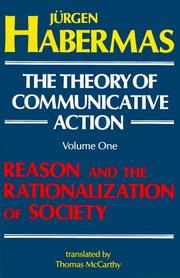
The masterwork, and the book the rest of the career rests on: a reconstruction of Weber, Mead, Durkheim and Parsons in service of a theory of communicative rationality and the colonisation of the lifeworld by system imperatives. The catalogue record here is Volume 1, Reason and the Rationalization of Society; Volume 2 exists and is where the lifeworld argument is completed.

Discourse ethics stated compactly, with the debate against Kant and against Kohlberg. Much shorter and clearer than the previous book and the best place to see what communicative rationality actually does in moral argument.

The follow-up that answers the standard objection to discourse ethics — that a norm justified in general may be wrong in the particular case. Read only after Moral Consciousness, which sets up every problem it addresses.
Modernity, law and the quarrel with postmodernism
BeginnerFollow the theory into its political and legal form, and into its most public fight. The stage covers Habermas's insistence that modernity is an unfinished project rather than an exhausted one, his argument with Foucault, Derrida and the French poststructuralists, and the reconstruction of constitutional democracy in Between Facts and Norms.
▸ Study plan for this stage
Pace: Ten weeks for 1,376 pages, and do not let the count mislead you — these are three demanding books and one of them is the heaviest object on the path. The philosophical discourse of modernity is 430 pages of twelve lectures on Nietzsche, Heidegger, Bataille, Foucault and Derrida; the difficulty is no
- Modernity as an unfinished project rather than an exhausted one — the thesis the whole stage defends
- The performative contradiction charge: a total critique of reason must use reason to make itself
- Habermas's readings of Foucault and Derrida, which are contested and have been called misreadings by their defenders
- Law as the medium translating communicative power into administrative power
- The co-originality thesis: private autonomy and public autonomy presuppose each other rather than one grounding the other
- Deliberative democracy as a two-track model — institutionalised procedures and informal public opinion
- Constitutional patriotism as an alternative to ethnic or cultural bases for political belonging
- The application of all of this to human rights, multiculturalism and postnational institutions in the final essays
- State the performative contradiction charge and the strongest reply a defender of Foucault could make to it.
- What does Habermas mean by saying law mediates between facts and norms, and what would a legal system look like that failed to?
- How does the co-originality thesis avoid both the liberal and the republican account of the relation between rights and democracy?
- In what specific sense is modernity unfinished, and what would finishing it consist of?
- The Inclusion of the Other applies the theory beyond the nation-state. Which of its arguments survive the objection that deliberation requires a shared language and a bounded public?
- Take the lectures on Foucault in The philosophical discourse of modernity and write the objection Habermas makes, then find the passage in Foucault he is quoting and judge whether the quotation carries the weight put on it.
- Map Between Facts and Norms onto the stage-one glossary: for each of your seven terms, find where the legal book uses it and note what it has come to mean by this point.
- Write the two-track model of deliberative democracy as a diagram, then place an actual piece of legislation you know onto it.
- Using The Inclusion of the Other, write Habermas's answer to a nationalist argument about political belonging in 300 words, and then the strongest counter-argument.
- Finally, return to Finlayson's summary of the whole project from stage one and mark every sentence you now consider an oversimplification. That list is the measure of what the path has given you.
Next up: This is the end of the path: the system is complete, and you are in a position to say for yourself which of its instalments you think survives.

Twelve lectures taking on Nietzsche, Heidegger, Bataille, Foucault and Derrida in turn, arguing that the critique of reason has been carried out in a self-undermining way. Contested and sometimes accused of misreading its targets, but it is the primary document of the quarrel and should be read before any account of it.

The legal-political culmination: law as the medium through which communicative power is translated into administrative power, and deliberative democracy as the standard against which constitutions are judged. Dense, and it presupposes the whole communicative apparatus from stage three.

The essays applying deliberative theory to what came after the nation-state — multiculturalism, human rights, European integration, the claims of minorities. The clearest picture of what the system is for, and the right place to end.
Discussion
Keep reading
Paths that share books, cover the same subject, or open a related topic.