Understanding Carl Schmitt: books to read, in order
Carl Schmitt was the most formidable legal theorist of the Weimar Republic, he joined the Nazi Party on 1 May 1933 and became the regime's leading jurist, and he is read today by scholars across the political spectrum. Those three facts are not in tension in the literature; they are the literature. This path is built so that the record comes first rather than arriving as a surprise halfway through: a biography and a critical reception history, then the three concept-defining texts, then the Weimar constitutional writings, then the post-1945 work on international order, and finally the argument about whether the concepts can be used without the politics. Primary texts are short but genuinely difficult, and each stage says what it assumes.
The record, before the theory
IntermediateEstablish the biographical facts before reading any Schmitt: that he joined the NSDAP on 1 May 1933, was appointed Prussian State Councillor and head of the Nazi jurists' association, published a defence of the Night of the Long Knives murders titled The Fuhrer Protects the Law, presided in 1936 over a conference on purging Jewish influence from German jurisprudence, was sidelined by the SS later that year but kept his chair, and after the war refused denazification and never recanted. Both book
▸ Study plan for this stage
Pace: Four to five weeks for 998 pages, both of them secondary literature and neither of them Schmitt. Reinhard Mehring's Carl Schmitt is 700 pages, built on the diaries and the full archive, and nobody should read all of it now: read the chapters covering 1933 to 1936 in full first — the NSDAP membership
- The documented record of 1933 to 1936, established before any of the theory is read — this is the sequence of the path and the reason for it
- Schmitt's standing before 1933 as the most formidable legal theorist of the Weimar Republic
- The Weimar constitutional crisis: Article 48 emergency rule, presidential government, and a parliament that could no longer form majorities
- Muller's reception history: how the concepts travelled through postwar European thought, first on the right and then increasingly on the left
- The distinction between explaining a reception and endorsing it, which Muller maintains and which the final stage tests
- Why 'opportunism' is not an available reading of 1933 once the diaries are in evidence
- What was Schmitt's institutional position in the Weimar republic before 1933, and who were his political patrons?
- What does Mehring's use of the diaries establish that the published writings alone could not?
- Which postwar thinkers does Muller trace as readers of Schmitt, and what did each want from him?
- Why do left-wing theorists find Schmitt's critique of liberalism useful, on Muller's account?
- What is the difference between reading Schmitt as a diagnostician and reading him as an advocate, and can the texts settle it?
- Write a dated chronology from Mehring running 1919 to 1947, with a column for what Schmitt published each year and a column for what he was doing institutionally. Keep it beside you for every primary text on this path.
- In Muller, list each stage of the reception and the specific concept being borrowed at each. You will check that list against the primary texts as you read them.
- Pick two of Mehring's diary quotations from 1933 to 1936 and write what each rules out as an interpretation of the career.
- Before reading any Schmitt, write down in one paragraph what you expect the friend-enemy distinction to mean. Return to it at the end of the next stage.
Next up: With the record and the reception established, the three short books of the next stage can be read as arguments rather than as revelations.

The standard scholarly biography, based on the diaries and the full archive, and the book that makes it impossible to treat the Nazi years as an aberration or a period of opportunism. Long, but the chapters on 1933 to 1936 are the ones to read before anything else here; the catalogue record displays under the bare title Carl Schmitt.
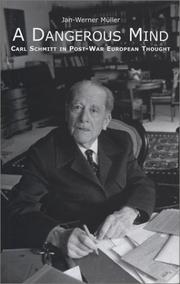
A reception history rather than a study of Schmitt himself: how his ideas travelled through postwar European thought, on the right and then increasingly on the left. Read second, because it frames the question the rest of the path keeps returning to — why people who abhor his politics keep finding his concepts indispensable.
The three core texts
BeginnerMeet the concepts Schmitt is read for: the political as the friend-enemy distinction, sovereignty as the power to decide on the exception, and the claim that parliamentary democracy rests on beliefs about discussion that nobody holds any more. These are short primary texts and they assume you know what Weimar was.
▸ Study plan for this stage
Pace: Four weeks for only 372 pages, and the ratio is the point: these are the shortest and hardest books on the path. The concept of the political is 144 pages, Political Theology is 96, The crisis of parliamentary democracy is 132, and none of them can be read at more than 15-20 pages a session with any
- The political as an autonomous criterion — the friend-enemy distinction — irreducible to morality, aesthetics or economics
- The specific claim that attempts to dissolve the political into ethics or economics are themselves political moves
- Sovereignty defined by the decision on the exception rather than by the normal legal order
- Political theology: modern political concepts as secularised theological ones, with the exception standing where the miracle stood
- Decisionism, and what it denies about the self-sufficiency of norms
- The claim that government by discussion has become a fiction, and that liberalism and democracy are separable and possibly opposed
- The role of the enemy as a public rather than a private category, which is the hinge nearly every reader gets wrong first
- State the friend-enemy distinction precisely. What kind of criterion is it claimed to be, and what would refute it?
- Why does Schmitt insist the enemy is public rather than personal, and what does that concession cost his critics?
- What is the argument that the exception reveals more than the norm, and is it an argument or an assertion?
- In The crisis of parliamentary democracy, what does Schmitt claim parliamentarism's founding beliefs were, and is his historical account of them accurate?
- If liberalism and democracy are separable, what does Schmitt think democracy without liberalism looks like?
- Compare your written prediction from the previous stage with what the friend-enemy distinction actually claims. What did you assume?
- Copy out the opening sentences of Political Theology and The concept of the political and write a paragraph of commentary on each. These two sentences carry most of what Schmitt is cited for.
- For each of the three books, write the strongest liberal reply in a paragraph, then Schmitt's rejoinder in a paragraph. The rejoinder is the harder half.
- Find every place in The crisis of parliamentary democracy where a descriptive claim shades into a normative one, and mark the transition.
- Take a present-day emergency-powers dispute and analyse it with Schmitt's vocabulary. Then write what the analysis leaves out — which is the test of whether the concepts can be borrowed.
Next up: You now have the concepts in their abstract form; the next stage shows them being applied to a specific constitution in the years it was failing.
The book to start with: politics has its own irreducible criterion, the distinction between friend and enemy, and any attempt to dissolve it into ethics or economics is itself a political move. Short enough to read in two sittings, and dense enough that you will want a third.
Opens with the most quoted sentence in twentieth-century legal theory — sovereign is he who decides on the exception — and argues that modern political concepts are secularised theological ones. Read immediately after The Concept of the Political; the two were written within five years of each other and are usually read together.

The frontal attack on liberal parliamentarism: government by discussion has become a fiction, and mass democracy and liberalism are separable and possibly opposed. Placed third because it applies the previous two books' concepts to an actual institution, and it is the text most often invoked in present-day arguments about democratic decay.
The Weimar constitutional writings
BeginnerSee the theory doing legal work in a collapsing republic — emergency powers under Article 48, the distinction between commissarial and sovereign dictatorship, and the argument that a constitution's substance can outrank its own amendment procedures. This stage requires the concepts from stage two and is the most technically legal part of the path.
▸ Study plan for this stage
Pace: Seven weeks for 1,039 pages, and the most technically legal reading on the path. Dictatorship is 288 pages and reads more like intellectual history than polemic — it works through Roman, French revolutionary and modern material — so two weeks at a steady pace. Constitutional Theory is 560 pages and
- Commissarial dictatorship, appointed to restore an existing order, against sovereign dictatorship, which founds a new one
- Constituent power (pouvoir constituant) and the claim that it is never exhausted by the constitution it produces
- The positive concept of the constitution: a fundamental political decision by a people, distinct from the constitutional laws that express it
- The argument that a constitution's substance can outrank its own amendment procedures
- Article 48 and the practice of presidential emergency government in the last Weimar years
- The equal-chance doctrine and Schmitt's case against extending it to anti-constitutional parties
- Identity and representation as the two principles Schmitt says every political form combines
- Distinguish commissarial from sovereign dictatorship with a historical case for each, taken from Dictatorship itself.
- What is the constituent power, and what stops it from being simply a name for whoever wins?
- How does the distinction between the constitution and constitutional laws license the claim that some amendments are impossible?
- In Legality and legitimacy, who is Schmitt arguing should act, and with what authority? Answer from the text, not from what happened next.
- Where in Constitutional Theory does the decisionism of Political Theology do explicit work, and where does the treatise proceed without it?
- Which of these arguments would a defender of militant democracy accept, and which must they reject?
- Reconstruct Schmitt's equal-chance argument as a numbered chain of premises, then identify which premise a constitutional democracy could deny while keeping the rest.
- Take one clause of the Weimar constitution discussed in Constitutional Theory and write how Schmitt reads it and how a normativist would.
- Put Legality and legitimacy on the chronology you built in stage one, alongside what Mehring records Schmitt doing in the same months. Write a paragraph on what the juxtaposition does and does not establish.
- Compare the account of the exception in Political Theology with the account of dictatorship here. Berlin-style summary will not do: quote both and show whether they are the same doctrine.
Next up: The republic ends here; the next stage is the work of a man excluded from academic life afterwards, in which the questions become spatial and international.

The 1921 study distinguishing the commissarial dictator, appointed to restore an existing order, from the sovereign dictator who founds a new one. It is the historical and conceptual groundwork for the state of exception, and reads more like intellectual history than polemic.
The systematic treatise, and Schmitt's most substantial single book: the constitution as a fundamental political decision by a people rather than a set of norms. Long and demanding; read after Dictatorship, which introduces the constituent-power argument it develops.

Written in 1932, months before the Nazi seizure of power, arguing that a parliamentary system that grants equal chances to parties seeking to destroy it has confused legality with legitimacy. The most chilling document here for what it is proposing and when; read it with the date in front of you.
After 1945: space, empire and the partisan
BeginnerFollow the late work, written after Schmitt's internment and exclusion from academic life, in which the questions become spatial and international: how the European order of states was constituted and dissolved, and what happens to war when the enemy is no longer a state. This stage assumes everything before it.
▸ Study plan for this stage
Pace: Four weeks for 565 pages, and the reading is unusually varied. Start with Land and sea, which is 73 pages and written for his daughter — an evening, and the easiest way into the late argument. The Nomos of the Earth in the International Law of Jus Publicum Europaeum is 372 pages and the substantial
- Nomos as appropriation, division and production — a spatial order prior to law rather than derived from it
- The jus publicum Europaeum: a European interstate order that bracketed war between recognised equals, built on the appropriation of non-European land
- The line of amity and the space beyond it where the bracketing did not apply
- The discriminating concept of war: once war is moralised, the enemy becomes a criminal and limitation collapses
- Land and sea as opposed elemental forms of world order, and the mythic register in which Schmitt makes the case
- The telluric partisan, tied to a place and a cause, and the transition to absolute enmity in Lenin and Mao
- The continuity between the friend-enemy distinction of 1932 and the partisan lecture, which is the stage's central question
- What does Schmitt claim the European order achieved, and at whose expense? Answer using his own account of the New World.
- What exactly is wrong, on his view, with a moralised international law? State it without agreeing with it.
- How does the partisan differ from a soldier and from a criminal, and why does Schmitt think the distinction is collapsing?
- Land and sea is a myth as much as an argument. What does the mythic form let him assert that a legal treatise could not?
- Is the Nomos a critique of European empire or a lament for it? Point to passages on both sides.
- Read Land and sea first and write a one-page summary of its argument. Then read the Nomos and mark where the short book was compressing and where it was simplifying.
- Apply the discriminating-concept-of-war argument to a contemporary conflict, then write the strongest objection: that limitation between recognised states was itself built on unlimited violence elsewhere.
- Trace the word 'enemy' from The concept of the political through to Theory of the Partisan and write what has changed in it.
- Using the Nomos, write the passage a defender of humanitarian intervention would find hardest to answer, and then answer it.
Next up: The primary works are behind you; the last stage is the argument about what may legitimately be done with them.
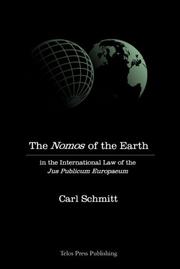
The major late work: European international law as an achievement built on the appropriation of the New World, and its collapse into a moralised, discriminating concept of war. The catalogue record carries the full published subtitle, in the International Law of the Jus Publicum Europaeum.

A short, strange, almost mythic essay on maritime and terrestrial powers as opposed forms of world order, written for his daughter. It compresses the Nomos argument into seventy-odd readable pages and is the least forbidding way into that book.
The 1963 lecture on irregular fighters from the Spanish guerrillas to Mao and the Algerian FLN, and the point at which the friend-enemy distinction is pushed toward the absolute enmity of the twentieth century. The most cited Schmitt text in contemporary writing on asymmetric war and terrorism; read it last of the primary works.
Can the concepts be separated from the politics?
BeginnerConfront directly the question the whole path raises. The stage sets a historian who argues Schmitt's antisemitism is structural to the theory against a political theorist who reads him from the left and a collection that treats him as a permanent challenge to liberalism. The point is not to settle it but to see what each side has to concede. All three books are secondary literature.
▸ Study plan for this stage
Pace: Four weeks for 922 pages, all three books secondary literature. Raphael Gross's Carl Schmitt and the Jews is 346 pages, works through the diaries and the wartime writings, and argues that the antisemitism is structural to the concepts rather than adjacent to them; read it first, over ten days, becau
- Gross's thesis: that the Jew functions in Schmitt's writing as the constitutive counter-concept, not as an incidental prejudice
- The distinction between a thinker's biography and the internal structure of their concepts, and why this case makes it hard to hold
- Balakrishnan's contextual method: reading each text against the specific political moment that produced it
- Mouffe's agonistic pluralism — antagonism converted into adversarial contest — as an attempt to use Schmitt against himself
- The instrumentalisation problem: whether a concept can be detached from the purposes it was built to serve
- What each side of this argument has to concede, which is the actual outcome the stage is after
- State Gross's argument in its strongest form, then state the strongest reply available to a reader who wants to keep the concepts.
- Where does Balakrishnan's chronological reading change the meaning of a text you read in stage two or three?
- What does Mouffe take from Schmitt and what does she have to discard? Is the discard consistent with the borrowing?
- Does the friend-enemy distinction require an existential enemy, and if it does, can it be made democratic?
- Muller predicted the shape of this reception in stage one. Having read the primary work, does his account still look right?
- Write your own answer to the stage's question in three sentences, and name the concession it costs you.
- Take one concept — the exception, the enemy, constituent power — and write how Gross, Balakrishnan and Mouffe each treat it. The divergence is the argument in miniature.
- Find a passage Gross reads as structurally antisemitic and go back to the primary text. Judge for yourself whether the reading is supported by what is on the page.
- Write the case for and against teaching Schmitt at all, in 400 words each, using material from all five stages rather than from general principle.
- Return to the reception list you made in stage one from Muller, and annotate each entry with what you now think that reader was actually taking.
- Draft the paragraph you would put at the front of any essay you write about Schmitt, stating the record and your own position on using the concepts. Every serious book on this path has one.
Next up: This is the end of the path: the question stays open in the literature, and you should now be able to hold your position in it with the primary texts and the record both in hand.
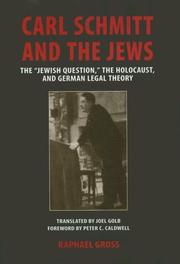
The strongest version of the case that the antisemitism runs through the concepts themselves rather than sitting beside them, traced through the diaries and the wartime writings. Read first in this stage; every defence of Schmitt has to answer it.
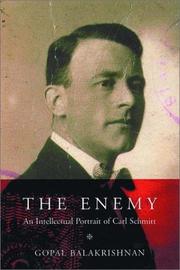
An intellectual portrait that follows the texts chronologically and in context, written from the left and neither exculpatory nor dismissive. The most useful single book for deciding what you actually think, because it stays close to what Schmitt argued in each specific moment.

The collection in which left theorists take Schmitt's critique of liberalism seriously as a challenge to answer rather than a doctrine to adopt, including Mouffe's own agonistic reworking. The right place to end: it shows the reception history from A Dangerous Mind in progress.