Carl Schmitt joined the Nazi Party on 1 May 1933. He was appointed a Prussian State Councillor and made head of the Nazi jurists' association; he published a defence of the Night of the Long Knives murders under the title The Führer Protects the Law; and in 1936 he presided over a conference on purging Jewish influence from German jurisprudence. He was sidelined by the SS later that year but kept his chair. After the war he refused denazification and never recanted. None of that is contested, and this list is ordered so you have it before you open anything he wrote.
He is nevertheless read seriously today, on the right and increasingly on the left, because his three central concepts — the political as the friend-enemy distinction, sovereignty as the power to decide on the exception, and the claim that parliamentary government rests on beliefs about public discussion nobody actually holds — have proved unusually hard to answer on their own terms. Whether those concepts can be used without the politics is a live scholarly dispute. This list ends with three books that take different sides of it; it does not settle it, because it is not settled.
The record first
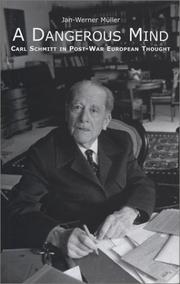
Reinhard Mehring's biography, catalogued under the bare title Carl Schmitt, is the standard scholarly life, built on the diaries and the full archive, and it makes it impossible to treat the Nazi years as an aberration or as opportunism. It runs to 700 pages; the chapters on 1933 to 1936 are the ones to read before anything else. Jan-Werner Müller's A dangerous mind is a reception history rather than a study of Schmitt himself — how the ideas travelled through postwar European thought — and it frames the question the rest of the list keeps returning to.
The three core texts
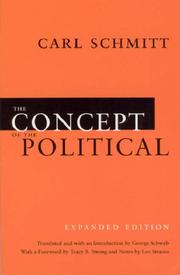
The concept of the political, 144 pages, is where to start: politics has its own irreducible criterion, and any attempt to dissolve it into ethics or economics is itself a political move. Political Theology is 96 pages and opens with the most quoted sentence in twentieth-century legal theory, on the sovereign and the exception; it belongs immediately after, since the two were written within a few years of each other and are normally read together. The crisis of parliamentary democracy, 132 pages, applies both to an actual institution, arguing that government by discussion has become a fiction and that liberalism and mass democracy are separable and possibly opposed. It is the text most often invoked in present-day arguments about democratic decay. All three are short, genuinely difficult, and assume you know what Weimar was.
The Weimar constitutional writings
This is the most technically legal stage and it needs the concepts above. Dictatorship is the 1921 study distinguishing the commissarial dictator, appointed to restore an existing order, from the sovereign dictator who founds a new one — the groundwork for the state of exception, and closer to intellectual history than polemic. Constitutional Theory is the systematic treatise and his most substantial single book at 560 pages: the constitution as a fundamental political decision by a people rather than a set of norms. Legality and legitimacy, 191 pages, was written in 1932, months before the Nazi seizure of power, and argues that a parliamentary system granting equal chances to parties seeking to destroy it has confused legality with legitimacy. Read it with the date in front of you.
After 1945
The Nomos of the Earth in the International Law of Jus Publicum Europaeum is the major late work: European international law as an achievement built on the appropriation of the New World, and its collapse into a moralised concept of war. Land and sea, 73 pages written for his daughter, compresses that argument into something almost mythic and is the least forbidding way in. Theory of the Partisan, the 1963 lecture on irregular fighters from the Spanish guerrillas to Mao and the Algerian FLN, is the most cited Schmitt text in contemporary writing on asymmetric war.
The dispute
Raphael Gross's Carl Schmitt and the Jews is the strongest version of the case that the antisemitism runs through the concepts themselves rather than sitting beside them, traced through the diaries and wartime writings. Every defence has to answer it. Gopal Balakrishnan's The Enemy is an intellectual portrait from the left, neither exculpatory nor dismissive, and the most useful book for working out what you think, because it stays close to what Schmitt argued in each specific moment. Chantal Mouffe's collection The Challenge of Carl Schmitt has left theorists treating his critique of liberalism as a challenge to answer rather than a doctrine to adopt.
The staged sequence, with a plan for each stage, is at /paths/pt_ai_understanding-carl-schmitt.