The Walking Dead Reading Order: Where to Start
The Walking Dead is one hundred and ninety-three issues collected as thirty-two numbered trade paperbacks, and the reading order is simply volume one to volume thirty-two — the comic ran continuously with no spin-offs woven into the main plot and no arc you can skip. The trap is the reprint lines: four Compendiums collect roughly eight trades each, sixteen hardcover Books collect two each, and the Omnibus and Deluxe editions renumber it again, so anyone who switches lanes mid-series will either repeat forty issues or lose them. This path stays in the trade paperback numbering the entire way. Two catalogue notes: volumes 2 and 3 are filed as The Walking Dead Volume 2 and Volume 3 rather than with a comma, and volume 16 is not catalogued in any verifiable form, so it is named in place rather than listed.
Start Here: The Farm and the Prison
BeginnerMeet Rick and the original group, and understand what the series is doing differently from every zombie film — it never cuts away when the crisis ends.
▸ Study plan for this stage
Pace: About two weeks. Each trade runs roughly 130–145 pages of Charlie Adlard's high-contrast black and white, which reads faster than prose but punishes skimming — the panel-to-panel gutters carry the time jumps. Two volumes a sitting is comfortable; six volumes in two weeks is a good pace. Read Vol. 1
- The premise inversion the whole series runs on: a zombie film ends when the survivors reach shelter, and The Walking Dead, Vol. 1 ends where a film would — everything after is the part nobody filmed
- The art change at Vol. 2. Tony Moore draws only Vol. 1; Charlie Adlard takes over permanently, and his heavier blacks and looser faces are the visual register for the next thirty volumes
- 'We are the walking dead' — Rick's speech at the close of Vol. 4 names the title, and it is an argument about the living, not the dead
- The Greene farm in Vol. 2 as the series' first false ending, and the template for every safe place that follows
- The prison in Vol. 3 and Vol. 4 as the first attempt at permanence: walls, a food supply, and immediately, governance problems
- Woodbury and the Governor in Vol. 5 and Vol. 6 as a mirror rather than an opposite — a leader who also built walls and also decides who lives
- Rick's hand, taken in Vol. 5, as the moment the book establishes that its protagonist is not protected by protagonist status
- What does Rick actually claim in the 'we are the walking dead' speech at the end of Vol. 4, and does the book endorse it or test it?
- Why does Kirkman put the farm before the prison rather than after — what does a place with no walls teach that a place with walls cannot?
- How is the Governor's Woodbury structurally similar to Rick's prison, and where does the similarity break down?
- What changes in the storytelling once Adlard takes over in Vol. 2 — not whether you prefer it, but what his line lets Kirkman do?
- By the end of Vol. 6, what has the group lost that cannot be replaced, and what have they learned to do without?
- Start a character ledger and keep it for all thirty-two volumes: name, volume introduced, volume died, who was responsible. Begin it now with Vol. 1 — by Vol. 24 it is the only way to feel the attrition rather than just read it
- Put a page from Vol. 1 (Moore) beside a structurally similar page from Vol. 3 (Adlard) — a group conversation, or a walker kill — and write down three concrete differences in how faces, shadow and backgrounds are handled
- Copy out Rick's closing speech from Vol. 4 by hand, then restate its claim in one sentence of your own words. You will want that sentence again at Vol. 21 and Vol. 32
- For each of the six volumes, write one sentence on the final page: what question does it leave open? The series is built as a serial and this makes the cliffhanger architecture visible
- Count roughly how many pages of Vol. 3 contain walkers at all. The answer surprises most first-time readers and is the fastest proof of what the book is actually about
Next up: You now have the group, the prison, and the Governor set against each other with the assault still pending — the next stage detonates all three and forces the series to rebuild itself from nothing.
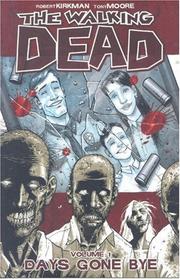
Volume one and the only starting point: Rick wakes from a coma into a collapsed world and walks to Atlanta looking for his family. Tony Moore draws only this volume, so the art shifts permanently afterwards — that is the series, not a printing error.
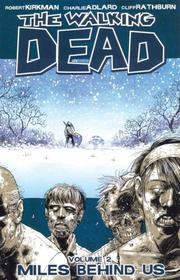
The winter road and the Greene farm, where the series establishes that its real subject is people arguing about how to live. Second, and catalogued under Volume 2 rather than Vol. 2 — the comma form pulls up an Omnibus instead.
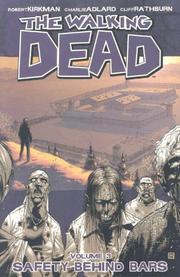
The prison, and the first sustained attempt at building something permanent. Third, and like volume two it is filed under the Volume spelling. This is where the cast becomes large enough for the deaths to hurt.
Domestic life inside the prison, and the series' first real look at what safety does to people. Fourth: the calm is doing structural work, so do not read it as filler.
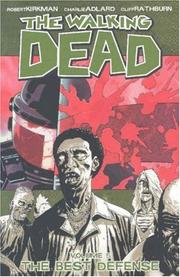
Woodbury and the Governor, the antagonist the first half of the series is built around. Fifth, and the volume most readers name as the point they were hooked.
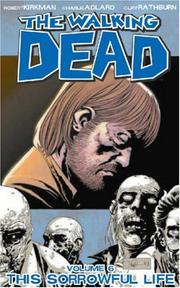
The consequences of Woodbury, and the cruellest stretch Kirkman had written to that point. Sixth — read it directly after five, they are a single arc.
The Governor, and the Road
BeginnerGet through the prison's ending and the long walk that follows, and see the series reset its own premise for the first time.
▸ Study plan for this stage
Pace: Two weeks, six volumes, but read Vol. 7 and Vol. 8 in one sitting — they are a single unit and the deliberate calm of Vol. 7 only works if the assault follows immediately. After Vol. 8 you may want a day off; take it, because Vol. 9 is written for a reader who has had one.
- Vol. 7 as engineered comfort: weddings, domesticity and future plans placed directly before the assault, and the reader's investment is the weapon
- The prison assault in Vol. 8 as the series' first structural break — after it, the cast, the location and the tone are all different, and Kirkman never rebuilds the same shape twice
- Rick's collapse and recovery in Vol. 9, which takes real narrative time rather than one page of resolve. This is the single clearest demonstration of what the serial format gives Kirkman that a film cannot
- Carl's promotion from child-in-danger to co-protagonist across Vol. 9 through Vol. 12
- The Washington mission in Vol. 10 as a direction rather than a destination — the group needs a heading more than it needs a cure
- The Hunters in Vol. 11 as the moral floor: the first antagonists Rick's group destroys pre-emptively and without hesitation, which tells you what six volumes have made of them
- Alexandria at the end of Vol. 12 as the first walled community that was already working before they arrived
- Why does Kirkman stage the two biggest losses of Vol. 8 in a single sequence instead of separating them?
- What is Vol. 9 for? Argue why the recovery could not have been compressed into ten pages
- The Hunters arc in Vol. 11 is short and vicious. What does it establish about Rick that Woodbury did not?
- How does the pacing of the road volumes (9 through 11) differ from the settlement volumes (3 through 8) — what does the book do with characters when there is no fixed location?
- By Vol. 12, what does Rick want? Compare it to what he wanted in Vol. 3 and name the moment it changed
- Keep the character ledger current — Vol. 8 alone will add more entries than Vol. 1 through Vol. 7 combined
- Write 200 words arguing why the series restarts after Vol. 8 rather than ending there. This is the standard objection to the back half and you should be able to answer it
- For Vol. 9 through Vol. 11, mark every decision Carl makes without asking Rick, and note the volume where Rick stops correcting him
- Compare the last page of Vol. 6 with the last page of Vol. 12 and write down what the group has become in between — same exercise, sixty issues apart
- Take the Hunters sequence in Vol. 11 and write out Rick's justification as he would state it, then write out the objection. Do not resolve it; the book does not
Next up: With the group inside a functioning town and no immediate enemy, the series can finally ask its real question — how people govern each other — which is what the Alexandria volumes are for.
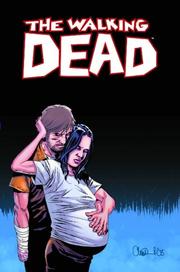
The quiet before the assault, spent almost entirely on relationships. Seventh: Kirkman is deliberately making you comfortable, and it works.
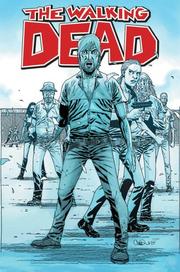
The prison assault and the series' most famous single sequence. Eighth, and the end of part one — everything after is a different book.
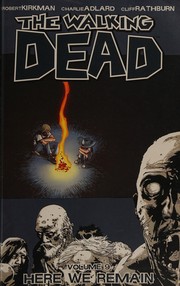
The survivors scattered and grieving, with Rick at his lowest. Ninth: this volume is the argument for reading a comic monthly rather than a novel — the recovery takes real time.

Eugene, Abraham and Rosita arrive with a mission to Washington. Tenth, and the point where the series acquires a direction again.

The Hunters, and the ugliest thing the book does. Eleventh — short, nasty, and the volume that defines what Rick is now willing to do.
Arrival at Alexandria and the first walled community that actually works. Twelfth: the series' second act starts here, so it is a reasonable place to pause.
Alexandria
IntermediateWatch the group try to live inside civilisation again, and see the series turn from survival horror into politics.
▸ Study plan for this stage
Pace: Two weeks for the five volumes here, plus one extra sitting for Vol. 16, which is not in our catalogue and has to be sourced separately. Do not skip it: it sits between Vol. 15 and Vol. 17 and is where the world beyond Alexandria opens up, so Negan's arrival in Vol. 17 lands as a shock rather than a
- Alexandria's original residents as the book's most uncomfortable idea: people who never had to become what Rick's group became, and who are therefore both softer and more decent
- Governance as the actual subject of the back half — Vol. 13 is a story about a town meeting, and the series never fully returns to survival horror after it
- The herd in Vol. 14 as the event that makes Alexandria theirs: the town survives only by adopting Rick's methods, which is both a victory and the loss of what made it worth having
- Negan in Vol. 17 as a different category of antagonist from the Governor — the Governor was a personality cult, Negan runs a working economy with tribute, quotas and enforcement
- The tribute arrangement in Vol. 18: the first time the group loses without being destroyed, and has to live inside the loss
- Rick's long game across Vol. 18, which the reader can read and the other characters cannot, because eighteen volumes have taught the reader how he thinks
- Douglas Monroe's Alexandria and the Governor's Woodbury are both walled towns with a leader who does what he thinks necessary. What separates them, and does the book take a side?
- Why does Kirkman make the crisis of Vol. 14 a herd rather than a human enemy, immediately after moving the group into a town full of people?
- Negan appears late in Vol. 17 and dominates it. What is he for, structurally — what does the series need in Vol. 17 that the Governor could not supply?
- In Vol. 18, how does the reader know what Rick is doing before the other characters do, and what does that trust cost if he turns out to be wrong?
- Which rules Rick imposes on Alexandria are about safety and which are about control? Is the distinction one the book thinks is available?
- Write 200 words comparing Alexandria under Douglas Monroe to Woodbury under the Governor as two forms of government, using only what is on the page
- List every rule or institution Rick establishes in Vol. 13 through Vol. 15 and sort them into safety and control. Argue the ambiguous ones with yourself
- Draw a rough map: Alexandria, the Hilltop, the Sanctuary, and the travel times the books actually state. You will need this for the war volumes and the book never draws it for you
- Read the last five pages of Vol. 17 and then the first five of Vol. 18 in one sitting, and write down what the gap between them does that a continuous scene could not
- Track how many panels Negan appears in across Vol. 17 and how many of them contain his dialogue. The ratio is the character design
Next up: Rick has spent Vol. 18 assembling something under Negan's nose, and the next stage is that plan executed at full scale — the coalition war the series has been building toward since Vol. 12.
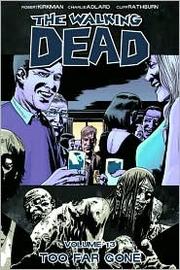
Rick's group inside a community that has never had to fight, and the friction that produces. Thirteenth — the whole back half of the series is about governance, and it begins here.
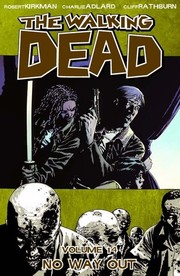
The herd, and the largest set piece in the book to that point. Fourteenth, straight on from thirteen.

Rebuilding, and the introduction of the Hilltop. Fifteenth: read volume 16 next — it is missing from our catalogue, not from the series, and it introduces the Kingdom.

Negan and the Saviors arrive, in the single most consequential volume of the second half. Seventeenth, and the reason people who quit the series come back to it.

Life under tribute, with Rick playing a much longer game than the reader is shown. Eighteenth — the deception only works because you spent seventeen volumes learning how he thinks.
All Out War
IntermediateRead the series' central war and the settlement that follows it, which is where Kirkman's real thesis finally shows.
▸ Study plan for this stage
Pace: Three weeks. Vol. 19 through Vol. 21 are a single continuous war and should be read close together — ideally Vol. 20 and Vol. 21 in one sitting, since they were published as two halves of one story. Then slow down: Vol. 22 opens two years later and the tonal reset needs a gap of its own. Vol. 23 and
- Coalition-building as the real military content of Vol. 19 — the war is won or lost in the negotiations between Alexandria, the Hilltop and the Kingdom, not in the fighting
- Rick's decision at the end of Vol. 21, which is the series' thesis stated outright and the reason twelve more volumes exist
- The two-year skip opening Vol. 22: trade routes, a fair, apprenticeships, an economy. Kirkman refuses to dramatise the rebuilding and shows only the result
- Alpha and the Whisperers in Vol. 23 as the first antagonists with an argument rather than an appetite — their claim is that everything built in Vol. 22 is a costume
- The border in Vol. 24, which is the counter-argument to the entire post-war settlement, delivered without a battle
- The structural principle underneath all six volumes: every time the series builds an institution, it immediately tests whether the institution can survive an atrocity
- Why does Rick make the choice he makes at the close of Vol. 21? Reconstruct his reasoning, then say whether the book thinks he is right
- What is the function of the two-year gap at the start of Vol. 22 — what would have been lost by showing those two years?
- State Alpha's philosophy in one sentence. Where, if anywhere, does the book concede that she has a point?
- The pike sequence in Vol. 24 is generally considered more devastating than the prison assault in Vol. 8. Why, given that Vol. 8 kills characters the reader had known longer?
- What has the Kingdom become by Vol. 24, and what does that say about Ezekiel's style of rule compared to Rick's?
- Write out the coalition of Vol. 19 as a treaty: who contributes what, who commands, what happens in a dispute. The book never states it formally and the gaps are where Vol. 22's politics come from
- Argue the losing side: 250 words for the opposite of Rick's decision at the end of Vol. 21, using only evidence from Vol. 20 and Vol. 21
- After Vol. 22, list every institution that exists in this world and did not exist in Vol. 12. That list is what Vol. 24 puts at risk
- Read Vol. 24's closing sequence, then go back to your character ledger and mark which of those deaths you had been prepared for and which you had not. Note what the book did differently in each case
- Reread Rick's Vol. 4 speech alongside his Vol. 21 decision and write 150 words on whether he still believes the same thing
Next up: The atrocity at the border has made war unavoidable and has also made Rick's leadership contestable for the first time since Vol. 13 — the next stage is fought on both fronts at once.

The alliance of Alexandria, the Hilltop and the Kingdom, and the decision to fight. Nineteenth: the coalition-building here is what the next two volumes spend.

All Out War, part one. Twentieth, and the start of a two-volume unit — do not stop between them.

All Out War, part two, and the ending that a lot of readers argued with for years. Twenty-first: the choice Rick makes here is the series' actual argument.

A two-year time skip into a functioning economy and trade routes. Twenty-second — the biggest tonal reset in the book, and it is intentional.

The Whisperers appear at the edges of the new world. Twenty-third, and the volume that starts the final long arc.
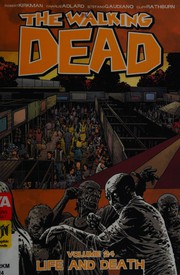
The border, and the atrocity that ends any chance of coexistence. Twenty-fourth: this is the series' most shocking volume, and it lands only if the previous two lulled you.
The Whisperer War
IntermediateFollow the last war, and watch the communities decide what kind of society they have actually built.
▸ Study plan for this stage
Pace: Two weeks for four volumes, but this is the tightest run in the series — Vol. 25 through Vol. 28 is one continuous movement from the aftermath of the border to the last physical crisis the book stages. Read Vol. 27 and Vol. 28 together; the war and the herd that follows it are a single problem.
- Grief as a political force in Vol. 25 — the challenge to Rick's authority comes from mourners, not rivals, and it is the most realistic power struggle in the series
- Negan's arc across Vol. 26, which asks the reader to accept usefulness from a character the book spent nine volumes making unforgivable
- Beta in Vol. 27 as ideology outliving its founder: the Whisperers continue, which is the point about movements the series has been making since Woodbury
- The herd in Vol. 28 as the last purely physical threat the book will stage, and the deliberate return to the visual vocabulary of Vol. 14
- The distinction the war forces: whether these communities are an alliance of towns or a single society with an argument about who leads it
- The radio contact at the close of Vol. 28, which is the seam into the final act and the first evidence that the collapse was not total
- In Vol. 25, what is the actual case against Rick? State it as its supporters would, not as he answers it
- Negan's actions in Vol. 26 are useful to Rick's side. Does that make him redeemed, and does the book think redemption is the relevant question?
- Beta takes over after Alpha. What does the series gain by making the Whisperers survive their leader — and what does that imply about Woodbury and the Saviors?
- Why does Kirkman end the war with a herd in Vol. 28 rather than a battle? What does that choice say about who the enemy was?
- By the end of Vol. 28, is this one society or several? Point to the evidence rather than the characters' claims
- Write the case against Rick from Vol. 25 as a two-paragraph speech that a reasonable person in Alexandria would give. Then write his rebuttal
- Track Negan's page count across Vol. 25 through Vol. 28 and note which volumes give him interiority and which only show him acting. The pattern is the argument
- Reread the herd sequence in Vol. 14 immediately after Vol. 28 and list the visual echoes. Kirkman and Adlard are quoting themselves and it is doing work
- Update the character ledger and then count: what fraction of the named cast alive in Vol. 12 is alive now? Write one sentence on what that number does to how you read Vol. 29
Next up: With the last physical enemy gone and a voice on the radio, the series can finally pose the question it has been circling since Alexandria — what happens when the survivors meet a civilisation that never fell.

The aftermath, with Rick trying to hold an alliance together through grief and a mob. Twenty-fifth — the politics here are the reason the war reads as a consequence rather than a plot.

Preparation, and Negan's strangest chapter. Twenty-sixth: his arc across the back half is the best long-form character work in the book.

The war itself, fought against an enemy that hides inside the herds. Twenty-seventh, straight on.

The largest horde in the series and the fight to survive it. Twenty-eighth — the last purely physical crisis the book stages.
The Commonwealth, and the End
IntermediateFinish the series and see the ending Kirkman published without warning, which reframes everything before it.
▸ Study plan for this stage
Pace: About ten days for four volumes, and this is the one stretch where reading fast is right — Vol. 29 through Vol. 32 is a single accelerating argument, and Vol. 32 was published as a surprise, so the abruptness is intentional and best experienced without a gap in front of it. Set aside an uninterrupte
- The Commonwealth in Vol. 29 as the best-argued antagonist in the series precisely because it is not villainous: fifty thousand people, functioning services, and a class system carried over intact from before the collapse
- Pamela Milton and Rick as two coherent theories of order, neither of which the book dismisses
- The reappearance of the pre-collapse world — jobs, uniforms, records, hierarchy — as the thing every earlier community was trying and failing to rebuild, now shown to be worth being afraid of
- Vol. 31's unrest as the consequence of a system that works for most people, which is a different failure mode from every antagonist since Vol. 5
- How the series ends Rick: not at the hands of a monster or an army, and the ordinariness is the entire statement
- The epilogue's jump forward, and the book-within-the-book, which reframes thirty-two volumes as something that got written down and survived
- The cancellation itself as a formal choice — Kirkman ended the series without announcement, so the ending has no ceremonial approach and reads the way the deaths in it always did
- What exactly is wrong with the Commonwealth? Answer without using the word 'evil' and without relying on Sebastian's behaviour
- Pamela Milton's position and Rick's position: state each in one sentence, then say which one the series has actually been arguing for since Vol. 13
- Why does the book end Rick the way it does rather than in the fighting? What would have been lost by the heroic version?
- How does the epilogue's time jump change your reading of the earlier volumes — specifically, what does the framing device claim about the value of what you have just read?
- Return to Rick's 'we are the walking dead' speech from Vol. 4. Does Vol. 32 confirm it, refute it, or leave it standing as the wrong question?
- Write 250 words on the Commonwealth as a political proposal, arguing for it. Then read Vol. 31 again and note which of your arguments it anticipates
- Line up the four communities the series has built — the prison, Alexandria, the Kingdom, the Commonwealth — and for each write one sentence on how it distributed power and one on what killed it
- Finish the character ledger. Count the survivors from Vol. 1 and write a paragraph on what the attrition rate did to how you read the last four volumes
- Reread the closing sequence of Vol. 32 immediately after the closing page of Vol. 1. Write 200 words on what the series claims to have been about, then on whether the middle twenty-five volumes support that claim
- Write the case for and against ending a serial abruptly with no announcement, using this series as the evidence. It is a real craft question and Vol. 32 is the best test case in comics
Next up: This is the end of the series; from here the natural next steps are Kirkman's other long-form work or the other great multi-volume comics that use serial length the same way this one does.

Contact with the Commonwealth, a surviving city of fifty thousand people with a class system intact. Twenty-ninth: the final argument of the series starts here.

Inside the Commonwealth, where the question stops being how to survive and becomes who gets to decide. Thirtieth.

The system cracking, and Rick as a politician rather than a fighter. Thirty-first — the penultimate volume, and the last one that feels like an ongoing series.

The final volume. Kirkman cancelled the book with no announcement, so the ending arrives abruptly by design; the closing sequence jumps forward far enough to answer what all of it was for. Thirty-second and last.