The history of Venezuela: books to read, in order
Venezuela is the country where oil arrived before the modern state did, and almost every argument about its history turns on what that sequence produced. This path starts with a short orientation and the independence-and-caudillo backstory, then works through the oil century and the Punto Fijo pact, the Caracazo and the rise of Hugo Chavez, and finally the collapse and mass emigration of the last decade. The books deliberately disagree with each other about who is to blame, and the later stages assume you have the earlier vocabulary of rentier state, punto fijo and chavismo.
Orientation and the long backstory
BeginnerGet a working map of Venezuelan history from independence to the twentieth century, and understand why Bolivar remains the country's central political symbol rather than merely a historical figure.
▸ Study plan for this stage
Pace: About four weeks. Marie Arana's Bolivar, American Liberator is 634 pages and carries most of the stage on its own; it is narrative biography and moves, so 40-50 pages a session is comfortable. Judith Ewell's Venezuela, a century of change is 258 pages but reads far slower per page — it is a compress
- Caudillo rule as the normal form of nineteenth-century Venezuelan government, which Ewell traces from independence through to Juan Vicente Gomez
- Gran Colombia and its collapse — the central drama of Arana's biography, and the reason Bolivar is a continental rather than a merely national figure
- Bolivarianism as a live political claim rather than a historical memory: later regimes argue from Bolivar, they do not merely commemorate him
- The Gomez dictatorship as the state-building moment that oil revenue arrived into, not after
- The transition to electoral democracy after 1958 as Ewell presents it — the endpoint her book treats as an achievement
- Why Venezuela was, into the 1980s, routinely described as Latin America's stable exception
- On what evidence does Ewell present Venezuela as an exception among Latin American states, and what does her 1984 vantage point let her assume?
- What did Bolivar actually propose for the government of the liberated republics, and how does Arana explain why it failed?
- How did the Gomez period concentrate authority in the central state, and why does that sequence matter for the next stage's argument?
- What does Tinker-Salas's question-and-answer format give you that Ewell's continuous narrative does not, and what does it cost?
- Which of Bolivar's own recorded positions would be awkward for a present-day government that claims his mantle?
- Build a one-page chronology from Ewell covering 1830 to 1958 and mark on it the point where Arana's biography stops. Keep it beside you for the whole path — the later stages assume this spine and never restate it.
- Pick three passages where Arana quotes Bolivar directly and write, for each, what it would commit a self-described Bolivarian government to today.
- Read Tinker-Salas's answers on oil before his answers on politics, then list which political facts he treats as downstream of oil. You are being handed the argument of stage two in compressed form.
- List every term Ewell uses without defining it — caudillo, Punto Fijo, Accion Democratica, COPEI, concertacion — and write a one-line gloss of each from her own text.
Next up: With the chronology and the political vocabulary in place, you can read the next stage's books as competing explanations rather than as introductions, which is what they are.

The most efficient single orientation to the whole country, written by the historian whose work on oil culture anchors this path. Read it first purely for the chronology and the vocabulary; the Open Library record for this one carries a mangled display title with a stray 'Cloth' from the hardback listing, but the book is the Oxford What Everyone Needs to Know volume.
A narrative biography of the Liberator that covers the independence wars and the collapse of Gran Colombia without assuming prior knowledge. Placed here because Bolivar is not background in Venezuela — every later regime, Chavez's above all, claims him, and you cannot read chavismo without knowing what is being claimed.
Ewell's survey carries the nineteenth-century caudillo era, the Gomez dictatorship and the transition to democracy in a single scholarly narrative. It is the oldest book here (1984) and stops before everything the later stages cover, which is exactly why it is useful: it shows what Venezuela looked like when it was still described as a stable success.
Oil and the state it built
IntermediateUnderstand the rentier state argument — that oil revenue accruing to the state before mass politics shaped everything that followed — and see it made in three different registers: political science, cultural history and theory.
▸ Study plan for this stage
Pace: Six weeks, and the heaviest stage on the path: 1,469 pages, of which only Franklin Tugwell's 210 pages move at survey speed. Read Tugwell in a week for the institutional story — concessions, taxation, the 1976 nationalisation. Tinker Salas's The enduring legacy is 334 pages of social history and rea
- The rentier state: revenue accruing to the state from subsoil rent rather than from taxing citizens, and what that does to the relationship between the two
- Coronil's specific claim — the state as a magician conjuring modernity out of oil money, with the citizenry as audience rather than as participants
- Sowing the oil (sembrar el petroleo) as the recurring national programme, and the recurring failure to do it
- The oil camp as a social institution in Tinker Salas: imported housing, schooling, hierarchy and consumption remaking Venezuelan class and identity
- The 1976 nationalisation as continuity rather than rupture — the state had been negotiating its share for decades
- Dutch disease and the pre-1998 productivity collapse as Hausmann and Rodriguez's contributors document it
- The distinction between oil as revenue and oil as culture, which is exactly where Tugwell and Tinker Salas divide the same subject
- State the rentier-state argument in three sentences without using the word oil more than twice. What is it actually a claim about?
- Where does Coronil's argument depend on evidence Tugwell supplies, and where does it depend on a reading of culture that Tugwell's method cannot reach?
- What do the contributors to Venezuela before Chavez identify as the start of the decline, and what would have to be true for that dating to be right?
- How does Tinker Salas's account of the camps change what nationalisation meant to ordinary Venezuelans, as opposed to what it meant fiscally?
- If the crisis was already well advanced by 1998, what work is left for an explanation centred on chavismo?
- Take one concrete episode from Tugwell — the 1943 Hydrocarbons Law or the 1976 nationalisation — and write how Coronil would narrate the same event. The gap between the two accounts is the whole methodological argument of this stage.
- From Venezuela before Chavez, find the specific figures its contributors use for GDP per capita or productivity across the 1970s and 1980s, and write them down. You will need them to argue with the next two stages.
- In Tinker Salas, mark every passage where an American company practice becomes a Venezuelan social norm, and note which of those norms outlived the camps.
- Try to state Coronil's argument to someone who has read none of these books, in under two minutes. If you cannot, you have read the prose rather than the argument — go back to his introduction and the chapter on the Gomez period.
Next up: You now have both explanations of what went wrong before Chavez — a rentier state that could not convert rent into production, and an economic collapse already two decades old — which is exactly the ground the next stage's books fight over.
The classic account of how the Venezuelan state negotiated with, taxed and finally nationalised the foreign oil companies. Read before the more theoretical books because it supplies the concrete institutional story they abstract from.

Tinker Salas on how the oil camps remade Venezuelan society, class and national identity — not just revenue but a whole imported way of life. The social-history complement to Tugwell's political one, and the bridge to Coronil's argument.
The single most influential theoretical book on Venezuela: the state as a magician conjuring modernity out of subsoil rent, and the citizenry as its audience. Genuinely difficult and worth the difficulty, but it assumes the empirical history the two previous books give you.

An edited volume of economists anatomising the pre-1998 collapse in growth and living standards. Placed at the end of this stage as the deliberate counterweight: it argues the crisis was well underway before chavismo, which is the claim the next stage has to answer.
The Caracazo, Chavez and the Bolivarian Revolution
IntermediateFollow the collapse of the Punto Fijo two-party system through the 1989 Caracazo riots and the 1992 coup attempts to Chavez's election and consolidation — and read a sympathetic account and a critical one against each other rather than choosing one.
▸ Study plan for this stage
Pace: Five weeks. Richard Gott's Hugo Chavez and the Bolivarian Revolution carries no page count in our record, so treat it as a full-length journalistic account and give it a fortnight rather than assuming a number; read it first, sympathetically, on its own terms. Brian Nelson's The silence and the scor
- The Punto Fijo pact of 1958 and how a power-sharing arrangement between parties hardened into a closed system
- The Caracazo of February 1989 as the hinge event — an IMF adjustment package, riots, and a state response whose death toll is still disputed
- The 1992 coup attempts, and Chavez's televised surrender as the moment a failed putschist became a national figure
- Competitive authoritarianism as Corrales and Penfold define it: real elections held on a deliberately tilted field, which is neither democracy nor dictatorship
- Missions, oil-funded parallel institutions that delivered services outside the existing state apparatus
- The April 2002 coup as the clearest case on this path of two incompatible accounts of the same forty-eight hours
- What does Gott see in chavismo that Corrales and Penfold's framework is not built to register, and is that a blind spot or a difference of subject?
- Reconstruct the April 2002 sequence from Nelson. At which specific point does the version told by Chavez's supporters diverge from the version told by the opposition, and what evidence would settle it?
- How, concretely, does a competitive authoritarian regime tilt a field while still holding elections it can lose?
- What did the missions achieve that the pre-1998 state had failed to, and what did funding them through PDVSA cost later?
- Carroll writes about daily life rather than ideology. Which of his observations would be strongest as evidence in Corrales and Penfold's argument?
- Write the events of 11-14 April 2002 twice — once from Gott's framing and once from Nelson's reconstruction — then list the factual claims that appear in only one version.
- Take Corrales and Penfold's list of mechanisms for tilting the playing field and tick off, from Gott and Carroll, which ones you can find a concrete instance of.
- Find in Carroll three scenes that are only about queuing, currency or electricity, and write what each implies about the institutional argument in Dragon in the tropics.
- Return to your stage-one chronology and add the Caracazo, the 1992 attempts, the 1998 election and April 2002. Note how compressed the run from riot to election actually is.
Next up: Having read the project both as its supporters and as its analysts describe it, you can take up the collapse without treating it as either an inevitable outcome or a betrayal.

The best-known sympathetic account, by a British journalist with long access to Chavez. Read it first so you meet the project on its own terms. Note that Gott's earlier book on the same subject was published as In the Shadow of the Liberator; this is the revised and extended version, so you do not need both.
A close reconstruction of the April 2002 coup that briefly removed Chavez, built from interviews on all sides. The single best case study of how contested the basic facts of this period are — useful precisely because Gott and the opposition press tell it differently.
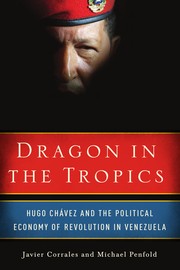
Corrales and Penfold's political-science account of how competitive authoritarianism was built institutionally — elections that continue while the playing field is tilted. The analytical frame for what the two narrative books describe.

The Guardian correspondent's portrait of Chavez's rule as lived daily life rather than ideology, drawn from six years in Caracas. Placed after the analysis because its texture lands harder once you know the institutional argument.
Collapse, emigration and what oil could not buy
IntermediateAccount for the post-2014 economic collapse and the exodus of millions, and be able to argue about how much of it is chavismo, how much is the oil price, and how much was structural long before either.
▸ Study plan for this stage
Pace: Three weeks, 578 pages, and the lightest reading on the path — both books are written by journalists for general readers. Raul Gallegos's Crude nation is 226 pages and can be done in a long weekend; read it first, because it is the direct payoff of the rentier argument you worked through in stage tw
- Exchange-rate controls and arbitrage as an engine of both scarcity and enrichment, which is Gallegos's central mechanism
- The 2014 oil price fall as trigger versus the rentier structure as cause — the whole argument of the stage in one distinction
- PDVSA's transformation from technocratic operator to political instrument, and what it did to production
- Hyperinflation as lived experience: what Neuman shows about wages, queues, and the bolivar itself
- Emigration on the scale of several million people, and what it removes from a country besides labour
- The limits of a single-commodity explanation once you have read Hausmann and Rodriguez
- Apportion the collapse between chavismo, the oil price, and pre-existing structure. Which books support which share, and where are you extrapolating?
- Gallegos was an oil analyst before he was an author. Where does that position sharpen his account, and where might it narrow it?
- Coronil died before the collapse. Which parts of The magical state read as prediction in Gallegos's hands, and which parts do not survive contact with events?
- What does Neuman show about the Maduro years that a purely economic account would miss entirely?
- If the price of oil had held after 2014, which of the failures described here would still have happened?
- Write a one-page answer to the path's governing question — why a country with the world's largest proven reserves ended up rationing food — citing at least one book from each of the four stages.
- List the mechanisms Gallegos identifies for how controls generated scarcity, then check each against a scene in Neuman where it appears from ground level.
- Go back to the productivity figures you copied out of Venezuela before Chavez and set them against Neuman's account of 2016-2019. Decide what the numbers can and cannot tell you.
- Name the three books on this path that most disagree with each other, and write the strongest sentence each would say about the other two.
Next up: This is the last stage: you should now be able to argue about Venezuela with someone who has read only one of these books, and know which one it was.

A former oil analyst's account of how a country sitting on the world's largest proven reserves ended up rationing food. The most direct answer to the question the whole path has been building toward, and best read after Coronil so you can see the rentier argument playing out.

The New York Times bureau chief's on-the-ground account of the Maduro years, the hyperinflation and the migration crisis. The most recent book on the path and the one that closes the story the others start; read last.