Parrots and Pet Birds: The Best Books to Read, in Order
A parrot is a wild animal with a fifty-year lifespan living in a house, and most of the problems people have with them follow from forgetting one half of that sentence. This path starts with what the commitment actually involves, moves through daily care and then through behaviour — where practice has changed most, from dominance-based handling toward positive reinforcement — then looks at what a parrot mind can do, and ends with where these birds come from and what the pet trade has cost them.
Before you get a bird
BeginnerDecide honestly whether a parrot fits your life, and know what species suits it if the answer is yes.
▸ Study plan for this stage
Pace: Three to four weeks, and the only stage on this path that is worth reading before you acquire anything. Birds for Dummies is 364 pages, Gallerstein's Complete Pet Bird Owner's Handbook is 441 and is a reference rather than a read-through, and Athan's Guide to a Well-Behaved Parrot is a compact 144.
- A parrot is a wild, undomesticated animal with a long lifespan kept in a house. Every difficulty in the rest of this path follows from one half of that sentence being forgotten, and the species surveys in Birds for Dummies exist so you can match a bird to a life rather than to an image.
- The practical differences between species that Spadafori and Speer set out plainly: a budgerigar or cockatiel is a different order of commitment from an African grey, and a macaw or cockatoo is different again in noise, mess, destructiveness and years.
- Lifespan as the central welfare fact. Larger parrots can outlive the arrangement that brought them home, which is why rehoming is normal rather than exceptional and why stage two spends a whole book on it.
- Gallerstein writes as an avian veterinarian, so the handbook is where you learn quarantine for a new bird, what a genuine avian emergency looks like, and the signs of illness that parrots are adapted to conceal until late.
- Prey-species concealment of illness: by the time a parrot looks obviously sick it is often seriously so. This changes what routine observation is for and is the strongest argument for finding an avian vet before you need one.
- Diet has moved: formulated pellets plus fresh vegetables and limited fruit is current practice, and an all-seed diet is associated with obesity, fatty liver disease and vitamin A deficiency. Read Gallerstein's nutrition material knowing it sits on the earlier side of that shift.
- Cage, and what it is not. Cage size, bar spacing, perch variety and placement matter, but a cage is where a parrot sleeps rather than where it lives; time out, flight and interaction are the substance and the cage is the frame.
- Athan wrote as a behaviour consultant and the day-to-day observation in her book is genuinely good. Take the routines, the household detail and the description of what normal parrot behaviour looks like; leave the dominance and height explanations behind.
- Write down, honestly, the number of hours a day and the number of years you can commit. Which species in Birds for Dummies actually fit that, and which have you been considering anyway?
- What are the signs of illness Gallerstein says to act on immediately, and why does a parrot conceal them for as long as it does?
- Where does Gallerstein's dietary advice sit relative to current formulated-diet practice, and what specifically would you do differently?
- Identify two places where Athan explains a behaviour in terms of dominance or height. What is the alternative explanation, and what would each predict about what happens if you changed your handling?
- What does an adequate cage setup consist of, and what does the cage still fail to provide no matter how well it is set up?
- If you concluded after this stage that you should not get a parrot, what specifically drove that? Being able to answer is the point of the stage.
- Cost the first year and a typical later year in full: cage, vet examination, an emergency reserve, pellets and fresh food, toys consumed rather than kept, and boarding. Most people underestimate the emergency reserve and the toy consumption.
- Find the nearest avian veterinarian, confirm they see the species you are considering, and note their emergency arrangements. Do this before acquiring a bird, not after.
- Draw the room the bird would live in, marking cage position, sleep location, natural light, draughts, and every kitchen hazard — non-stick cookware fumes, open water, unscreened windows.
- Shortlist three species and write a paragraph on each: noise at its worst, mess, expected years, and what it needs daily. Then cross off any you shortlisted for how it looks.
- Visit a rescue or sanctuary and ask what they most often take in and why. This is the most useful hour available at this stage and it will change what you think stage two is about.
Next up: You have chosen deliberately rather than reactively and you know what the bird needs to survive; the next stage is about what it needs in order to have a life it can actually live.
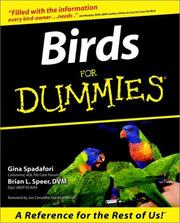
Written with an avian veterinarian, and the most efficient survey of the species available as pets — budgerigars and cockatiels through to macaws — with the practical differences in noise, mess and lifespan stated plainly. Start here so you are choosing rather than reacting.
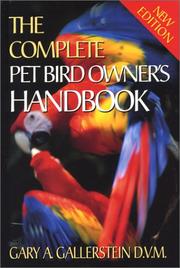
Gallerstein is an avian vet and this is the health and husbandry reference: cage setup, quarantine, first aid, what an emergency looks like. Read it before acquiring a bird, not after the first crisis. Note that nutrition advice has moved further toward formulated diets and away from seed since it was written.
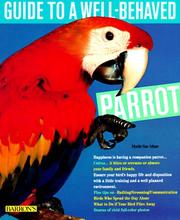
The long-standing general handbook on living with a parrot, from a writer who worked as a behaviour consultant. It predates the shift to fully reinforcement-based training and uses some dominance and height-hierarchy framing that current practice has abandoned — read it for the day-to-day detail, then let the behaviour stage correct the method.
Living with the bird you have
BeginnerSet up a life the bird can actually live in — foraging, sleep, flight, socialisation — and understand what changes when the bird has a history before you.
▸ Study plan for this stage
Pace: Three to four weeks for around 570 pages. Doane and Qualkinbush's My Parrot, My Friend is 260 pages, Doane's The Pleasure of Their Company is 220, and Athan's The Second-Hand Parrot is a short 96. Read them in that order — the first is organised around causes of problems, the second around the relat
- Doane and Qualkinbush's organising move: treat screaming, biting and feather-destructive behaviour as symptoms with causes rather than as faults to be corrected. A bored, under-stimulated or under-slept parrot produces all three, and addressing the cause is more effective than addressing the noise.
- Foraging as the single largest gap between a wild and a captive parrot's day. Wild parrots spend hours finding and processing food; a bowl of pellets takes minutes, and the remaining hours have to go somewhere.
- Sleep. Parrots need long, dark, uninterrupted sleep, and chronic sleep disruption in a family living room is a common and easily missed cause of irritability and screaming.
- Flight and wing-clipping, which is genuinely contested. Clipping is presented as routine in older material; current welfare thinking weighs the loss of exercise, confidence and natural behaviour against the safety argument, and many keepers now keep birds flighted in a bird-proofed room.
- Feather-destructive behaviour is multi-causal — medical, environmental, social — and the first response is always a veterinary workup rather than a behavioural theory. Doane is good on this and it is worth taking seriously.
- From The Pleasure of Their Company: what it means to be the bird's flock. Parrots are intensely social, pair-bonding animals, and the behaviours people read as jealousy or spite are usually ordinary social behaviour aimed at the wrong target.
- Athan's second-hand parrot problem: a rehomed bird arrives with a history you cannot see, and its fears and habits are about someone else. The practical consequence is that you work at the bird's pace and read its body language rather than following a schedule.
- Parrot body language — pinned eyes, raised feathers, beak grinding, posture before a bite — is the actual channel of communication, and almost every bite described as unprovoked was preceded by a signal that was missed.
- Take screaming and work backwards through the causes Doane and Qualkinbush identify. Which are environmental, which are social, and which need a vet first?
- How many hours a day does a wild parrot spend foraging, and what specifically would you put in a captive bird's day to replace that time?
- State the case for and against wing-clipping as fairly as you can. What would change your answer for a particular bird in a particular home?
- What does Doane mean by being the bird's flock, and what does it imply about leaving a strongly pair-bonded parrot alone all day?
- A rehomed parrot lunges whenever you approach with your left hand. What are the plausible explanations, and what is the first thing you do — before any training plan?
- List five body-language signals that precede a bite. Which of them have you actually seen, and which do you only know from the page?
- Keep a seven-day log of one bird's day in half-hour blocks: awake, dark, out of cage, foraging, interacting, alone. Add up the alone hours and the true dark hours. Most logs surprise the person keeping them.
- Build three foraging devices at three difficulty levels from household materials and introduce the easiest first. A bird that cannot solve the first one will stop trying, which is the commonest mistake in enrichment.
- Audit sleep specifically: measure the hours of genuine darkness and quiet the bird gets, and change one thing about the sleeping arrangement based on what you find.
- Photograph or sketch the same bird in five states — relaxed, alert, excited, frightened, about to bite — and label the features that distinguish them. Keep this and check it against Heidenreich in the next stage.
- Write out the history you would want to know about a rehomed bird, then write what you would do given that none of it is available. That second list is the actual plan.
Next up: You now understand why parrots do what they do, which is exactly the point at which the older prescriptions in these books stop being adequate and the next stage replaces the method.
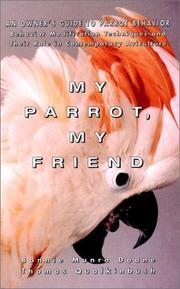
Written with a parrot behaviour consultant and organised around the causes of common problems rather than their symptoms. The clearest older account of why a bored parrot becomes a screaming or plucking parrot.
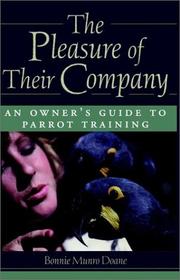
Doane's companion volume on the relationship itself — what a parrot's social needs are and what it means to be its flock. Read second because it assumes the practical ground the first book covers.

Most parrots change homes at least once, and rehomed birds arrive with fears and habits that have nothing to do with you. This is the only book on the list about that specific problem, and it is the reason many adoptions succeed.
Behaviour, the way it is done now
IntermediateReplace any dominance or punishment framing with positive reinforcement, and be able to build a training plan for biting, screaming or feather-destructive behaviour.
▸ Study plan for this stage
Pace: Four to six weeks for a modest 428 pages, because this stage is practice rather than reading. Heidenreich's The Parrot Problem Solver is 192 pages, her Good Bird! is a short 80, and Johnson's Clicker Training for Birds is 156. Read Problem Solver first for the argument, keep Good Bird! by the cage a
- Heidenreich's central move is to put companion-parrot behaviour on the same footing as professional zoo and marine-mammal training: antecedent, behaviour, consequence, and behaviour change driven by reinforcement rather than by force or hierarchy.
- The explicit rejection of dominance and height hierarchy. A parrot on your shoulder is not staging a coup; it is on a high perch. Heidenreich also rejects towel restraint and other coercive handling as routine tools, and the reasons she gives are about trust and fallout rather than about kindness al
- Positive reinforcement means adding something the animal will work for. Identifying what a specific bird will actually work for — a particular nut, a head scratch, a return to a preferred perch — is the first practical step and is bird-specific.
- Why punishment is avoided in this framework: it suppresses behaviour without teaching an alternative, it damages the relationship the training depends on, and with a parrot it very reliably produces a bird that bites sooner and signals less.
- Target training as the foundation behaviour. Teach the bird to touch a stick, and you have a way to move it without hands, which solves a large fraction of biting and step-up problems without confrontation.
- From Johnson: the mechanics. A marker signal — a click or a word — must be precisely timed to the instant of the behaviour, and shaping means reinforcing successive approximations rather than waiting for the finished behaviour.
- Behaviour is analysed functionally. Screaming maintained by attention, screaming maintained by isolation distress, and screaming maintained by an environmental trigger are three different problems with three different plans, even though they sound identical.
- Differential reinforcement: rather than punishing screaming, reinforce a quieter contact call. The bird is not being stopped from doing something; it is being paid for doing something else.
- Write the antecedent-behaviour-consequence analysis for a specific biting incident. What was the antecedent, and what consequence is maintaining the behaviour?
- Why does Heidenreich reject the height-dominance explanation? Give her reasoning, and say what her framework predicts instead about a bird that bites when it is above your head.
- What is a reinforcer, how do you find out what a particular bird's reinforcers are, and why can you not simply assume it is food?
- Describe target training from first session to a bird reliably following a target. Where in that sequence do most people go too fast?
- You have a bird that screams for an hour when you leave the room. Give two different functional explanations and the different plan each one implies.
- Which specific piece of advice from stage one or stage two do you now consider superseded, and what does this stage say to do instead?
- Run a preference test: offer several food items separately and record which the bird takes first and works hardest for. Rank them. This ranking is the currency for everything that follows.
- Charge a marker signal, then train a target touch in sessions of no more than five minutes, twice a day, keeping a written record of criteria and success rate each session. Stop the session while the bird is still keen.
- Take one real problem behaviour and write a full plan: functional analysis, the alternative behaviour you will reinforce, the criteria for each step, and how you will measure whether it is working.
- Deliberately practise timing — mark a specific moment such as the instant a foot lifts, and check with a second person whether your mark is early or late. Timing is the skill that separates this working from not working.
- Reread one chapter of Athan or Doane after finishing Heidenreich and annotate every recommendation you would now do differently. Keep the annotated version; that comparison is the most durable thing this stage gives you.
Next up: Having spent weeks establishing what a parrot can be taught and how, you are in a position to judge the much stronger claim in the next stage: what a parrot can be shown to understand.
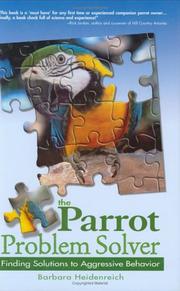
Heidenreich is a professional animal trainer and this is the book that moved companion-parrot advice onto the same footing as zoo and marine-mammal training. Explicitly rejects the height-dominance and towel-restraint approaches found in older manuals. Read it as the corrective to stage one.
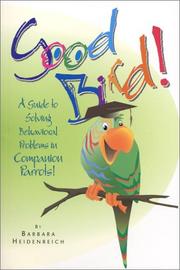
Published as 'Good Bird! A Guide to Solving Behavioral Problems in Companion Parrots'. Shorter and more procedural than The Parrot Problem Solver — this is the one you keep next to the cage while you work through a specific behaviour.
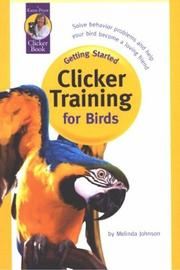
The mechanics: marking, shaping, timing, targeting. Once Heidenreich has convinced you of the approach, this teaches the hand skills that make it work in practice.
What a parrot mind can do
IntermediateKnow what has actually been demonstrated about parrot cognition, and where the evidence stops.
▸ Study plan for this stage
Pace: Four to six weeks for 666 pages of very unequal difficulty. Alex and Me is 232 pages and reads in a few evenings; The Alex Studies is 434 pages of academic writing with experimental protocols, statistics and careful qualification, and it is the harder book by a wide margin. Read the popular account
- What was actually demonstrated with Alex: use of English labels for objects, colours, shapes, materials and numbers, and — the harder result — responses to questions about category, such as which of two objects differs in colour, that require the concept rather than the label.
- Why the controls matter. The obvious objection to any talking-animal claim is cueing, so Pepperberg's protocols involve trainers blind to the answer, novel object sets and questions the bird could not have rehearsed. Learn what each control rules out.
- The model-rival training method: two humans model the exchange while the bird watches, which supplies both a social context and a reason to compete for the object. It is a specific methodological claim, not just a teaching convenience.
- The distinction Pepperberg is careful about and popular coverage is not: demonstrating that a bird uses a label functionally is a narrower claim than demonstrating that it has language, and she does not make the second claim.
- Sample size of one. Alex was a single bird, and Pepperberg says so; results from an n of one are a proof of possibility rather than an estimate of what African greys generally do.
- What was not established. Syntax, recursive structure and open-ended generativity are where the evidence stops, and knowing precisely where it stops is more valuable than knowing the headline results.
- The implication for the previous stage: a parrot capable of these discriminations is an animal for which enrichment and training are cognitive requirements rather than optional extras. The cognition literature is a welfare argument as much as a scientific one.
- Alex and Me is also a memoir about a scientific career, funding and institutional scepticism, and reading it as testimony about doing this kind of research is a legitimate second use of the book.
- Name three specific experimental results from The Alex Studies and, for each, state what the control condition ruled out.
- What is the model-rival method, and why does Pepperberg argue that a purely operant approach would not have produced the same results?
- Where exactly does Pepperberg draw the line between label use and language? Quote or paraphrase her own formulation rather than a summary of it.
- What follows, and what does not follow, from a result obtained with a single bird?
- Compare the same result as told in Alex and Me and as reported in The Alex Studies. What is present in the technical account that the popular one leaves out, and does its absence change what you believe?
- How should the cognition evidence change what you consider adequate enrichment for a parrot in a home?
- Take one experiment from The Alex Studies and write out its design as a protocol: subject, stimuli, procedure, control condition, measure. Then write the objection you would raise as a reviewer.
- List the claims about parrot cognition you had before this stage and mark each as demonstrated, plausible but unproven, or unsupported, citing the specific result behind each judgement.
- Design a small discrimination task you could actually run with a bird using the training skills from stage three — same or different, or a colour label — and specify what result would and would not be convincing.
- Write a paragraph explaining Alex's number results to a sceptical friend, without overstating them. Overstatement is the standard failure and this is the exercise that catches it.
- Reread your enrichment plan from stage two and revise it in light of what a parrot is now demonstrated to be able to do.
Next up: Knowing what these birds are capable of makes the final stage unavoidable: where they come from, and what taking them out of it has cost.
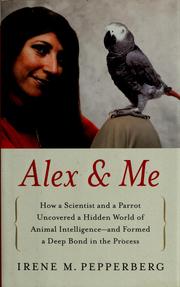
Catalogued as 'Alex & me'. The popular account of thirty years of work with an African grey who used English labels for objects, colours, numbers and categories. Read it first — it is the story, and it is short.

The academic version: the experimental protocols, the controls, and Pepperberg's careful case for what the results do and do not establish. It is the difference between a good anecdote and a scientific claim, and it is worth the effort.
Where these birds come from
IntermediateUnderstand the species in the wild and the conservation and welfare consequences of the trade that put them in living rooms.
▸ Study plan for this stage
Pace: Four to six weeks for around 1,220 pages, though Forshaw is a reference to work through rather than read. Parrots of the World is 584 pages of species accounts illustrated by William T. Cooper and exists both as the large original monograph and as a later field guide — either serves here. Tweti's Of
- The order Psittaciformes as an actual group: geographic distribution across the tropics and southern hemisphere, the major radiations, and where the species commonly kept as pets sit within it. Forshaw is the standard reference for this.
- Wild behaviour as the standard against which captive life is measured — flock size, foraging range, pair bonds, nesting requirements. This is what makes Forshaw a welfare book as well as a taxonomic one.
- Conservation status. Parrots are among the most threatened bird orders, and the pressures are habitat loss, nest-site loss and trapping for the trade, usually in combination rather than singly.
- The trade as Tweti reports it: commercial breeding operations, smuggling routes, the mortality involved in moving wild-caught birds, and the sanctuary and rescue system that absorbs birds people can no longer keep.
- Surrender as a structural outcome rather than a personal failure. Long lifespans, noise, and behaviour problems that were never addressed produce a steady supply of birds needing homes, which connects this stage directly back to stage two.
- Regulation has changed the picture: import restrictions in major markets shifted the supply from wild-caught to captive-bred birds, which addressed part of the problem and created others around breeding conditions and surplus.
- Spix's macaw as the concrete case: a single species followed to extinction in the wild, with collectors, traders, governments and conservationists all in the story and none of them straightforwardly the villain.
- The honest conclusion of the path. Reading Tweti and Juniper after four stages of husbandry and training makes the question of whether to keep a parrot at all a live one, and the books are placed here so that question arrives with evidence rather than as a slogan.
- Take the species you were most drawn to in stage one. Using Forshaw, describe its wild range, social structure and diet. What does a home fail to provide?
- What are the main pressures on wild parrot populations, and how do they interact rather than simply adding up?
- How did import restrictions change the trade, and what problems did that shift create rather than solve?
- Trace the chain in Tweti's reporting from a wild nest or a breeding operation to a bird in a living room. Where in that chain is the mortality concentrated?
- In Juniper's account, who is responsible for the loss of Spix's macaw in the wild? Answer without settling on a single party.
- Having finished this path, what would you now say to someone at stage one who is about to buy a macaw?
- Use Forshaw to write a wild profile of one species and set it beside a realistic captive profile of the same species, line by line. The mismatches are your enrichment and welfare priorities.
- Research the parrot species that occur in the wild nearest to you, or the introduced populations if any, and note their status. Local reality is more instructive than a global summary.
- Contact a parrot rescue and ask what proportion of intakes are behavioural, what proportion are owner life-change, and what happens to birds that are not adopted. Compare their answer with Tweti's account.
- Build a timeline of the Spix's macaw case from Juniper, marking each point at which a different decision could plausibly have changed the outcome.
- Write a one-page honest statement of your own position: whether you would keep a parrot, which species, from what source, and what you would commit to. This is the deliverable of the whole path, and it is a legitimate outcome for it to be no.
Next up: This is the end of the path: you have the husbandry, a behaviour method that current practice actually endorses, an accurate picture of what these animals can do, and the wild and welfare context in which every decision about keeping one sits.
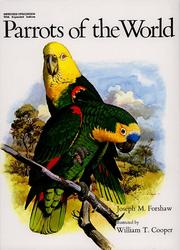
Forshaw's monograph, illustrated by William T. Cooper, is the standard reference on the order — every species, range, and habits. It exists both as the large original and as a later Princeton field guide; either serves the purpose here.

Journalism on the pet-bird industry — breeding mills, smuggling, and the rescue and sanctuary system that absorbs the birds people give up. Uncomfortable and directly relevant to anyone considering a bird.
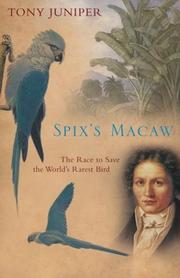
One species, followed to extinction in the wild, with collectors and conservationists both in the story. It is the concrete case that makes Tweti's argument land, and the right place to finish.