One Piece Reading Order: Where to Start and What Order to Read the Manga In
One Piece has run since 1997 and is past a hundred volumes, which is exactly why people ask where to start. A catalogue note first, because it changes what you are buying: the records this path uses are VIZ's 3-in-1 OMNIBUS editions, not the slim single volumes — each one collects three singles and runs around 600 pages, which is why the numbering here does not line up with the numbering on a single-volume spine. Omnibus 1 is singles 1-3, omnibus 2 is singles 4-6, and so on. The fourteen omnibus volumes below therefore carry you through roughly the first fifty-odd single volumes: past the end of East Blue, past the entry to the Grand Line, and into Alabasta — far enough to know whether you want the rest. Two further limits, stated plainly: the omnibus volumes numbered 4, 9, 15, 16 and 17 have no usable record here, so there are gaps you will need to fill elsewhere, and this is nowhere near an ending.
East Blue: The First Five Volumes
BeginnerMeet Luffy, understand what a Devil Fruit costs, and see the pattern the whole series repeats — arrive somewhere, meet someone broken by a local tyrant, recruit them. Note: every volume in this stage is a 3-in-1 omnibus collecting three single volumes, so the numbers here are omnibus numbers.
▸ Study plan for this stage
Pace: These are VIZ 3-in-1 omnibus volumes, each collecting three single volumes at roughly 600 pages, so budget accordingly and note the numbers are omnibus numbers rather than single-volume ones. Two to three weeks, reading a volume every couple of evenings. Before anything else, be clear about what thi
- The premise stated in chapter one and never abandoned: a boy with a rubber body, a straw hat he owes to someone, and a stated goal announced before he has a crew or a ship
- Crew recruitment as the engine of the opening act - each new arc introduces one member, gives them a debt or a wound, and resolves it enough for them to leave
- Oda's comedy-then-sincerity rhythm: a gag two panels before a serious beat, deployed so consistently that it becomes the series' tonal signature
- Zoro's introduction and the first real fight, which establishes that combat in this series is about a promise rather than about power
- Usopp as the crew member who is neither strong nor useful, and why a series about pirates needs one
- The Baratie arc and Sanji's flashback about hunger and obligation - the first stretch where the writing is genuinely good rather than merely energetic
- Mihawk, and the moment the series shows a ceiling above its heroes instead of a villain they can out-punch
- The East Blue as a deliberately small stage: everything here is a rehearsal for a scale the reader has not yet seen
- What does the straw hat represent, and how much of that is established in chapter one versus filled in later?
- For each crew member recruited in these volumes, what is the debt or wound that gets them aboard?
- How does Oda time a joke against a serious beat? Find one page where the switch happens inside a single panel row.
- What does the Mihawk fight establish that a victory could not have?
- Sanji's flashback is the first sustained serious sequence. What is it about, and why is it placed where it is?
- Track the straw hat. Note every panel across these volumes in which the hat is mentioned, given, taken, damaged or refused. It is the series' central object and Oda plants its meaning far earlier than most readers notice.
- Chart the recruitment formula on one page: for each of Zoro, Nami, Usopp and Sanji, write the arc, the antagonist, the debt, and the panel where they commit. By the fourth entry the template should be obvious - and noticing that the template is obvious while the arcs still work is the thing worth learning here.
- Take one page where a gag lands immediately before a serious beat and describe what changes between panels: framing, screentone, how much white space, how the faces are drawn. Oda switches register with drawing rather than with dialogue, and one page of close attention makes it visible everywhere afterwards.
- Reread chapter one immediately after finishing volume six. Almost everything the series will do at scale is stated there in miniature; list what you can now see in it that you could not on the first pass.
Next up: The crew is assembled and the stage is still small; the next stretch closes East Blue with the arc that turns a gag ensemble into people with histories, and then leaves it behind.
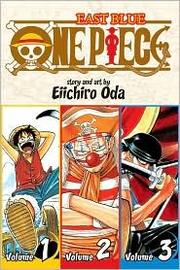
The correct starting point and the only one: Luffy sets out alone in a rowing boat, and the opening chapter establishes the rubber body, the straw hat and the debt behind it. Do not start with a later arc on someone's recommendation — the emotional payoffs later are all built on introductions made here.
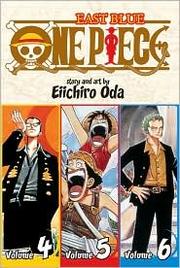
Zoro and the first real fight, and the volume where Oda's comedy-then-sincerity rhythm becomes legible. Read straight on from volume one; these two are effectively a single opening movement.
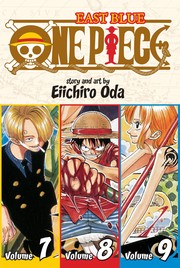
The Buggy and Captain Kuro material, and the introduction of Usopp — the first crew member who is neither strong nor useful, which turns out to matter. Volume 4 continues this arc but has no separate English single-volume record in our catalogue; read it in sequence between this and the next entry.

The Baratie arc opens and Sanji arrives, along with the flashback that is the series' first genuinely good piece of writing about hunger and obligation. This is usually the volume where sceptical readers stop being sceptical.

Mihawk, and the first time the series shows you the ceiling above its heroes rather than a villain they can simply out-punch. It sets the ambition for everything after.
Finishing East Blue and Entering the Grand Line
BeginnerRead the Arlong Park arc — the story that converts most readers — and cross into the Grand Line, where the rules change and the map stops being a map. Note: every volume in this stage is a 3-in-1 omnibus collecting three single volumes, so the numbers here are omnibus numbers.
▸ Study plan for this stage
Pace: These are VIZ 3-in-1 omnibus volumes, each collecting three single volumes at roughly 600 pages, so budget accordingly and note the numbers are omnibus numbers rather than single-volume ones. Two weeks, and if you can manage it, read volumes seven through eleven in as few sittings as possible - Arlo
- The flashback as Oda's primary structural device: the fight stops, the past is delivered whole, and the fight resumes with different stakes
- Nami's backstory and the shift it produces - the crew acquire histories, and the series acquires the register it uses for the next ninety volumes
- Arlong Park as a five-volume single arc, and what that length allows that a two-volume arc cannot
- Bounties and the world's reaction to the crew: the moment the story stops being local and the wider world starts responding
- Loguetown as a deliberate threshold - the place the series returns to its own origin story before crossing into the main narrative
- The end of the opening act: everything through volume twelve is the prologue, and Oda structures it as one
- Why this is where a reader can honestly decide - the series' method is fully visible by now and does not fundamentally change
- How does the Arlong flashback change what the reader thinks the preceding volumes were about?
- Where exactly does Oda cut from present to past in the Arlong sequence, and why at that moment?
- What do the bounties change about how the world treats the crew, and how does Oda show it rather than state it?
- What is Loguetown for, structurally? What would be lost if the series went straight from Arlong Park to the Grand Line?
- Having reached volume twelve, state in two sentences what One Piece is actually about. Then keep the sentences and check them against what you think at volume nineteen.
- Read volumes seven to eleven in one or two sittings, then go back and mark every page on which the flashback interrupts the present action. Diagram the interleaving. This is the technique the series runs on and it is never again as easy to see as it is here.
- Compare the Arlong flashback with Sanji's in the previous stage: length, placement relative to the fight, how much is shown versus told. Two examples are enough to derive the rule Oda is working to.
- Write down, at volume eleven, your prediction of what the Grand Line will be like. Then read volume twelve and note where the series confirms your expectation and where it deliberately undercuts it.
- Take the bounty poster sequence and list everything it accomplishes at once - plot, tone, world-building, character. Oda uses single objects to do several jobs, and this one is the clearest instance in the opening act.
Next up: The prologue is over and the crew crosses into the ocean the whole series is named for, where the antagonists stop being individuals and start being organisations.
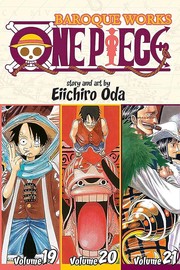
Arlong Park begins, and Nami's backstory turns the crew from a gag ensemble into people with histories. Read volumes 7 through 11 in one sitting if you can — the arc is designed as a single unit.
The middle of Arlong Park, where the flashback lands and the stakes stop being about treasure. This is the volume most often cited as the point of no return for new readers.

The Arlong fight itself. Volume 9 sits between this and the previous entry and does not resolve to its own record in our catalogue — it returns volume 14 instead — so it is omitted here rather than listed as a wrong book; read it in sequence.

The end of Arlong Park and the aftermath, including the bounty that changes how the world treats the crew. A short breather volume, and the last quiet one for a long time.
Loguetown and the entry to the Grand Line — the formal end of the opening act. If you have read this far and are not interested, the series will not change your mind; if you are, everything after this is the actual story.
The Grand Line and the Start of Alabasta
BeginnerSee what the series becomes once the world opens up: a long-form political adventure with a comedy pirate crew inside it. Note: every volume in this stage is a 3-in-1 omnibus collecting three single volumes, so the numbers here are omnibus numbers.
▸ Study plan for this stage
Pace: These are VIZ 3-in-1 omnibus volumes, each collecting three single volumes at roughly 600 pages, so budget accordingly and note the numbers are omnibus numbers rather than single-volume ones. Two weeks. This stage covers volumes thirteen through nineteen, of which volumes thirteen, fourteen, eightee
- Baroque Works and the shift from a person to an organisation as antagonist, which is the structural change that makes the rest of the series possible
- Vivi's promotion from plot device to viewpoint character, and what having an outsider on the ship does to the crew scenes
- Chopper's introduction as the first crew member recruited by grief rather than by debt or by a fight
- The Drum Island flashback and its handling of illness, quackery and death - the strongest evidence to this point that the series can do more than adventure
- Alabasta as the first arc about a country: rebellion, famine, and a scale at which the crew are not the largest thing in the story
- Oda's practice of planting details many volumes before they matter, now visible for the first time as a deliberate method rather than a coincidence
- That the crew stops growing by accident from here, and the series knows what it is
- What changes about the fights once the antagonist is an organisation rather than a single opponent?
- How does Vivi's presence change how the crew talk to each other? Point to a specific scene.
- Chopper is recruited differently from everyone before him. How, and what does the difference say about where the series has got to?
- The Drum Island flashback deals with a death the story cannot undo. How does Oda handle the tonal switch back into comedy afterwards?
- What is Alabasta about that no earlier arc could have been about?
- Return to the two-sentence statement you wrote at volume twelve about what this series is about, and revise it now. Keep both versions. The gap between them is the argument for reading this far rather than stopping at the end of East Blue.
- List every detail in volumes thirteen to nineteen that you are fairly sure will matter later - names dropped once, objects shown without explanation, characters who appear for a panel. Oda plants heavily, and the list is the most useful thing you can carry into volume twenty if you continue.
- Compare the Drum Island flashback with the Arlong flashback: what is at stake, who is saved, and what the series is willing to leave unfixed. Two hundred pages apart, they are the clearest measure of how far the writing has travelled.
- Make the decision explicitly and in writing. On one page, list what these nineteen volumes did well, what wore thin, and whether the pattern you charted in stage one has stopped rewarding you. There are eighty-odd volumes on the other side of that page, and the honest answer is worth an hour.
Next up: This is where the path ends rather than where the story does: the crew is complete, the ambitions are visible, and the numbered English volumes continue past thirty for anyone who has decided to keep counting.

Whisky Peak and Baroque Works — the first arc where the antagonist is an organisation rather than a person, and the first hint of the scale Oda is working at.

Little Garden and Drum Island are set up here, and Vivi becomes a viewpoint character rather than a plot device. Volumes 15, 16 and 17 continue this stretch but resolve only to Japanese-language editions in our catalogue, so they are not listed; read them in order.

Chopper's introduction and the Drum Island flashback, which is the series making a case that it can do grief as well as slapstick. Also the point where the crew stops growing by accident.
Alabasta proper begins, and with it the first arc that is about a country rather than a town. A good place to stop and take stock: the English single volumes continue in this same numbered form through volume 30 and beyond, so if you want to keep going, just keep counting.