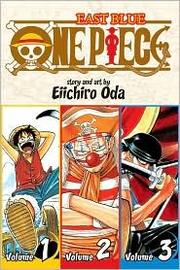
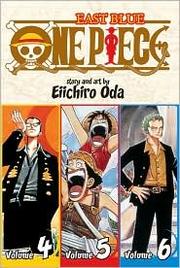
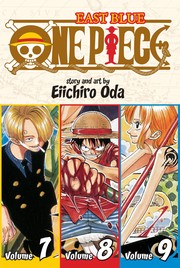
Start with One Piece, Vol. 1. There is no chronological alternative, no recommended skip and no better entry point — One Piece is a single continuous story published in sequence since 1997 and the first chapter sets up the goal the whole series is still pursuing.
Before you buy anything, read the next paragraph, because the numbering on this path is not the numbering everyone else uses.
These are omnibus volumes, not single volumes
The records here are VIZ's 3-in-1 omnibus editions. Each one collects three single volumes at roughly six hundred pages. So One Piece, Vol. 1 is single volumes 1 to 3, One Piece, Vol. 2 is singles 4 to 6, One Piece, Vol. 3 is singles 7 to 9, and the pattern continues: omnibus number N holds singles 3N minus 2 through 3N. The fourteen omnibus volumes on this path carry you through roughly the first fifty-odd single volumes.
This matters constantly. Every discussion, wiki, anime comparison and recommendation online counts in single volumes. If someone tells you the series turns at volume twelve, they mean single volume twelve, which sits inside omnibus four. Do the arithmetic before you assume you have read further than you have — and do not mix the two editions on your shelf, or you will buy the same chapters twice.
What is missing
Omnibus volumes 4, 9, 15, 16 and 17 have no usable record in our catalogue. In single-volume terms that removes chapters from three separate stretches of the story, and the gaps fall in the middle of long arcs rather than between them, which is the worst place for a gap to fall. If you want an uninterrupted read, buy the omnibus run directly rather than working from this list alone. The absence is in our records, not in the series.
The opening: omnibus one to three
One Piece, Vol. 1, One Piece, Vol. 2 and One Piece, Vol. 3 cover the East Blue, the introductory sea where the crew is assembled one member at a time. Each recruit gets a short arc with a self-contained villain, which makes this the most approachable stretch and the fairest test of whether the series is for you. The art is visibly early and the humour is broad. Give it at least through the second omnibus before deciding — the tonal range that the series is admired for, where slapstick and genuine cruelty sit in the same chapter, does not fully arrive in the first few hundred pages.
The Grand Line: omnibus five to fourteen
One Piece, Vol. 5 through One Piece, Vol. 14 take the crew onto the Grand Line and into the long-arc structure the rest of the series uses: an island, a regime, a backstory delivered in flashback, and a fight that resolves it. This is where One Piece stops being an adventure serial and starts being a very large book about power and who is permitted to hold it. It is also where the cast expands past the point where you can afford to skim.
The later omnibuses
One Piece, Vol. 18 and One Piece, Vol. 19 land far past the point where the earlier ones stop, with omnibus 15, 16 and 17 absent between them. Read them knowing you have jumped a stretch of story.
Nowhere near an ending
One Piece is ongoing and has passed a hundred single volumes. Fourteen omnibus volumes is a fraction of it, and the path stops mid-story rather than at a natural break. Starting One Piece is a commitment measured in months at least, and the series has no ending yet.
If you want a genuine stopping point, the end of the East Blue — single volume 12, which is the end of omnibus four — is the one place the series offers a clean exit: the crew is complete, the opening antagonist is defeated, and everything before it forms a whole. That omnibus is one of the five missing from our catalogue, which is worth knowing if you intend to stop there.
What you can skip
Nothing in the manga. The filler arcs people complain about are anime-only, created because the television adaptation caught up to the printed chapters and had to stall. The manga runs clean.
Follow the full ordered path here: One Piece Reading Order: Where to Start and What Order to Read the Manga In.