Naruto Reading Order: Where to Start and What Order to Read the Manga In
Naruto has one reading order and one real decision to make before you start: which edition. The original run is seventy-two slim volumes, but VIZ's 3-in-1 omnibus editions collect them three at a time in twenty-four larger books, and that is the format this path uses throughout — it is cheaper, it is what is reliably in print, and it stops the early arcs feeling as thin as they do at seventy pages a volume. Do not mix the two numbering systems; a shelf holding both will double-count and gap. Boruto is a sequel series with its own numbering and belongs after the whole run, not woven into it.
Start Here: The Land of Waves
BeginnerMeet Team 7, learn what the Nine-Tails is, and get through the arc that decides whether the series is for you.
▸ Study plan for this stage
Pace: About 2 weeks for 1,328 pages across two omnibus volumes — Naruto #1-3 (704 pages) and #4-6 (624 pages). Each omnibus is three of the original slim volumes, so a week each is a comfortable pace even though the page counts look large. Settle the format before you buy anything: the original run is sev
- The Academy premise and what a ninja village actually is: a military contractor with a school attached
- The Nine-Tails sealed in Naruto, and the village's treatment of him as the series' founding injustice
- Team 7 — Naruto, Sasuke, Sakura and Kakashi — and the three-genin-plus-jonin structure the whole series runs on
- The bell test as a statement of the series' values: cooperation over individual capability
- Chakra, jutsu and the hand-seal system as a magic system with rules that will be enforced later
- Zabuza and Haku as the first antagonists with a case, which is where Kishimoto shows what the series will be about
- The weakness of the opening stretch, which is well known and worth knowing in advance — the series improves sharply after it
- What is a jinchuriki, and what is the village's relationship to Naruto because of it?
- What does the bell test measure, and what does Kakashi's verdict establish about the series' values?
- What is Zabuza and Haku's argument, and how does the arc's ending treat it?
- How does the chakra system constrain what characters can do? Name three rules the series establishes early.
- What is Sasuke's stated motivation at the end of the Land of Waves arc, and what has he not yet explained?
- Decide your format now and write it down — 3-in-1 omnibus throughout, or slim volumes throughout. Mixing them is the single most common way readers lose their place in this series.
- Read the Haku sequence at the end of #4-6 and then reread the bell test at the start of #1-3. The arc is a deliberate answer to the test and the pairing is the clearest early evidence that Kishimoto is planning.
- List the rules of chakra as the first two omnibuses state them. The series is unusually consistent about its own mechanics and having the rules written down makes the later fights legible.
- Note where the first omnibus loses you, if it does, and read to the end of the second before judging. This is the stretch readers most often abandon and the one the whole fandom agrees is the weakest.
Next up: Team 7 is formed and tested, which is exactly the setup the tournament arc needs in order to measure them against everyone else.
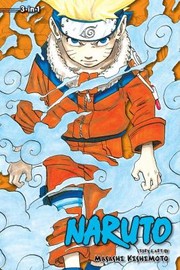
The only place to begin. The first omnibus covers the Academy, the bell test and the beginning of the Land of Waves mission — and it is the stretch that most readers find weakest, so know going in that the series improves sharply.
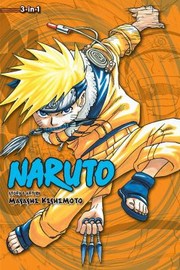
Finishes the Zabuza and Haku arc, which is where Kishimoto first shows he can write an antagonist with a case. If this does not hold you, the series will not.
The Chunin Exams
BeginnerRead the long tournament arc that introduces most of the supporting cast and the series' best early fights.
▸ Study plan for this stage
Pace: About 3 weeks for 1,724 pages: Naruto #7-9 (600 pages), #10-12 (545 pages) and #13-15 (579 pages). One omnibus a week. This is a long arc and reading it in a continuous run is worth it — the cast roughly triples during it, and spacing the volumes out makes the new names much harder to hold.
- The tournament structure as a device for mass character introduction, and how many characters Kishimoto brings in at once
- Orochimaru's entrance in the Forest of Death, and the shift from mission-of-the-week to a plot with a villain in it
- The curse mark and the first sign that Sasuke's arc will run against the team's
- Neji and Hinata's material — the branch and main house structure — which the series returns to for the next sixty volumes
- Rock Lee as the series' argument that effort can substitute for talent, stated more directly than anywhere else in it
- The training month as structural machinery: a gap that lets several characters change off-page and return measurably stronger
- The invasion of the Leaf and the series' first permanent loss, which ends its lighter mode
- What are the Chunin Exams for inside the world, and what is Kishimoto using them for as a writer?
- What is the Hyuga branch-house system, and why does the series keep coming back to it?
- What does Orochimaru want from Sasuke, and how much of it does the exam arc actually explain?
- Which of the new characters introduced in #7-9 are still load-bearing sixty volumes later?
- What does the invasion change permanently, and how does the series signal that it will not be undone?
- Keep a roster as you read #7-9: every new genin, their village, their technique. The arc introduces more characters than any other stretch in the series and the roster is what makes the finals followable.
- Read the Neji and Hinata fight, then reread it after the invasion. The family material is being planted, not just staged, and the second read shows the planting.
- Chart the finals bracket and, before each match, write down what you think the fight is for narratively rather than who wins. Kishimoto almost never uses a fight only to determine an outcome.
- Mark the exact page where the series stops being comic. Readers disagree about it and the disagreement is worth having with yourself.
Next up: The exam arc establishes who is powerful and why; the next stage reframes that entirely by introducing the generation above it.
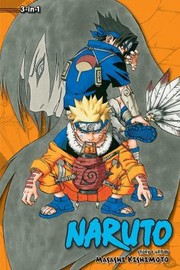
The exam begins and the Forest of Death introduces Orochimaru. The cast roughly triples in size here, which is the point of the arc.

The preliminary rounds and the training month. Contains the Neji and Hinata material that the series returns to for the next sixty volumes.

The finals and the invasion of the Leaf. The first time the series lets a major loss stand, and the end of its lighter mode.
Sasuke Leaves
IntermediateFollow the search for Tsunade and the retrieval arc that closes Part I.
▸ Study plan for this stage
Pace: About 3 weeks for 1,683 pages: Naruto #16-18 (566 pages), #19-21 (581 pages) and #22-24 (536 pages). One omnibus a week again. The Sasuke Retrieval arc in #19-21 is a sequence of one-on-one fights and is the strongest sustained stretch of Part I — read it in as few sittings as you can. #22-24 ends P
- The Sannin — Jiraiya, Tsunade and Orochimaru — and how their introduction reframes who is actually powerful in this world
- Itachi's first appearance and the reframing of everything Sasuke's motivation was assumed to be
- The Akatsuki as an organisation glimpsed before it is explained
- The Retrieval arc's structure: parallel one-on-one fights, each testing a different member of Naruto's generation against a different limit
- Defeat as the series' argument — the arc's outcome is a failure, and the series does not soften it
- The Valley of the End as the emotional statement Part I has been building toward
- The time skip: a two-and-a-half-year gap that effectively restarts the series with older characters
- What does the Sannin material establish about the power structure that the Chunin Exams got wrong?
- What does Itachi tell Sasuke, and what does the series withhold about it at this stage?
- Why does Kishimoto structure the Retrieval arc as separate simultaneous duels rather than one battle?
- The arc ends in failure. What does the series gain by that, and what would have been lost if it had not?
- What is genuinely finished at the end of #22-24, and what is merely paused?
- Take each duel in the Retrieval arc and write one line on what limit that character is being tested against. All five are different and the arc is designed as a set.
- Read the Valley of the End sequence, then reread the bell test from #1-3. Part I is bracketed by those two scenes and the pairing is deliberate.
- Write down the state of every major character at the end of #22-24 before you open the next omnibus. The time skip changes all of them and the before-picture is only available now.
- Decide here whether you are continuing. #22-24 is the cleanest stopping point in the entire series and it is a legitimate place to end.
Next up: Part I closes on a failure and a time skip, and Part II opens with older characters in what is effectively a different genre.

Jiraiya, Tsunade and the introduction of Itachi. The Sannin material reframes everything the exam arc established about who is actually powerful in this world.
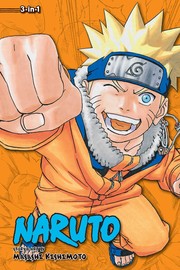
The Sasuke Retrieval arc — a sequence of one-on-one fights that is the strongest sustained stretch in Part I, and the arc that most defines the series' emotional argument.

Ends Part I at the valley. This is a genuine stopping point: the story pauses for a two-and-a-half-year time skip and effectively restarts with older characters.
Part II Begins
IntermediateAbsorb the time skip and the shift from a school story to a war story.
▸ Study plan for this stage
Pace: About 2 weeks for 1,124 pages: Naruto #25-27 (561 pages) and #28-30 (563 pages). Note that Part I ends and Part II opens inside #25-27, so that omnibus straddles the time skip — expect the tone, the stakes, the pacing and the art all to change partway through a single book.
- The time skip's effect: a school story becoming a war story, with the same cast
- The Gaara rescue arc as Part II's statement of new stakes — the series is now willing to put major characters beyond saving
- The Akatsuki as an organisation with membership, methods and an objective, rather than as a rumour
- Sai and the new Team 7, and what replacing Sasuke with a stranger does to the team dynamic
- The tailed beasts as a system: the jinchuriki premise from volume one becomes the central plot
- Denser plotting as a permanent change — from here the series runs multiple simultaneous threads
- Kishimoto's art after the skip, which changes markedly in panel construction and character design
- What is different about the world when Part II opens, beyond the characters being older?
- What does the Akatsuki actually want, and how much of the plan is disclosed in these two omnibuses?
- What is Sai for, both inside the story and structurally as a replacement for Sasuke?
- How does the Gaara arc's resolution differ from the way Part I resolved comparable stakes?
- How many separate plot threads are running by the end of #28-30? Name them.
- Find the exact page inside #25-27 where Part II begins and reread the twenty pages either side of it. The tonal shift is legible in the art before it is legible in the writing.
- Compare a Part I fight with a Part II fight of similar length on panel count and how much of the outcome is decided by preparation rather than by escalation. The series changes its combat grammar at the skip.
- List the Akatsuki members as they are introduced, with the technique and the objective attached to each. The organisation drives the next thirty volumes and the list is worth keeping.
- Compare your end-of-Part-I character notes against the same characters at the end of #28-30. The gap is what the time skip was for.
Next up: With the Akatsuki established as the plot rather than the backdrop, the series moves into the arcs it is actually remembered for.
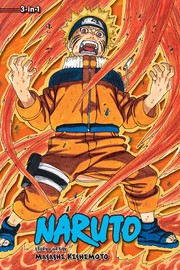
Part I ends and Part II opens inside this omnibus, with the Gaara rescue arc. Expect a change of tone rather than a continuation — the stakes, the pacing and the art all move at once.
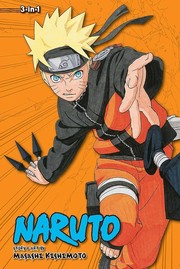
Sai, the new Team 7 and the first sustained look at the Akatsuki as an organisation. The plotting gets denser here and stays that way.
The War, and Where to Go Next
BeginnerReach the arcs the series is remembered for, and know how the remaining volumes are numbered.
▸ Study plan for this stage
Pace: About 2 weeks for 1,119 pages: Naruto #31-33 (553 pages) and #34-36 (566 pages). Read the Pain arc in #34-36 in as few sittings as possible — it is the series' most famous sequence and it is constructed as one continuous movement. #31-33 contains a death that finally forces the plot and Naruto's tra
- The Hidan and Kakuzu arc as the point where a death changes the protagonist's development rather than just the mood
- Nature transformation and the training that comes out of that loss, which is the first time Naruto's power growth is plot-driven
- The Pain arc as the fullest statement of the series' argument about cycles of revenge
- Pain's position stated as an argument the series takes seriously rather than as villain rhetoric
- The scale change — an assault on the village itself rather than a mission away from it
- The series' central proposition: that the cycle is broken by refusing revenge, and what the arc costs to make that case
- Where to go from here — the omnibus run continues in the same format all the way to Naruto #70-72, and Boruto is a sequel series with its own numbering that belongs after the whole run rather than woven into it
- What does the death in #31-33 change about how Naruto trains and why he trains?
- State Pain's argument in a form he would accept. What is his account of how peace is actually produced?
- How does Naruto answer him, and does the series present that answer as sufficient?
- What is different about an arc fought inside the village rather than outside it?
- What is your continuation plan — which omnibuses remain, and where do the sequel series go?
- Write out Pain's argument as a numbered case and then write Naruto's reply as a numbered case. The arc is a debate with fights attached and both sides are stated properly.
- Trace the cycle-of-revenge motif backwards from Pain through Sasuke, Gaara and Zabuza. Four antagonists, one thesis — the series has been making this argument since #4-6.
- Reread Naruto's first meeting with Nagato's introduction pages after finishing the arc, and note how much of the reveal was visible on the first pass.
- Set your continuation now: the omnibus run to Naruto #70-72 in the same format, then Boruto afterwards. Writing down the format decision again here prevents the shelf problem the first stage warned about.
Next up: This is where the path stops rather than the series: carry straight on in the same omnibus numbering to Naruto #70-72, and leave Boruto until the main run is finished.
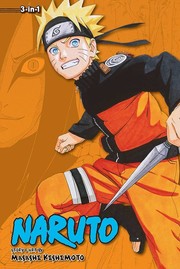
The Hidan and Kakuzu arc, and the death that finally forces Naruto's training to become the plot. The last arc before the series' most famous sequence.

The Pain arc — widely regarded as the peak of the series and the fullest statement of its argument about cycles of revenge. The omnibus run continues in the same format all the way to Naruto #70-72; keep going straight from here, and leave Boruto until you have finished.