Laszlo Krasznahorkai Reading Order: Where to Start with the Long-Sentence Hungarian
Krasznahorkai writes paragraph-long sentences and book-long paragraphs, and there are no chapter breaks to rest in. The entry point therefore decides whether you continue at all. This path starts with the one that has a plot you can hold on to, and only then goes back to the famous debut.
Start here
BeginnerBegin with the novel that has the strongest narrative pull.
▸ Study plan for this stage
Pace: 2-3 weeks at roughly 25 pages a sitting. The Melancholy of Resistance has no chapter breaks to rest in, so stop at a paragraph end rather than a page count, and expect a single sentence to run for pages.
- The long sentence as the unit of composition: clauses accumulate rather than resolve
- Eszter and the Werckmeister tuning argument as the novel's intellectual spine
- A hollow apocalypse: the whale and the Prince are a pretext, the crowd supplies the catastrophe
- Mrs Eszter's opportunism against Valuska's blankness as the two ways of surviving the town
- The provincial Hungarian town as a closed system with no outside to escape to
- Where the paragraph breaks fall, and what that does to pacing
- What actually causes the riot, and how little does the whale have to do with it?
- How does the narration move from one character to another without a scene break?
- What is Eszter's retuning experiment arguing about order and the natural world?
- Why does Valuska pass through the entire plot without understanding it?
- Which passages could be lifted out as self-contained, and which depend on everything before them?
- Mark where each paragraph begins and ends for the first fifty pages, then read one paragraph aloud to feel the clause rhythm the eye skips
- Read the Eszter tuning passages twice, once for the argument and once purely for sound
- Keep a one-line note per paragraph across the riot sequence, then check afterwards how much of the violence you could actually see happening
- Watch Bela Tarr's Werckmeister Harmonies after finishing and list what the film had to cut; the compression shows what the prose was doing
Next up: Once you can hold a Krasznahorkai paragraph without losing the thread, Satantango's twelve-part structure becomes navigable rather than punishing.
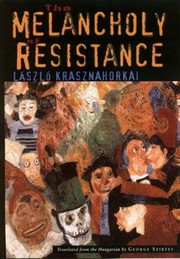
A circus arrives in a Hungarian town with a stuffed whale, and the town falls apart. It has a plot, a monster and a mob — which makes it the only one of his books that reads at speed. Béla Tarr filmed it as Werckmeister Harmonies.
The debut
BeginnerNow read the famous one, which is much harder without the first behind it.
▸ Study plan for this stage
Pace: About 3 weeks. Twelve chapters across 287 pages: read one chapter per sitting and stop there, because the chapter is the designed unit and its ending is the only rest built into the book.
- The tango structure: six chapters forward, six back, with the numbering reversing at the midpoint
- Irimias as saviour and police informer at the same time
- The rain-soaked collective estate as a place that never releases anyone
- The doctor's notebooks and the ending that folds the novel back onto its own first page
- Estike's chapter as the moral centre and the hardest thing in the book
- Pre-Melancholy prose: the same sentence, held with less control
- How does the chapter numbering work, and where exactly does the book turn back on itself?
- What is Irimias actually offering the villagers, and who pays for it?
- What does the final chapter reveal about who has been writing what you just read?
- How does Estike's episode change your reading of the villagers' credulity?
- Is Satantango harder than The Melancholy of Resistance, and if so, at what level: sentence, structure or plot?
- Write out the chapter numbers in the order they appear and map the reversal before you reach chapter seven
- Reread the last chapter immediately after finishing, then reread chapter one; the join is the whole point
- Compare the opening cattle-bell paragraph with the opening of The Melancholy of Resistance for how each establishes weather and dread
- Track every mention of the doctor's observations and note where they match what the narration has told you elsewhere
Next up: With the debut behind you, the later novels leaving Hungary read as a deliberate extension of the method rather than a change of subject.

A collapsing collective farm and the swindler who returns to save it. Twelve chapters that step forward six and back six, like the dance. This is the book he is known for and the one that defeats people who start here.
The later novels
BeginnerFollow the method as it leaves Hungary.
▸ Study plan for this stage
Pace: 5-6 weeks. War and War in about a fortnight; Seiobo There Below is 451 pages of seventeen discrete chapters, so give it a month at one chapter per sitting, because nothing accumulates as plot.
- Korin's manuscript and the compulsion to transmit something he cannot explain
- New York as the end of the world rather than the New World in War and War
- Seiobo's Fibonacci chapter numbering and what it implies about growth
- The craftsman chapter as a form: making one thing exactly right, at length
- Beauty as a threat rather than a consolation
- Sentence-level continuity holding across two books with almost nothing else in common
- What does Korin believe the manuscript is, and does the novel ever confirm it?
- Why is Seiobo numbered by the Fibonacci sequence instead of consecutively?
- Which Seiobo chapters have a plot at all, and what carries the ones that do not?
- How has the sentence changed since Satantango: longer, or differently weighted?
- What does moving out of Hungary cost these books, and what does it buy?
- Read the Noh mask chapter and the Alhambra chapter of Seiobo back to back and note what each does with a single made object
- After War and War, read about the Kossuth Square installation the novel is tied to, then reread the closing pages
- Pick one Seiobo chapter and count its sentences; most run to a handful across many pages
- Reread a Satantango chapter next to a Seiobo chapter and list the differences in how a paragraph ends
Next up: Seiobo's discipline of the standalone chapter is the best preparation for a late book that spends 576 pages arriving at a single homecoming.
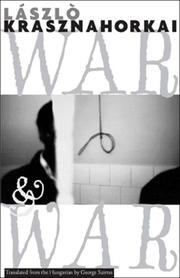
An archivist finds a manuscript and travels to New York to type it onto the internet before killing himself.

Seventeen chapters on artists and craftsmen across centuries, numbered in the Fibonacci sequence. The most beautiful thing he has written and the least like a novel.
The late work
BeginnerFinish with the long farewell and a short entry point you can hand to someone else.
▸ Study plan for this stage
Pace: 4-5 weeks for Baron Wenckheim's Homecoming at roughly 30 pages a sitting, then two or three evenings for The Last Wolf and Herman. The Last Wolf is one sentence of about seventy pages and reads best in a single unbroken run.
- The Baron as a comic novel, and the register shift that makes it one
- A town projecting wealth and salvation onto a man who has neither
- Explicit closure of the cycle Satantango opened, stated by the author as such
- The single-sentence novella as the method distilled to its minimum
- Herman as the early, harder version of the same obsession
- Which of these six books you would hand a new reader, and why it is not Satantango
- How does the Baron's comedy work against the dread of the earlier books?
- In what specific ways does the Baron close what Satantango opened?
- What does The Last Wolf gain by never stopping?
- Why is Herman paired with The Last Wolf in this volume, and what do they share?
- If you had to give one of these six books to a friend, which one, and on what grounds?
- Read The Last Wolf in one sitting, then reread its first page; the entrance looks different once you know the exit
- Return to the Satantango finale and the Baron's finale on the same day and write the two endings out side by side
- Give The Last Wolf and Herman to someone who has read none of these and note where they stall
- Hold the Baron's page count against a one-paragraph plot summary and account for the difference
Next up: With the cycle read end to end, the natural next step is outside the novels, to the Bela Tarr films Krasznahorkai co-wrote from them.

An exiled baron returns to his home town, which is convinced he is rich. Explicitly written as the closing of the cycle Satantango opened.

Two novellas in one record — The Last Wolf is a single sentence of about seventy pages, and it is the cheapest way to find out whether you can read him at all.