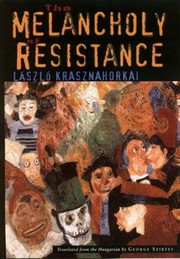
Start with The Melancholy of Resistance. A circus arrives in a small Hungarian town carrying the stuffed body of the largest whale in the world and a deformed man called the Prince, a crowd gathers in the freezing square, and over one night the town tears itself apart. It is the most propulsive thing Krasznahorkai wrote — there is an actual event unfolding, with dread accumulating page by page — and that forward pull is exactly what you need while you are getting used to the sentences.
The obvious alternative is Satantango, his 1985 debut, better known because of Béla Tarr's seven-hour film. Read it second. It is a great novel and a harder shape: six chapters advance and six retreat, mirroring the dance of the title, and the whole thing takes place in ceaseless rain among people waiting on a swindler's return. It has no engine, only a circling. Coming to it after The Melancholy of Resistance you will read the circling as design; coming to it cold you may read it as being stuck.
The honest warning about the prose
Krasznahorkai writes in sentences that run for pages. Paragraph breaks are close to absent — Satantango gives you one paragraph per chapter — and the syntax accumulates by subordination, doubling back, qualifying itself, refusing to stop where you expect a stop. There is no technique for making this easy. The only thing that works is reading in longer sittings than you normally would, because the rhythm does the carrying and stopping mid-sentence breaks it. Most readers who bounce off him have been reading in ten-minute fragments.
His translators, George Szirtes and Ottilie Mulzet, have done something remarkable in English, and the sentences are genuinely beautiful rather than merely long. But they are long.
The eighty-page test drive
If you want to know whether you can do this before committing to a novel, The Last Wolf & Herman is two short pieces in one slim volume, and the first is a single unbroken sentence about a failed writer sent to a Spanish region to write about its last wolf. It is the concentrated form of everything he does. Some readers use it as a sampler; be aware it is also the most extreme version of the style, so it is a harsh test rather than a gentle one.
The middle novels
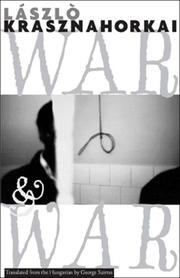
War and war comes third. A small-town archivist finds a manuscript he believes must be preserved before the world ends, travels to New York to type it onto the internet, and the novel alternates his unravelling with the strange narrative he is transcribing. It is his most emotionally direct book, and the one readers most often name as the moment he clicked for them.
Seiobo there below is not a novel but a sequence of episodes about art and the sacred — a Noh mask carver, a Byzantine icon, a Baroque restoration, the rebuilding of a shrine — with chapters numbered in the Fibonacci sequence. It contains his best individual writing. It also has no plot at all, which means it is either the finest thing he did or the one you cannot finish, depending on why you are here.
The late summa
Baron Wenckheim's Homecoming returns to the town of the early novels for a ruined aristocrat's homecoming and a comic, apocalyptic farce. The sentences are the longest of his career, and he described it as the closing of the arc that began with Satantango. Read it only if the first three worked; as a first Krasznahorkai it would be a genuinely bad idea.
Where to stop
Two books is a legitimate stopping point, and many readers stop there — The Melancholy of Resistance and Satantango between them contain the whole vision, and the later books extend rather than transform it. If you want a third, make it War and war. He won the International Booker in 2015 and the Nobel Prize in Literature in 2025, so there is now a great deal of encouragement to keep going; take it or leave it on the evidence of the first two. Find more world-literature reading paths on Discover.
Follow the full ordered path here: Laszlo Krasznahorkai Reading Order: Where to Start with the Long-Sentence Hungarian.