John Dickson Carr books in order: where to start with the locked-room mysteries
The master of the impossible crime — the locked room, the footprints that stop, the murder in a watched house. He wrote two main series under two names: Dr Gideon Fell as John Dickson Carr, and Sir Henry Merrivale as Carter Dickson. Our catalogue files everything under Carr, so the pen name is invisible here even though it is not on a bookshop shelf.
Start here
IntermediateBegin with the two Fell novels that are always named first.
▸ Study plan for this stage
Pace: Two weeks. The Hollow Man is 256 pages and He Who Whispers 206 — both readable in three or four sittings each. Give The Hollow Man a full week on its own: it is the densest puzzle Carr built, and the locked-room lecture in the middle rewards stopping to think rather than reading on.
- The impossible crime as a distinct sub-genre — not whodunit but how-was-it-possible-at-all
- Dr Gideon Fell, the lexicographer detective modelled on G. K. Chesterton, and the bulk-and-bluster manner that goes with him
- The locked-room lecture in The Hollow Man, in which Fell classifies every possible solution to a sealed-room murder and admits he is in a detective story
- The double problem: a man vanishes from a sealed room, and a second victim is shot in an empty snow-covered street with no footprints
- Fair play — Carr's contract with the reader that every clue is on the page, and the Detection Club culture that enforced it
- The atmosphere of the supernatural deployed and then withdrawn: He Who Whispers takes a vampire explanation seriously for longer than is comfortable
- The published-title problem: The Hollow Man appears in the United States as The Three Coffins, and readers regularly buy it twice
- Fell's lecture lists the categories of locked-room solution. Which category does The Hollow Man's own answer fall into, and does naming it in advance spoil or sharpen the effect?
- Why does Carr have Fell admit, inside the novel, that they are all in a detective story?
- In He Who Whispers, at what point does the supernatural explanation stop being available, and what has Carr been doing with the delay?
- Compare the two solutions: which is more ingenious and which is more fairly clued? They are not the same book.
- Fay Seton is one of Carr's few genuinely realised characters. Does He Who Whispers work as a novel about her, or only as a puzzle she happens to be inside?
- Stop at the end of the locked-room lecture in The Hollow Man and write down your solution before reading on. This is the only correct way to read the book and almost nobody does it.
- Draw the street plan for the second murder from the text alone — positions of the witnesses, the snow, the sightlines. Carr supplies enough to do it, and the drawing is where the trick becomes visible or does not.
- In He Who Whispers, list every fact that supports the vampire reading and mark the page where each is eventually accounted for. Two or three will be accounted for very late.
- Check which title your copy of The Hollow Man carries. If it says The Three Coffins, it is the same book — note it now, before you buy a second one.
Next up: You now know the Fell manner and the fair-play contract, which is exactly what you need to enjoy the other series — written under a pen name our catalogue does not show.
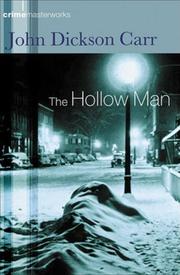
Published in the United States as The Three Coffins. A man vanishes from a sealed room and a second victim is shot in an empty street. It contains the famous locked-room lecture, in which Fell classifies every possible solution — including this one.
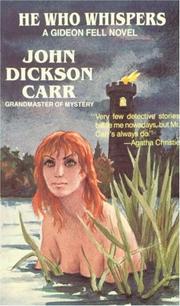
A murder at the top of a tower nobody could have climbed, and a vampire explanation the novel takes seriously for longer than is comfortable. Often called his best-constructed book.
Sir Henry Merrivale
IntermediateThe other series, written as Carter Dickson — probe under either name, our records answer to both.
▸ Study plan for this stage
Pace: Two weeks. The Judas Window is 255 pages and The Plague Court Murders 251, both quick once the cast is straight. Read The Judas Window first even though Plague Court came earlier — the courtroom structure makes it the most accessible book Carr wrote, and it is the better introduction to H.M.
- The Carter Dickson pen name: the Sir Henry Merrivale novels were published under it, and our catalogue files everything under Carr, so the split is invisible here but not on a bookshop shelf
- Sir Henry Merrivale — barrister, physician, baronet, and a comic grotesque where Fell is merely large
- The Judas Window's premise: a man wakes in a locked room with a corpse and an arrow through it, and is tried for murder
- The courtroom as a structure that does the exposition for you, which is why this is the easiest Carr to follow
- The title's meaning, which is also the solution — a rare case of Carr putting the answer on the cover
- The Plague Court Murders as H.M.'s first appearance: a haunted house, a seance, and a stabbing inside a locked stone outbuilding
- The seance and the fraudulent medium as period furniture, and Carr's consistent position that the supernatural is atmosphere rather than explanation
- What does a trial setting give Carr that a house-party investigation does not, and what does it cost him?
- The Judas Window's title names its solution. Why is that not a spoiler, and what does the fact that it is not tell you about how these books work?
- Merrivale and Fell solve by different means. Characterise the difference from these two books alone.
- In The Plague Court Murders, how much of the atmosphere is load-bearing and how much is decoration you could cut without touching the solution?
- Carr used a pen name for a second series by the same hand in the same genre. What was the commercial logic, and does the writing differ at all?
- In The Judas Window, note the exact page where the phrase of the title is first explained. Then go back and find every earlier passage that would have let you get there first.
- Reconstruct the Plague Court outbuilding on paper — door, window, mud, footprints. Carr's impossible situations are geometric and the geometry is always given.
- Read the first appearance of H.M. and the first appearance of Fell side by side. Two detectives, one author, and the difference is a deliberate commercial decision as much as an artistic one.
- If you buy further volumes, search under both John Dickson Carr and Carter Dickson. Our catalogue answers to both names, but a bookshop will not.
Next up: Both series are now familiar; the last stage takes the two books where the solution is so audacious that readers have argued about whether it is legitimate for eighty years.
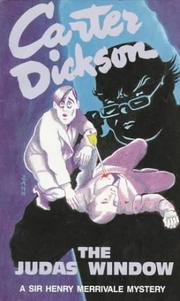
A man wakes in a locked room with a corpse and an arrow in it, and is tried for murder. The courtroom setting makes it the most accessible of all his puzzles.

Merrivale's first appearance — a haunted house, a seance and a stabbing in a locked stone outbuilding.
The other famous ones
IntermediateTwo more where the solution is the entire point.
▸ Study plan for this stage
Pace: Two weeks. The Crooked Hinge is 255 pages and The Burning Court 280. Read The Crooked Hinge first and argue with it, then take The Burning Court slowly — its last chapter reverses the book, and the only sensible response is to reread the first fifty pages the same evening.
- The Crooked Hinge's impostor plot, drawn from the Victorian Tichborne claimant case: two men claim the same estate and both are convincing
- The automaton — a mechanical figure at the centre of the house, and Carr's willingness to hang a murder on machinery
- A murder committed in full view of witnesses, which is the impossible-crime problem inverted
- The Crooked Hinge's solution as the most divisive in Carr: either brilliant or outrageous, and the argument is genuinely unsettled
- The Burning Court as a standalone with no series detective, and a poisoning case with a supernatural explanation offered in earnest
- The final chapter of The Burning Court, which upends the rational solution the reader has just accepted
- Whether that epilogue breaks the fair-play contract that the whole path has been built on
- Is The Crooked Hinge's solution fairly clued, or does it depend on a fact a reader could not reasonably have entertained?
- The automaton is one of Carr's great images. Does the novel need it, or is it atmosphere attached to a solution that works without it?
- In The Burning Court, does the final chapter cancel the detective solution, coexist with it, or reveal that the detective solution was a lie told to a specific person?
- Fell's lecture in The Hollow Man laid out the rules. Which of these two books breaks them, and does the break improve the book?
- Having read six, rank them by ingenuity and separately by pleasure. Carr is a writer where the two orders diverge sharply.
- Which of the six would you hand to someone who has never read a locked-room mystery, and has your answer changed since stage one?
- After finishing The Crooked Hinge, write down the single fact the solution rests on and decide whether it appeared before the reveal. Then find the page. This is the argument in miniature and you can settle it for yourself in ten minutes.
- Read The Burning Court's last chapter, then immediately reread its first chapter. The novel is designed to be read this way and almost nobody does it.
- Go back to Fell's locked-room lecture and test all six books against its categories. Two of them will not fit, which is the point of doing it.
- Look up the Tichborne case in outline and compare it with The Crooked Hinge's claim plot. Carr habitually built on real cases — He Who Whispers and The Judas Window both have real-world antecedents — and knowing the source changes what feels contrived.
- Write one paragraph on whether The Burning Court is a detective novel. Whatever you conclude, the paragraph is the best summary of what reading Carr is actually for.
Next up: You have the six books the reputation rests on; from here the wider shelf — the historical mysteries, the radio plays, the Conan Doyle biography — opens up with the puzzle grammar already learned.
An impostor claim, an automaton and a murder in full view of witnesses. The solution is either brilliant or outrageous and readers have argued about it for eighty years.
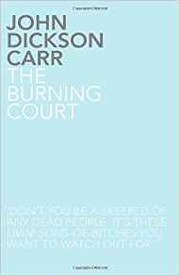
A poisoning case with a supernatural explanation and a final chapter that upends everything. The most genuinely unsettling thing he wrote.