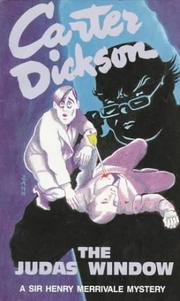
Start with The Judas window. A man wakes in a locked study with a corpse and an arrow through it, no other way in or out, and goes on trial for murder — and Carr then solves it in open court without withholding a single fact from you. It is the fairest of his impossible crimes and the easiest to admire on a first reading, because the explanation is the kind you can kick yourself for missing rather than the kind you have to be told to appreciate.
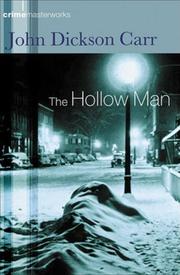
The obvious alternative is The hollow man, which has topped more than one poll of the best locked-room novel ever written. Read it second. It contains the celebrated chapter where the detective stops the plot dead to lecture on every conceivable way to seal a room, which is exhilarating once you already love the form and merely strange if you do not, and its solution is elaborate enough that a minority of readers close the book feeling conned. Better to arrive at it already converted.
Two series, two names, one author
Carr wrote his best work across two detectives under two names. Dr Gideon Fell — a vast, wheezing, beer-drinking lexicographer modelled on G. K. Chesterton — appeared under John Dickson Carr. Sir Henry Merrivale, a bald, bad-tempered barrister-baronet who is funnier and less dignified, appeared under the pen name Carter Dickson.
Our catalogue files everything under Carr, so the split is invisible on this page. It is not invisible on a bookshop shelf or in a library catalogue, where the Merrivale novels sit under D and can look like a different writer entirely. If you go hunting for more Sir Henry Merrivale after The Judas window, search Carter Dickson.
The publication order, for reference
The Plague Court murders came in 1934, The hollow man in 1935, The Burning Court in 1937, The Crooked Hinge and The Judas window both in 1938, and He who whispers in 1946. Almost none of it matters. Carr wrote self-contained puzzles with negligible continuity between them; there is no running arc, no character development you can spoil, and no reason to read chronologically unless you want to watch his technique tighten through the 1930s.
The Gideon Fell novels
The hollow man gives you two impossible murders — a man vanishes from a sealed room, then a second victim is shot in an empty snow-covered street with no footprints. It was published in the United States as The Three Coffins, and you will meet both titles for the same book.
The Crooked Hinge turns on a disputed inheritance claim and an automaton, and it is the one to be wary of: the solution depends on a physical revelation that some readers find brilliantly audacious and others find preposterous. It is worth reading for the atmosphere either way.
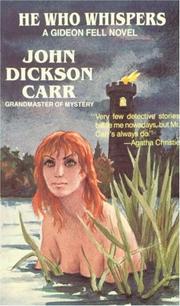
He who whispers is late Carr and, for many, the best-written thing he did — a murder on top of a tower with no one near the victim, wrapped in a suggestion of vampirism that the book takes seriously for far longer than you expect. If you only ever read two Fell novels, make it this and The hollow man.
The Henry Merrivale novels
The Plague Court murders introduces H.M. and is the most gothic of the six: a haunted London house, a séance, a body in a locked stone outbuilding surrounded by unmarked mud. It is slower than the others and the occult scene-setting takes its time, so do not make it your first.
The Judas window is where the series peaks, which is why it is the entry point here.
The standalone
The Burning Court is Carr's strangest book. It is a poisoning case, apparently rational, that ends with a final chapter reframing everything supernaturally. Readers split hard: some think the coda is the most audacious ending in the genre, others that it retroactively cheats. Read it last, when you can judge it against the rest.
Where to stop
Six books is a fair sample. Carr kept writing into the 1970s, but the later novels — increasingly historical mysteries — are generally held to be weaker, and his reputation rests almost entirely on the decade covered above. Browse more crime and mystery reading paths on Discover.
Follow the full ordered path here: John Dickson Carr books in order: where to start with the locked-room mysteries.