Learn information theory: the best books to read in order
This curriculum builds a rigorous, deep understanding of information theory starting from an intermediate level — assuming comfort with probability and basic math but no prior exposure to Shannon's framework. The path moves from intuitive foundations and historical context, through the core mathematical theory of entropy, coding, and channels, and finally into advanced topics like rate-distortion theory, algorithmic information, and network information theory. Each stage equips the reader with the vocabulary and tools needed to tackle the next.
Foundations & Intuition
IntermediateBuild a clear mental model of what information theory is, why it matters, and how entropy, compression, and communication fit together — without yet diving into full mathematical rigor.
▸ Study plan for this stage
Pace: 8–10 weeks, ~25–30 pages/day (alternating between narrative and technical sections)
- Information as a measurable, physical quantity tied to entropy and disorder
- Entropy as a measure of uncertainty, surprise, and the number of possible states
- The relationship between information, compression, and redundancy
- Shannon's foundational insight: information is about reducing uncertainty, not meaning
- How communication channels have limits (bandwidth, noise) that constrain information flow
- The distinction between data, information, and meaning in practical systems
- Probability distributions as the foundation for quantifying information content
- Real-world applications: from DNA to digital communication to language
- Why is entropy a useful measure of information, and how does it relate to uncertainty?
- What did Shannon mean by saying information is about reducing uncertainty rather than conveying meaning?
- How do compression algorithms exploit redundancy, and what does this reveal about information?
- What is the relationship between the probability of an event and the amount of information it carries?
- How do communication channels with noise and bandwidth limits constrain the information we can transmit?
- Why does Gleick frame information as a historical and cultural phenomenon, and how does this complement the mathematical view?
- Calculate entropy by hand for simple probability distributions (e.g., a fair coin, a loaded die, a language letter frequency) using Shannon's formula; compare results to intuition about uncertainty
- Compress a short text file using a simple algorithm (e.g., run-length encoding, Huffman coding by hand) and measure compression ratio; reflect on what redundancy you removed
- Analyze the information content of a real message: estimate the entropy of English text, DNA sequences, or stock prices; discuss why some are more 'surprising' than others
- Design a simple communication scenario (sender, receiver, noisy channel) and calculate how much information can be reliably transmitted given bandwidth and noise constraints
- Read a chapter from Gleick on a historical figure (e.g., Maxwell, Boltzmann, Shannon) and write a one-page reflection on how their insights shaped modern information theory
- Create a visual diagram or concept map connecting entropy, compression, communication, and uncertainty; use examples from both books to populate it
Next up: This stage establishes the intuitive and historical foundations of information theory, preparing you to engage rigorously with mathematical formalism, advanced topics like mutual information and channel capacity, and specialized applications in the next stage.
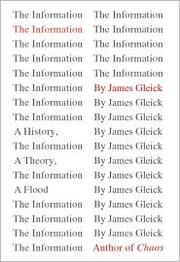
A compelling narrative history of information from drums to Shannon that builds deep intuition and motivation before any equations. Reading this first ensures you understand *why* the theory was developed and what problems it solves.

A concise, mathematically accessible introduction to Shannon entropy, mutual information, and coding that bridges the gap between popular science and the full technical treatment. It provides the essential vocabulary needed for the rigorous texts ahead.
The Core Canon
IntermediateMaster the central theorems of information theory — Shannon entropy, source coding, channel capacity, and the noisy-channel coding theorem — with full mathematical precision.
▸ Study plan for this stage
Pace: 10–12 weeks, ~40–50 pages/day (Cover first 4–5 weeks, MacKay 5–7 weeks). Allocate 2–3 days per major theorem for deep engagement with proofs and worked examples.
- Shannon entropy as a measure of uncertainty: definition, properties (non-negativity, maximum entropy, concavity), and interpretation as average information content
- Source coding and the Kraft inequality: optimal prefix-free codes, Huffman coding, and the fundamental limit that average codeword length ≥ H(X)
- Mutual information and channel capacity: definition of I(X;Y), properties, and the channel capacity C = max I(X;Y) as the supremum rate of reliable communication
- The noisy-channel coding theorem: statement, proof sketch, and interpretation that rates below capacity are achievable with arbitrarily low error, while rates above capacity are impossible
- Relative entropy (KL divergence) and its role in information geometry: properties, non-negativity, and connection to hypothesis testing and model selection
- Asymptotic equipartition property (AEP): typical sets, their probability concentration, and application to source and channel coding
- Data processing inequality and Markov chains: how information decreases along a chain, and implications for sufficient statistics
- Inference and learning through information-theoretic lenses: connection between entropy, likelihood, and Bayesian model comparison (from MacKay)
- Define Shannon entropy H(X) and prove that it is maximized when X is uniform. What does entropy measure intuitively?
- State and prove the Kraft inequality. How does it constrain the design of prefix-free codes, and what is its connection to source coding?
- Derive the relationship between average codeword length and entropy. Why is Huffman coding optimal among prefix-free codes?
- Define channel capacity C for a discrete memoryless channel. State the noisy-channel coding theorem and explain why it is a fundamental limit.
- Prove the data processing inequality: if X → Y → Z form a Markov chain, then I(X;Z) ≤ I(X;Y). What does this imply about information flow?
- Explain the asymptotic equipartition property and typical sets. How are they used to prove the channel coding theorem?
- Define relative entropy D(P||Q) and prove that D(P||Q) ≥ 0 with equality iff P = Q. How does it relate to hypothesis testing?
- How do Cover and MacKay connect information theory to statistical inference and learning? Give examples of how entropy and mutual information inform model selection.
- Compute Shannon entropy for 3–4 concrete distributions (e.g., Bernoulli, uniform, geometric). Verify properties like concavity and maximum entropy.
- Construct a Huffman code for a small alphabet (5–8 symbols with given probabilities). Compare its average length to the entropy lower bound.
- Prove the Kraft inequality from first principles and construct a prefix-free code that achieves it with equality.
- Calculate channel capacity for 2–3 specific channels (e.g., binary symmetric channel, erasure channel). Optimize the input distribution numerically.
- Work through a complete proof of the noisy-channel coding theorem (or a simplified version) from Cover, Chapter 7–8. Identify the role of the AEP.
- Compute mutual information I(X;Y) for a joint distribution you define. Verify that I(X;Y) = H(X) − H(X|Y) and interpret the result.
- Prove the data processing inequality for a 3-node Markov chain. Apply it to a real scenario (e.g., a communication system with intermediate processing).
- Implement a simple source coding algorithm (Huffman or arithmetic coding) in code. Test it on a text file and verify that compression ratio ≈ H(X) / 8 bits.
Next up: Mastery of these core theorems provides the mathematical foundation and intuition needed to explore advanced topics such as rate-distortion theory, network information theory, and the information-theoretic underpinnings of machine learning and statistical inference.

The definitive graduate-level textbook on information theory, covering entropy, mutual information, data compression, channel capacity, and rate-distortion theory with clarity and rigor. This is the field's canonical reference and should be read systematically, chapter by chapter.
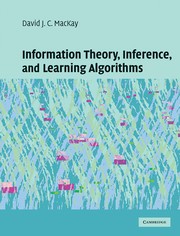
A brilliantly written companion that connects information theory to Bayesian inference, error-correcting codes, and machine learning. Reading it alongside or after Cover & Thomas reveals the deep unity between coding and probabilistic reasoning.
Compression & Coding in Depth
IntermediateUnderstand the practical and theoretical sides of data compression and error-correcting codes — from Huffman and arithmetic coding to turbo codes and LDPC codes.
▸ Study plan for this stage
Pace: 8–10 weeks, ~40–50 pages/day. Start with Sayood's compression fundamentals (weeks 1–4, ~25 pages/day), then transition to Lin's error-correcting codes (weeks 5–10, ~40–50 pages/day). Allocate 1–2 days per week for hands-on coding and problem sets.
- Entropy and information measure as the theoretical foundation for compression limits (Sayood Ch. 2–3)
- Huffman coding: optimal prefix-free codes and their construction via greedy algorithm (Sayood Ch. 4)
- Arithmetic coding: range-based encoding that approaches entropy bounds more closely than Huffman (Sayood Ch. 5)
- Lossless vs. lossy compression trade-offs and practical codec design (Sayood Ch. 6–8)
- Linear block codes, syndrome decoding, and the Hamming bound (Lin Ch. 1–3)
- Cyclic codes and polynomial representations for efficient encoding/decoding (Lin Ch. 4–5)
- Convolutional codes and Viterbi algorithm for sequential error correction (Lin Ch. 6–7)
- Turbo codes and LDPC codes: iterative decoding and modern capacity-approaching schemes (Lin Ch. 8–9)
- Why is entropy the theoretical lower bound on compression, and how do Huffman and arithmetic coding relate to this bound?
- How does arithmetic coding achieve better compression than Huffman coding, and what are its computational trade-offs?
- What is the difference between lossless and lossy compression, and when is each appropriate?
- How do linear block codes use parity-check matrices and syndrome decoding to detect and correct errors?
- What is the Viterbi algorithm, and why is it optimal for decoding convolutional codes?
- How do turbo codes and LDPC codes achieve near-Shannon-limit performance, and what makes iterative decoding effective?
- Implement Huffman coding from scratch: build a frequency table, construct the tree, generate codes, and compress/decompress a text file.
- Implement arithmetic coding for a simple alphabet; compare compression ratios and speed against your Huffman implementation.
- Calculate entropy for a given text or image; predict theoretical compression limits and compare against actual Huffman/arithmetic results.
- Construct a [7,4] Hamming code by hand: generate the generator and parity-check matrices, encode a message, introduce errors, and verify syndrome decoding.
- Implement syndrome decoding for a linear block code; test error detection and correction on corrupted codewords.
- Simulate a convolutional encoder and implement the Viterbi algorithm; decode a sequence with bit errors and verify correctness.
- Implement or simulate an LDPC code decoder using belief propagation; observe convergence and bit-error-rate (BER) performance.
- Compare compression ratios and speed across Huffman, arithmetic, and a simple run-length encoding on multiple file types (text, image, binary).
Next up: This stage equips you with both the mathematical foundations and practical algorithms for compression and error correction—the two pillars of reliable communication—preparing you to explore advanced topics like channel capacity, source-channel coding theorems, and modern wireless/storage systems in the next stage.
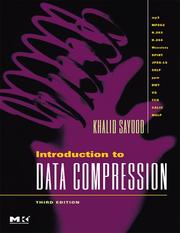
The most thorough treatment of lossless and lossy compression algorithms, grounding abstract source-coding theorems in concrete, implementable methods. It builds directly on the entropy concepts from Stage 2.
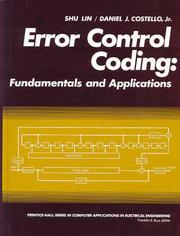
A comprehensive reference on the algebraic and probabilistic foundations of error-correcting codes — linear block codes, cyclic codes, convolutional codes — making the channel-coding theorems from Cover & Thomas concrete and operational.
Advanced Theory
ExpertReach the research frontier: algorithmic information theory, Kolmogorov complexity, network information theory, and the connections between information theory and statistics.
▸ Study plan for this stage
Pace: 8–10 weeks, ~40–50 pages/day (with 2–3 days per week for problem sets and implementation)
- Kolmogorov complexity as a measure of algorithmic randomness and incompressibility; the halting problem and uncomputability of K(x)
- Prefix-free codes, self-delimiting descriptions, and the relationship between Kolmogorov complexity and Shannon entropy
- Applications of Kolmogorov complexity: randomness testing, data compression lower bounds, and inductive inference
- Multi-terminal information theory: capacity regions for channels with multiple senders and receivers
- Gaussian networks, relay channels, interference channels, and broadcast channels—their capacity regions and achievability proofs
- Coding theorems for network scenarios: achievability via random coding and converse bounds via information-theoretic inequalities
- Connections between information-theoretic limits and statistical estimation: Fisher information, mutual information, and sample complexity
- What is Kolmogorov complexity K(x), why is it uncomputable, and how does it relate to Shannon entropy and data compression?
- How do prefix-free codes and self-delimiting descriptions formalize the notion of description length in algorithmic information theory?
- What are the key differences between the capacity regions of broadcast channels, interference channels, and relay channels, and how are they derived?
- Explain the role of random coding and the use of information-theoretic inequalities (e.g., Fano's inequality) in proving converses for network information theory.
- How does mutual information connect to statistical estimation problems, and what is the relationship between information-theoretic bounds and sample complexity?
- What are concrete applications of Kolmogorov complexity beyond compression, and how do they relate to randomness and inductive inference?
- Work through Li & Vitányi's proofs that K(x) is uncomputable and that K(x) ≤ |x| + O(log|x|); implement a simple compression-based approximation of Kolmogorov complexity for small strings.
- Prove that for any computable probability distribution p, the average description length using an optimal prefix-free code is approximately H(p); verify this with a concrete example.
- Analyze a relay channel scenario (e.g., a three-node network) and compute or bound its capacity region using the decode-and-forward and compress-and-forward strategies from El Gamal.
- Derive the capacity region of a two-user interference channel under different regimes (very strong, strong, weak interference) and compare achievable rates with outer bounds.
- Implement a random coding argument for a broadcast channel: show how to achieve a point on the capacity region and verify the probability of error decays exponentially.
- Connect a statistical estimation problem (e.g., parameter estimation under noise) to an information-theoretic lower bound using Fano's inequality or mutual information arguments.
Next up: This stage equips you with the theoretical foundations—algorithmic randomness, network capacity regions, and information-statistical duality—needed to tackle specialized topics such as source coding for networks, distributed inference, quantum information theory, or applications in machine learning and cryptography.

Extends Shannon's probabilistic framework to the algorithmic setting, defining the complexity of individual objects rather than ensembles. This is the natural next step after mastering classical information theory and opens deep connections to computability and logic.

The authoritative graduate text on multi-user information theory — broadcast channels, multiple-access channels, relay networks — representing the current frontier of the field and the culmination of this curriculum.
Discussion
Keep reading
Paths that share books, cover the same subject, or open a related topic.