Best Books to Learn French Horn, in Reading Order
This curriculum takes a French horn student from first notes to orchestral-level playing across four carefully sequenced stages. Each stage builds on the last — establishing physical fundamentals before tackling the horn's unique acoustic challenges (partials, tone production) and finally the demanding repertoire of the orchestral excerpt world.
First Notes & Foundations
BeginnerEstablish a correct embouchure, basic hand position in the bell, breath support, and the ability to read and play simple melodies in the middle register.
A classic two-book method that complements Rubank by emphasizing tone quality and musicality from the very start. Reading it alongside or just after Rubank reinforces good habits before they can calcify into bad ones.
Embouchure, Hand Position & Tone Production
BeginnerUnderstand the mechanics of horn embouchure, the critical role of the right hand in the bell, and how to produce a centered, resonant tone across the instrument's registers.
▸ Study plan for this stage
Pace: 4–5 weeks, ~15–20 pages/day (focusing on Chapters 1–4 of Farkas), with 3–4 practice sessions per week
- Embouchure formation: the role of the lips, aperture, and muscular control in producing a vibrating reed-like mechanism
- Hand position in the bell: how the right hand acts as a valve and tone modifier, and the relationship between hand angle and pitch/tone color
- Breath support and air stream: the foundation for consistent tone production and the connection between diaphragmatic breathing and embouchure stability
- Tone production across registers: how embouchure adjustments and hand position work together to produce centered, resonant tones in low, middle, and high registers
- The concept of 'centering' the tone: achieving a focused, vibrant sound through precise embouchure and hand coordination
- Resonance and acoustics: understanding how the horn's natural overtone series and the player's embouchure/hand position interact to amplify desired frequencies
- What are the key anatomical components of an effective horn embouchure, and how do the lips, teeth, and facial muscles work together?
- Explain the role of the right hand in the bell and how hand position affects both pitch and tone color.
- How does breath support from the diaphragm contribute to embouchure stability and tone consistency?
- What adjustments to embouchure and hand position are necessary to produce a centered tone across the horn's low, middle, and high registers?
- How does the concept of a 'vibrating reed' in the embouchure relate to the horn's acoustic properties and resonance?
- What is the relationship between hand angle in the bell and the instrument's natural harmonic series?
- Embouchure formation drills: practice forming the embouchure without the horn, focusing on lip tension, aperture size, and symmetry; use a mirror to monitor consistency
- Long tones on a single pitch: play sustained notes (whole notes at quarter note = 60 bpm) in the middle register, focusing on steady air support and a vibrant, centered tone
- Hand position exploration: play the same pitch while systematically adjusting right-hand angle and depth in the bell, listening for changes in tone color and pitch; document which positions produce the most resonant sound
- Register transitions: play ascending and descending scales (e.g., B♭ major) across low, middle, and high registers, consciously adjusting embouchure and hand position to maintain tone consistency
- Breath support exercises: practice long tones while maintaining steady diaphragmatic breathing; use a metronome to ensure even air pressure throughout the phrase
- Harmonic series exploration: play the natural harmonic series on a single fingering (e.g., all harmonics on open horn), listening for resonance and using hand position to 'center' each harmonic
- Tone matching: record a reference tone (e.g., a professional recording of a centered middle-register note) and practice matching its resonance and color using embouchure and hand adjustments
Next up: This stage establishes the mechanical and acoustic foundation for tone production, preparing you to explore articulation techniques, dynamic control, and stylistic interpretation in the next stage.
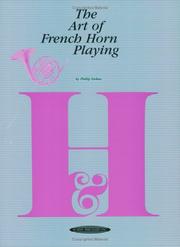
The definitive text on horn embouchure and physical technique by one of the 20th century's greatest horn pedagogues. Every serious student reads this early — it gives precise, illustrated guidance on lip formation, mouthpiece placement, and hand position that no method book matches.
Builds directly on Book 1 with more demanding études that require the player to apply the embouchure and hand concepts from Farkas in a musical context, bridging theory and practice.
Conquering the Partials & the Full Range
IntermediateUnderstand the harmonic series and why the horn's closely spaced upper partials make accuracy so difficult; develop reliable technique across the full range through targeted études.
These études isolate the specific interval leaps and register shifts that expose partial insecurity. Placed after Maxime-Alphonse's foundational exercises, they stress-test the player's control in a wide variety of musical contexts.
A comprehensive reference that explains the acoustics of the horn — including the physics of the harmonic series and partials — in player-friendly language. Reading this alongside the études gives the student the intellectual framework to understand *why* the horn behaves as it does.

