Ed McBain 87th Precinct books in order: where to start
Fifty-five 87th Precinct novels, and they effectively invented the police procedural — a squad rather than a hero, several cases at once, and a city that is the real subject. Ed McBain was a pen name of Evan Hunter, who had already legally changed his name from Salvatore Lombino, and our catalogue files the same series under both names. That is the catalogue being accurate, not confused.
Start here
BeginnerBegin at the 1956 debut, which is where the form starts.
▸ Study plan for this stage
Pace: Four or five evenings. Cop Hater is a short fifties paperback — our record carries no page count, but it runs under two hundred pages in most editions and moves like a book written to a deadline. Read it in as few sittings as you can manage; the heatwave is cumulative and it thins out if you space i
- The squad is the protagonist. Cop Hater kills detectives, which means the book keeps removing the person you assumed was the hero — that is the structural announcement the whole series is built on.
- Steve Carella is the closest thing to a lead, but notice how much page time he shares and how little interiority he is given compared with a Chandler or a Hammett narrator.
- Isola is an invented city that is transparently New York. McBain gets to keep real geography's density while inventing precinct houses, and the city's weather is doing narrative work — the heat is a character.
- Procedure is the entertainment. Canvassing, lab work, dead ends and paperwork are not filler between the good bits; they are what the form replaced the amateur detective with.
- Teddy Carella is deaf and cannot speak, so her scenes have to be built out of lipreading, notes and gesture. It is the first sign that McBain is more interested in craft problems than the pulp packaging suggests.
- The solution arrives partly through legwork and partly through luck, which is closer to how police work actually resolves than the puzzle novels of the previous thirty years allowed.
- Who is the protagonist of Cop Hater, and at what point did you realise the book was not going to answer that the way a detective novel usually does?
- How does McBain use the heatwave — what does it let him do to tempers, timelines and the city that a mild week would not?
- Which parts of the investigation actually produce the solution, and which are dead ends the book keeps anyway? Why keep them?
- How does the prose change when Teddy is on the page, and what is McBain solving for there?
- What does an invented city buy him that setting it in a named New York precinct would cost?
- Keep a list of every named detective as they appear, with one line on each. You are building the roster you will carry through the rest of the path — and watching which names survive the book.
- Mark the point in Cop Hater where the investigation stops being about the first victim and becomes about the pattern. Note how many pages McBain spends before that turn.
- Count the scenes that advance the case versus the scenes that only show the squadroom working. Then ask what the book would lose if the second kind were cut.
- Write down the solution's final mechanism in one sentence. You will want it to compare against The Mugger, where he runs the trick differently.
Next up: You now have the squad and the city in your head, which is exactly what the next two books assume you have so they can start splitting the narrative between cases.

Detectives are being shot in an unbearable heatwave. The first 87th Precinct novel and the one that established that the squad, not a detective, is the protagonist.
The early run
BeginnerThe first years, where he is working the formula out at speed.
▸ Study plan for this stage
Pace: About two weeks, one book a week. The Mugger is 159 pages and Lady Killer 184 — these are two- or three-sitting books. Lady Killer works far better read across a single day if you can arrange it, because the novel is timed to one.
- The Mugger runs two unrelated investigations at once — the mugging spree and a killing — and the pleasure is watching them refuse to be the same case in the way a tidier novel would insist on.
- The Mugger promotes Bert Kling, a young patrolman, to a lead role. The series will keep rotating its focus this way, which is how a fifty-five book run avoids exhausting one detective.
- Lady Killer is a stunt executed straight: a letter announces a murder for eight that evening, and the novel occupies the hours before it. Time pressure replaces the whodunit question entirely.
- Both books reproduce documents — reports, notes, lab findings — as objects on the page. McBain is making the reader do a little of the detectives' reading.
- Our catalogue files both of these under Evan Hunter rather than Ed McBain. Same author, same series; the record is being accurate about a name he legally held, not confused.
- The formula is visibly being invented here rather than executed. Compare the confidence of the plotting to the roughness of some of the transitions.
- In The Mugger, what does McBain gain by keeping the two cases separate for as long as he does?
- Lady Killer knows the hour of the murder from page one. What is left to generate suspense once whodunit is off the table?
- How does Kling's inexperience change the texture of The Mugger compared with a Carella-led book?
- Where do the reproduced documents appear, and what do they do that a paragraph of summary would not?
- Which of these two novels feels more like a fixed formula, and which feels like an experiment?
- Read Lady Killer in one day and note the clock at the head of each section as you go. Whether the real-time gimmick holds is a question you can only answer by matching your reading hours against the book's.
- Take the two threads of The Mugger and write out each one's timeline separately, then lay them beside each other. The interleaving is the craft on display.
- Go back to Cop Hater's ending and set it beside Lady Killer's. In one, the squad reconstructs; in the other, it races. Name what McBain kept and what he swapped out.
- Note every place a document is reproduced rather than described across both books, and decide which ones are genuinely informative and which are texture.
Next up: You have seen the machine assembled at speed in the fifties; the next stage jumps thirty years to see what happens when the same machine is given room.
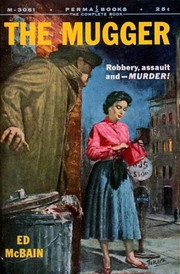
The second novel, and the first to use the structure of two unrelated cases running at once. Filed under Evan Hunter in our catalogue.
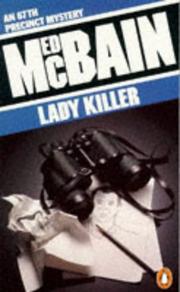
A note announces a murder for that evening, and the squad has a day to prevent it. The whole book runs in real time.
The mature period
IntermediateThe books from the years when he was writing at his best.
▸ Study plan for this stage
Pace: A week and a half. Ice is 322 pages, nearly double the early novels, and it is deliberately unhurried — roughly 30 pages a day, or two long weekend sittings if the winter setting appeals.
- Length changes the form. Ice has room for scenes that do not advance a case at all, and the squadroom stops being a functional space and starts being somewhere people live.
- The multiple-case structure that The Mugger introduced is now standard, and Ice runs four killings, a Broadway production and a drug operation without treating the convergence as a surprise.
- New York in winter is doing what the heatwave did in Cop Hater — but McBain is now confident enough to let the weather be atmosphere rather than plot pressure.
- The detectives have thirty years of accumulated history by 1983. Watch how much McBain assumes and how little he re-explains, and note that the books still work cold.
- The prose has loosened. Dialogue runs longer, jokes land more often, and the procedural detail is delivered with less of the fifties documentary earnestness.
- The gap between the early and mature novels is the real subject of this stage: the same author, the same squad, and a completely different reading experience.
- What does Ice do with its extra 150 pages that Cop Hater could not afford?
- How many separate investigations are running, and at what point does McBain let them touch? Was the convergence earned or asserted?
- Which detectives have changed most since the fifties books, and is the change dramatised or simply stated?
- Is the winter setting load-bearing in Ice the way the heat was in Cop Hater, or is it decoration?
- Does the looser mature style cost the books any of their early speed, and is that a loss?
- Pick a single squadroom scene in Ice and a single squadroom scene in Cop Hater and read them back to back. Count the lines of dialogue in each and note what the extra room in the later book is spent on.
- Track the four killings on one page as they are reported, and mark where the squad first believes they are connected versus where the reader does.
- Note every reference in Ice to events from earlier in the series. Then judge honestly whether a first-time reader would have been lost.
- Compare how each book handles a victim's family. It is the clearest measure of what three decades did to McBain's interest in people outside the squad.
Next up: The series voice is now fixed in your ear, which is the only way to hear how different he sounds when he stops being Ed McBain.
Four killings, a Broadway dancer and a drug operation, in a New York winter. The long mature novels are more spacious and less mechanical than the fifties books.
Under his own name
IntermediateOne book as Evan Hunter, to see the difference.
▸ Study plan for this stage
Pace: One week. The record shows 309 pages. It reads faster than the number suggests because the classroom scenes are almost all dialogue, but it is a heavier book than anything in the 87th Precinct and does not want to be rushed.
- This is the novel that made the pen name necessary. Hunter kept his legal name for the serious fiction and invented McBain for the crime series, and reading them side by side shows what he thought the distinction was.
- The Blackboard Jungle is set in a New York vocational school in 1954 and follows a first-year teacher through it. The institution is the subject, exactly as the precinct is in the series — but here he is allowed to editorialise.
- The sensation the book caused, and the film that followed, are part of why the split into two names became permanent.
- The dialogue is the continuity between the two names: the same ear for how people in a New York institution talk to each other, deployed toward a completely different end.
- Where the 87th Precinct novels refuse interiority, this one insists on it. That refusal in the crime books now looks like a choice rather than a limitation of the form.
- Our record for this book carries a film-series suffix in its title. It is the novel, credited to Evan Hunter; the suffix is catalogue noise, not a different work.
- What can Hunter do in this novel that McBain will not do in the 87th Precinct books, and why do you think he kept them apart?
- The school and the precinct are both institutions observed by an outsider-narrator. How does the treatment differ?
- Where does the book's 1954 politics show most plainly, and does it hold up or date?
- Which is the better-written book — this or Ice — and by what standard are you judging?
- Having read both names, does the pen-name division still look necessary to you?
- Read a classroom scene here immediately after a squadroom scene in Ice. The ear is identical; write down the two or three things that are nonetheless different.
- Mark every passage where the narration tells you what to think about the school. Then look for an equivalent passage anywhere in the four crime novels — the absence is the finding.
- Set the opening pages of Cop Hater and The Blackboard Jungle side by side and decide which writer you would have predicted would go on to write fifty-five procedurals.
- Write one paragraph on what the 87th Precinct series owes to this book. The answer is not nothing, and it is not the plot.
Next up: This closes the path: you have the invention of the police procedural, its mature form, and the serious novelist who chose to spend his career on it under another name.
A first-year teacher in a New York vocational school in 1954. It was a sensation and a film, and it is the book that made the pen name necessary — he kept Hunter for serious novels and McBain for crime. Our record carries a film-series suffix.