Best Books on Crystallography and X-ray Diffraction
Crystallography is the discipline that turned a pattern of spots on a film into the atomic coordinates of a molecule, and it has produced more Nobel prizes than almost any other technique. This path starts with the human story and a short conceptual introduction, builds up lattices, symmetry and reciprocal space, then moves through diffraction practice to the phase problem and refinement, and ends with macromolecular crystallography, where the same mathematics is applied to proteins.
What a crystal is, and why it mattered
BeginnerUnderstand what long-range order means, what a diffraction pattern is a picture of, and why the technique reshaped twentieth-century science
▸ Study plan for this stage
Pace: 4-5 weeks, and none of it is technically demanding. Glazer's Crystallography is a 140-page Very Short Introduction and takes two evenings. Tilley's Crystals and Crystal Structures is a 291-page gentle undergraduate text - two weeks at 20 pages a day, assuming only school chemistry and a little geome
- Long-range order and periodicity as the definition of a crystal, and what a quasicrystal does to that definition
- The unit cell, close packing, and the common structure types - rock salt, fluorite, perovskite, zinc blende - that Tilley builds
- A diffraction pattern as a picture of reciprocal space rather than of the crystal
- Photo 51 and what could actually be read off it: helix, pitch, diameter, the 3.4 angstrom repeat
- How Franklin's unpublished data reached Watson and Crick, and what the documentary record does and does not establish
- Model building as a method used alongside diffraction rather than instead of it
- Why the technique reshaped twentieth-century chemistry, mineralogy, materials science and biology at once
- What does long-range order mean precisely, and what makes a solid crystalline rather than merely ordered?
- What structural information can be read directly off a fibre diffraction pattern like Photo 51?
- What is the documented sequence of events by which Franklin's data reached Watson and Crick, and where do Maddox and Watson disagree?
- What does The Double Helix minimise, and what is it nonetheless genuinely good evidence for?
- Name four common structure types from Tilley and describe the coordination in each.
- Build physical models of close-packed layers using coins or marbles and derive the difference between cubic and hexagonal close packing by stacking, then verify your packing fraction against Tilley's value.
- Sketch the unit cells of rock salt, caesium chloride, fluorite and zinc blende from memory and count the formula units per cell for each.
- Find a reproduction of Photo 51 online and mark on it, by hand, the features Maddox describes - the X pattern, the missing fourth layer line, the strong meridional reflection - and write what each implies.
- Read Maddox's account of the King's College data and Watson's account of the same weeks side by side, and keep a two-column log of every factual disagreement with page numbers.
Next up: With a physical sense of what a crystal is and what a pattern shows, the geometry and symmetry of the next stage has objects to describe rather than being abstract from the start.

Catalogued under the bare title Crystallography. Glazer is a crystallographer of long standing and this is the fastest honest overview of the whole field, symmetry included. Read it first so the textbooks have somewhere to land.

A gentle undergraduate introduction to crystal chemistry: unit cells, close packing, common structure types and defects. It gives you the structures that later books will be determining.

The definitive biography of the crystallographer whose Photo 51 made the double helix solvable, and a clear-eyed account of how her data was used. Read it here because it makes the stakes of a good diffraction pattern concrete.

The other side of the same story, told with famous unreliability. Read it directly after Maddox rather than before, so you can see exactly what it minimises, and for its genuine value as an account of how model building and diffraction data interacted.
Lattices, symmetry and reciprocal space
IntermediateWork confidently with the 14 Bravais lattices, point and space groups, Miller indices and the reciprocal lattice, and derive the Bragg and Laue conditions
▸ Study plan for this stage
Pace: 3-4 months, and this is where the path becomes technical. Sands's Introduction to Crystallography is only 165 pages but it is a working Dover text - do every derivation, at roughly 5-8 pages a day over six weeks. Hammond's The Basics of Crystallography and Diffraction is 320 pages and is the bridge
- The 7 crystal systems, 14 Bravais lattices, 32 point groups and 230 space groups, and why each list has the length it does
- Symmetry operations and their combination: rotation, reflection, inversion, rotoinversion, screw axes and glide planes
- Hermann-Mauguin notation, and reading a space group symbol as a description of the symmetry rather than a label
- Miller indices, lattice planes, d-spacings and zone axes
- The reciprocal lattice as the Fourier transform of the direct lattice, and why diffraction sees it
- The Bragg and Laue conditions as the same statement in two languages, and the Ewald sphere construction that unifies them
- Systematic absences as the diagnostic fingerprint of centring, screw axes and glide planes
- Why are there exactly 14 Bravais lattices, and why is a face-centred tetragonal lattice not among them?
- Read a space group symbol such as P2_1/c aloud and state every symmetry element it asserts.
- Derive the Bragg condition, then derive the Laue conditions, and show they are equivalent.
- Construct the Ewald sphere for a given wavelength and orientation and state which reflections are in diffracting condition.
- Given a list of systematic absences, deduce the possible space groups.
- Why is the reciprocal lattice of a face-centred cubic lattice body-centred cubic?
- Work every problem in Sands; the book is short precisely because the problems carry the content.
- Draw the 14 Bravais lattices from memory, repeatedly, until you can also state the centring conditions and the lattice point count for each.
- Take five real space groups from the International Tables or an online space group database and, for each, list the symmetry elements, the general position multiplicity and the systematic absence conditions.
- Construct a reciprocal lattice by hand for a monoclinic direct lattice, verifying the reciprocal axis directions and lengths from the defining relations.
- Draw the Ewald sphere construction for copper K-alpha radiation and a cubic crystal of a given cell edge, and calculate how many reflections lie within the limiting sphere.
Next up: Fluency with reciprocal space and systematic absences is exactly what the experimental stage assumes when it starts talking about data collection strategies.
A very short Dover text that does the geometry and symmetry properly and nothing else. Start the technical part of the path here, because it is the cheapest and most compact route to fluency with lattices and point groups.

Catalogued with its IUCr monograph series subtitle. Hammond is the standard bridge between geometry and diffraction, exceptionally good on the reciprocal lattice and the Ewald sphere, which are where most learners stall. Read it straight after Sands.
Doing the diffraction experiment
IntermediateUnderstand X-ray sources, structure factors, powder versus single-crystal methods, and how raw intensities become a usable dataset
▸ Study plan for this stage
Pace: 2-3 months. Cullity's Elements of X-ray Diffraction is 514 pages of the materials-science standard - two months at a chapter a week, and it teaches the experiment rather than the theory, so it is less mathematically demanding than Hammond. Massa's Crystal Structure Determination is a compact 210-pag
- X-ray production: characteristic K-alpha lines, bremsstrahlung, filters and monochromators, and what synchrotron radiation adds
- The structure factor as the sum over atoms of scattering factors with phase, and intensity as its modulus squared
- Atomic scattering factors and their fall-off with sin(theta)/lambda, and the temperature factor
- Powder versus single-crystal methods, and what each is good for: phase identification, quantitative analysis, stress and texture on one side, full structure determination on the other
- Crystal selection, mounting, cooling, and why a bad crystal cannot be rescued by good software
- Data reduction: Lorentz and polarisation corrections, absorption, scaling, merging, and the R-merge statistic
- Resolution, completeness and redundancy as the quality measures of a dataset
- Write the structure factor expression and explain what each term means physically.
- Why do atomic scattering factors fall off with angle, and what does the temperature factor add to that fall-off?
- When would you choose powder diffraction over single-crystal diffraction, and what do you give up?
- What corrections turn raw measured intensities into structure factor magnitudes, and why is each needed?
- What makes a crystal good, and what specific defects show up in the data as which pathologies?
- Index a published powder pattern by hand for a cubic material: extract the d-spacings, find the ratios, assign hkl, and refine the lattice parameter.
- Calculate the structure factors for the first several reflections of a simple structure - rock salt is ideal - and verify by hand which reflections are systematically absent.
- Take a published crystallographic information file from an open database, read its data-collection and reduction statistics, and write a paragraph assessing the dataset quality against Massa's criteria.
- Follow Massa's workflow end to end on paper for one structure, listing every decision point from crystal selection to a merged dataset and what could go wrong at each.
- Use Cullity's treatment of line broadening to estimate a crystallite size from a published pattern with the Scherrer equation, and state the assumptions that make your answer approximate.
Next up: With real intensities in hand you meet the problem the whole discipline is organised around: the phases were never measured.
The long-standing materials-science standard, best on powder diffraction, phase identification and stress measurement. Read it first in this stage because it teaches the experiment rather than the mathematics.
A short, practical account of the small-molecule workflow from crystal selection through data collection to a finished structure. It is the natural next step once Cullity has explained where the intensities come from.
The phase problem and refinement
BeginnerSolve a structure: direct methods and Patterson techniques, least-squares refinement, and the symmetry relationships between related structures
▸ Study plan for this stage
Pace: 6-9 months, the technical core of the path. Glusker and Trueblood's Crystal Structure Analysis is a 278-page primer and the clearest statement of the phase problem - six weeks, worked carefully. Ladd and Palmer's Structure Determination by X-ray Crystallography is 756 pages with worked problems and
- The phase problem stated exactly: intensities give magnitudes, the electron density needs phases, and half the information is not measured
- The Patterson function as the autocorrelation of the electron density, and heavy-atom and molecular-replacement methods built on it
- Direct methods: the Sayre equation, triplet relations, probabilistic phase estimation, and why atomicity and positivity make it possible
- Fourier synthesis and difference maps as the tools for building and correcting a model
- Least-squares refinement, restraints and constraints, and the R factor and weighted R factor as measures of fit
- Overfitting and R-free, and why a low R factor is not by itself evidence of a correct structure
- Group-subgroup relations and Barnighausen trees as the formal account of how structure types are related by symmetry loss
- Why can the phases not simply be measured, and what would it take to measure them?
- What does a Patterson map show, and how does a heavy atom make it interpretable?
- State the Sayre equation and explain why atomicity and positivity of the electron density make direct methods work.
- What does a difference Fourier map show, and how do you use it to find a missing atom?
- What R factor should a good small-molecule structure achieve, and what does an anomalously low one suggest?
- Take a familiar pair of structure types and express their relationship as a group-subgroup relation in Muller's formalism.
- Work through Glusker and Trueblood's worked example of a Patterson interpretation by hand before reading their solution.
- Do the problems in Ladd and Palmer, especially the structure-factor and Fourier chapters; the book is designed around them.
- Solve at least one real small-molecule structure end to end from published raw data using open software, from direct methods through to a refined model with anisotropic displacement parameters.
- Take a published crystallographic information file, deliberately delete one atom, run a difference map, and confirm that the missing atom reappears as the largest peak.
- Construct a Barnighausen tree for one structural family from Muller and check every group-subgroup step against the International Tables.
- Look up two published structures later shown to be wrong and write 500 words on what in the deposited statistics should have raised suspicion.
Next up: Being able to solve and refine a small-molecule structure is the prerequisite for the macromolecular case, where every step is the same and every step is harder.

Glusker and Trueblood's classic primer, the book most crystallographers were actually taught from, and the clearest statement of the phase problem and how direct methods get around it. This is the centre of the path.
A fuller course covering the same ground with worked problems and modern software practice, so it is the place to consolidate what Glusker introduces. Read it second because it is long and rewards knowing where you are going.
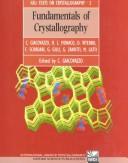
The IUCr's comprehensive reference volume, rigorous on diffraction theory and direct methods. Treat it as the authority to consult rather than a book to read end to end.

Group-subgroup relations and Barnighausen trees: the formal machinery for seeing how structure types are related to one another. It is the deepest symmetry material here and belongs after you can solve a structure.
Macromolecular crystallography
BeginnerApply the method to proteins, where crystals are weakly diffracting and disordered, and read a published protein structure critically
▸ Study plan for this stage
Pace: 4-6 months. Rhodes's Crystallography Made Crystal Clear is 288 pages written for biologists and is the most readable book in the path - three weeks, and read it first here even if you are a physical scientist, because it teaches you what a protein structure paper is actually claiming. Rupp's Biomole
- Why protein crystals are hard: large cells, high solvent content, weak diffraction, radiation damage and disorder
- Phasing macromolecules: isomorphous replacement, anomalous dispersion (SAD and MAD), and molecular replacement
- Electron density maps at 1.5, 2.5 and 3.5 angstrom resolution, and what can honestly be built at each
- R factor, R-free, and the geometry validation statistics - Ramachandran outliers, clashscore, real-space correlation
- Model bias: how a wrong model reproduces itself in the maps, and the specific techniques that guard against it
- Over-refinement, over-interpretation of ligand density, and the documented cases of structures in the database that are simply wrong
- Reading a Protein Data Bank entry critically rather than accepting the deposited coordinates as measurement
- What resolution do you need before you can place a side chain confidently, and what before you can see an ordered water?
- How does anomalous scattering supply phase information, and what does a MAD experiment require of the crystal and the beamline?
- What is model bias, how does it arise, and how do omit maps and cross-validation mitigate it?
- What does R-free measure that R does not, and what gap between them signals trouble?
- Given a published protein structure, what would you check before believing a claim about a bound ligand?
- What are the recurring failure modes Rupp identifies in deposited structures?
- Download a Protein Data Bank entry with its structure factors, recompute the maps yourself, and inspect the density around the modelled ligand at several contour levels.
- Take one high-resolution and one low-resolution structure of the same protein and write a paragraph on exactly which claims the low-resolution model can and cannot support.
- Run a validation report on three deposited structures and write a short assessment of each using Rupp's criteria, saying which one you would trust for a mechanistic argument.
- Build a small region of a model into real density using open software, deliberately misplace a side chain, refine, and observe how the map responds - this is model bias made visible.
- Read one published paper's structural claims and write 1,000 words on whether the deposited data supports them, citing resolution, R-free, occupancy and the real-space fit.
Next up: You finish able not just to solve a structure but to judge one, which is the difference between using the crystallographic literature and being at its mercy.
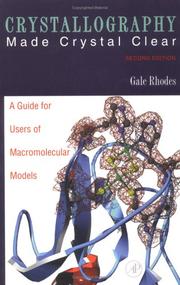
Written for biologists who need to understand what a protein structure paper is claiming, and the most readable account of electron density maps, resolution and R-factors. Read it first in this stage even if you are a physical scientist.
The comprehensive modern reference on protein crystallography, blunt about model bias, over-refinement and structures in the database that are simply wrong. It is the right final book: it turns you from someone who can solve a structure into someone who can judge one.
Discussion
Keep reading
Paths that share books, cover the same subject, or open a related topic.