C# and .NET: books to master modern app development
This curriculum takes a beginner from zero C# knowledge all the way to building production-quality ASP.NET Core applications, progressing through four tightly sequenced stages. Each stage builds directly on the last — establishing syntax and OOP fundamentals first, then deepening language mastery, then tackling the .NET ecosystem and async patterns, and finally applying everything to real-world web development with clean architecture.
Foundations: C# Syntax & Object-Oriented Thinking
BeginnerRead, write, and understand basic to intermediate C# code — variables, control flow, classes, interfaces, inheritance, and core OOP principles — with enough fluency to move into deeper language features.
▸ Study plan for this stage
Pace: 8–10 weeks, ~40–50 pages/day (Head First C#: 4–5 weeks; C# 12 and .NET 8 Fundamentals: 4–5 weeks)
- Variables, data types, and type safety in C# (int, string, bool, nullable types)
- Control flow: if/else, loops (for, while, foreach), and switch statements
- Methods: parameters, return types, overloading, and optional/named arguments
- Classes and objects: constructors, fields, properties, and encapsulation
- Inheritance: base classes, derived classes, virtual methods, and the protected keyword
- Interfaces: contracts, implementation, and polymorphism through interfaces
- Core OOP principles: abstraction, encapsulation, inheritance, and polymorphism (SOLID foundations)
- Exception handling: try/catch/finally and custom exceptions
- What are the differences between value types and reference types in C#, and when would you use each?
- How do constructors work, and what is the purpose of constructor chaining (this and base)?
- Explain the difference between inheritance and interface implementation—when would you use each?
- What is polymorphism, and how does it enable you to write flexible, maintainable code?
- How do properties differ from fields, and why should you prefer properties for encapsulation?
- What is the purpose of access modifiers (public, private, protected), and how do they enforce encapsulation?
- How does exception handling work, and what is the difference between catching specific exceptions vs. a general Exception?
- Build a simple console application that prompts for user input, validates it, and stores data in variables of different types
- Write a program with at least 3 methods that use different parameter types (required, optional, named arguments) and demonstrate method overloading
- Create a class hierarchy (e.g., Animal → Dog, Cat) with a base class, derived classes, virtual methods, and demonstrate polymorphism
- Implement an interface (e.g., IPaymentProcessor) with multiple implementations (CreditCardProcessor, PayPalProcessor) and use them polymorphically
- Write a class with properties (auto-properties and full properties with backing fields) and demonstrate encapsulation by validating data in setters
- Build a small application that reads data from user input, performs operations, and handles exceptions gracefully (try/catch for invalid input, file I/O errors, etc.)
- Refactor a procedural program into an object-oriented design using classes, inheritance, and interfaces to demonstrate OOP principles
Next up: This stage equips you with the syntax and structural thinking needed to read and write real C# code; the next stage will deepen your mastery of advanced language features (LINQ, async/await, generics, delegates) and practical .NET ecosystem skills (working with libraries, NuGet, and building production applications).

A visually rich, beginner-friendly introduction that teaches C# syntax and OOP concepts through hands-on projects. Its conversational style removes the intimidation of starting from scratch and builds strong mental models before anything else.

After the intuition from Head First, this comprehensive yet accessible book solidifies every core language feature — types, collections, error handling, and the .NET runtime — giving you a complete and up-to-date foundation to build on.
Language Mastery: Deeper C# & Idiomatic Code
IntermediateUnderstand the full depth of the C# language — generics, delegates, lambdas, LINQ, nullability, pattern matching, and writing clean, idiomatic C# the way experienced professionals do.
▸ Study plan for this stage
Pace: 8–10 weeks, ~40–50 pages/day (mix of reading and active coding)
- Generics: constraints, variance (covariance/contravariance), and how they enable type-safe reusable code
- Delegates, events, and lambda expressions: how they form the foundation for functional programming in C#
- LINQ: query syntax vs. method syntax, deferred execution, and composing complex data transformations
- Nullable reference types and the null-coalescing operators: writing defensive code that prevents null reference exceptions
- Pattern matching (switch expressions, property patterns, relational patterns): modern C# syntax for elegant control flow
- Async/await and Task-based asynchrony: understanding how to write responsive, non-blocking code
- Idiomatic C# practices: naming conventions, immutability, SOLID principles, and when to use each language feature
- Reflection and attributes: introspecting types at runtime and decorating code with metadata
- What are generic constraints and how do you use them to restrict type parameters? Give examples of where-clauses in practice.
- Explain the difference between covariance and contravariance in generics. When would you use IEnumerable<out T> vs. IComparer<in T>?
- How do delegates, events, and lambda expressions relate? Write a delegate-based callback pattern and then refactor it using lambdas.
- What is deferred execution in LINQ, and why does it matter? How does it differ from eager evaluation?
- Describe the difference between LINQ query syntax and method syntax. When is each more readable?
- How do nullable reference types work in C# 8+, and what is the purpose of the null-coalescing operator (??) and null-coalescing assignment (??=)?
- What are pattern matching expressions and switch expressions? Rewrite a traditional switch statement as a switch expression.
- Explain async/await: what problem does it solve, and how does it differ from synchronous code? What are common pitfalls?
- Build a generic repository pattern: create a generic Repository<T> class with constraints (where T : class, IEntity) and implement CRUD operations with LINQ queries.
- Refactor callback-heavy code using delegates and events: take a legacy event system and modernize it with custom events and lambda expressions.
- Write a LINQ query chain that performs a complex data transformation (e.g., grouping, filtering, projecting). Then convert it from query syntax to method syntax and vice versa.
- Create a type-safe builder pattern using generics and fluent interfaces; ensure it compiles only for valid configurations.
- Implement a custom IEnumerable<T> that demonstrates deferred execution; log when enumeration happens vs. when the sequence is created.
- Rewrite a series of nested if-else statements as pattern matching expressions and switch expressions; compare readability.
- Write an async method that chains multiple asynchronous operations (e.g., fetching data, processing, saving) using async/await; identify and fix common pitfalls like not awaiting or blocking on async code.
- Build a simple attribute-based validation system: define custom attributes, use reflection to inspect them, and validate objects at runtime.
Next up: This stage equips you with the language depth and professional coding practices needed to architect robust, maintainable applications—preparing you to move into the next stage where you'll apply these skills to real-world frameworks and design patterns.
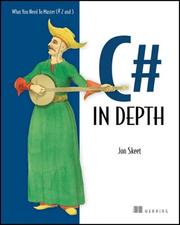
The definitive book on the C# language itself, written by one of the world's foremost C# experts. It explains the 'why' behind every major language feature — especially LINQ, async/await, and generics — in a way no other book does.
Read immediately after C# in Depth to learn how to apply the language correctly. Its 50 concrete, actionable items teach you to write clean, performant, and idiomatic C# — bridging the gap between knowing the language and using it well.
The .NET Ecosystem: Async, Concurrency & Core Libraries
IntermediateConfidently write asynchronous and concurrent .NET code, understand the Task Parallel Library, async/await patterns, and navigate the broader .NET class library for I/O, networking, and data access.
▸ Study plan for this stage
Pace: 8–10 weeks, ~40–50 pages/day (mix of reading and hands-on coding)
- Async/await patterns and Task-based asynchronous programming (TAP) fundamentals from Cleary's cookbook approach
- Concurrency primitives: locks, semaphores, mutexes, and when to use each (Cleary's practical recipes)
- The Task Parallel Library (TPL) and dataflow patterns for parallel decomposition
- Async I/O operations, cancellation tokens, and exception handling in async contexts
- .NET memory management: heap vs. stack, garbage collection generations, and allocation patterns
- Object pooling, disposal patterns, and memory leaks in concurrent/async scenarios
- Performance profiling and memory diagnostics tools for identifying bottlenecks
- Integrating async/concurrent patterns with memory-efficient code design
- What is the difference between Task-based asynchronous programming (TAP) and callback-based patterns, and when should you use async/await?
- How do you properly implement cancellation in async methods, and what role do CancellationTokens play?
- Explain the difference between concurrent and parallel execution, and how the Task Parallel Library enables both.
- What are the main garbage collection generations in .NET, and how does understanding them help you write more efficient code?
- How can you identify and prevent memory leaks in asynchronous and concurrent code?
- What are the trade-offs between using locks, ReaderWriterLockSlim, and lock-free patterns for thread synchronization?
- Build a multi-threaded console application that fetches data from multiple web APIs concurrently using HttpClient and async/await; measure performance improvements over sequential calls.
- Implement a producer-consumer pattern using BlockingCollection and TPL Dataflow; experiment with different buffer sizes and measure throughput.
- Write a custom async method that supports cancellation via CancellationToken; test cancellation at different stages of execution.
- Create a memory profiling exercise: write two versions of a data-processing application (one with poor allocation patterns, one optimized); use dotMemory or Visual Studio's profiler to compare heap usage.
- Implement a thread-safe cache using different synchronization primitives (lock, ReaderWriterLockSlim, SemaphoreSlim); benchmark each under read-heavy and write-heavy workloads.
- Build an async file I/O application that processes large files in parallel chunks while respecting memory constraints; use object pooling to reduce GC pressure.
Next up: This stage equips you with the asynchronous, concurrent, and memory-aware foundations needed to build scalable, high-performance .NET applications—preparing you to tackle advanced topics like distributed systems, microservices architecture, and production-grade performance optimization in the next stage.

Stephen Cleary is the leading authority on async/await in .NET. This cookbook-style book provides clear, practical recipes for every async and concurrency scenario you will encounter, making it the perfect focused deep-dive after the language fundamentals are solid.

Understanding how the .NET GC and memory model work is what separates intermediate from advanced developers. Reading this here ensures you write efficient code before you start building full applications.
Real-World Applications: ASP.NET Core & Clean Architecture
ExpertDesign and build production-quality ASP.NET Core web applications and APIs using clean architecture, dependency injection, Entity Framework Core, and professional software design principles.
▸ Study plan for this stage
Pace: 12–14 weeks, ~40–50 pages/day with 2–3 days per week for hands-on projects. Allocate: ASP.NET Core in Action (4 weeks), Pro ASP.NET Core Identity (2.5 weeks), Dependency Injection Principles (2.5 weeks), Designing Hexagonal Architecture (2.5 weeks), plus 1 week for capstone integration.
- ASP.NET Core fundamentals: middleware pipeline, routing, dependency injection container, and request/response handling
- Building production-grade REST APIs with proper HTTP semantics, error handling, and validation
- ASP.NET Core Identity system: user authentication, authorization, claims-based security, and role management
- Dependency Injection principles: inversion of control, service lifetimes (singleton, scoped, transient), and composition root patterns
- Clean Architecture layers: presentation, application, domain, and infrastructure with clear separation of concerns
- Entity Framework Core: DbContext configuration, migrations, relationships, and query optimization for data access
- Hexagonal Architecture (Ports & Adapters): isolating business logic from external dependencies and enabling testability
- Professional patterns: Repository pattern, CQRS, Unit of Work, and domain-driven design fundamentals
- How does the ASP.NET Core middleware pipeline work, and how do you configure custom middleware for cross-cutting concerns like logging and error handling?
- What are the differences between authentication and authorization in ASP.NET Core Identity, and how do you implement role-based and claims-based authorization?
- Explain the three service lifetimes in dependency injection (singleton, scoped, transient) and when to use each in a real application.
- How does Hexagonal Architecture improve testability and maintainability compared to traditional layered architectures?
- What is the relationship between Entity Framework Core's DbContext, migrations, and the repository pattern in a clean architecture?
- How do you design a REST API that follows clean architecture principles while maintaining proper separation between domain logic and infrastructure concerns?
- Build a complete REST API for a blog platform using ASP.NET Core, implementing CRUD operations with proper HTTP status codes and error handling.
- Implement user authentication and authorization using ASP.NET Core Identity with custom claims, roles, and policy-based authorization.
- Refactor a monolithic controller into a clean architecture structure with separate Domain, Application, Infrastructure, and Presentation layers.
- Create a custom dependency injection container configuration that demonstrates singleton, scoped, and transient lifetimes with real-world scenarios.
- Design and implement a Hexagonal Architecture for a simple e-commerce domain, isolating business logic from database and external API adapters.
- Set up Entity Framework Core migrations for a multi-tenant application with proper DbContext configuration and relationship mapping.
- Build a CQRS-style application with separate command and query handlers, using dependency injection to wire everything together.
- Write comprehensive unit tests for domain logic and integration tests for API endpoints, demonstrating how clean architecture enables testability.
Next up: This stage establishes the architectural and design patterns necessary for building scalable, maintainable production systems; the next stage will likely deepen into advanced topics like microservices, distributed systems, performance optimization, or specialized domains (e.g., real-time applications, machine learning integration) that build upon this solid foundation.

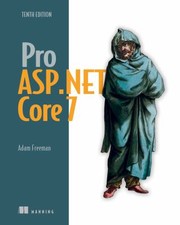
The most thorough and up-to-date guide to ASP.NET Core, covering middleware, routing, Razor Pages, Web APIs, and security. It is the essential first read before tackling architecture and design patterns in the web context.

Authentication and authorization are non-negotiable in real apps; this book covers ASP.NET Core Identity in full depth, filling a critical gap that general ASP.NET Core books only touch on.

DI is the backbone of every well-structured .NET application. This is the canonical book on the subject and teaches you to compose applications correctly — read it here so clean architecture patterns click immediately.

Clean, ports-and-adapters architecture is language-agnostic; the patterns here translate directly to C# and ASP.NET Core, and reading it last ties together everything — DI, separation of concerns, and testability — into a coherent architectural vision.
Discussion
Keep reading
Paths that share books, cover the same subject, or open a related topic.